

First, do not force it
When a key will not turn, the natural reaction is to turn harder. That is the one thing to avoid. An ignition key is a thin blade, and the ignition cylinder is a small mechanism of spring-loaded wafers, a plug and a housing. Enough force will snap the key inside the ignition, bend the wafers or break the cylinder's internal stops. At that point the problem that could have been solved with a wiggle of the steering wheel now needs a locksmith and a new ignition cylinder.
Take your hand off the key for a moment, and work through the checks below in order. They start with the most common and cheapest causes and move toward the ones that need professional attention. Most drivers who call us with a key that will not turn find the answer in the first two.
This guide is about traditional keyed ignitions, where a metal key goes into a slot in the steering column or dash and turns. If your car has a push button start, the problem is different, and usually relates to the key fob battery or the car not detecting the fob. Our push button start versus key page explains how those systems work.
Check one
The steering lock.
The most common cause by far, and the easiest to fix.
Most cars with a keyed ignition have a steering lock. When you remove the key and turn the wheel, a steel pin drops into a notch in the steering column and holds the wheel in place. It is an anti-theft feature, and it works well. The trouble is that if the wheel was turned while parking, or the front wheels are resting against a curb, the steering column is under tension. That tension presses the lock pin hard against the side of its notch, and the ignition cannot turn because the pin cannot retract.
The fix is simple. Put gentle pressure on the key in the direction you normally turn it, and at the same time turn the steering wheel left and right. You will feel the wheel move a small amount in one direction before it stops. Keep turning it gently in that direction while turning the key. When the pressure comes off the lock pin, the key will turn.
It takes a little coordination, and it can take a few tries. Do not yank the wheel, and do not force the key. A firm, steady wiggle is all it needs. If you parked on a slope or against a curb, the tension may be quite strong, and you may need to use both hands on the wheel while keeping light pressure on the key with a finger.
If the wheel does not move at all in either direction and the key still will not turn, the steering lock may not be the problem. Move on to the next check.
Check two
The shifter and the park interlock.
Most automatic transmission cars have an interlock that connects the ignition to the gear selector. It stops you turning the key to the lock position or removing it unless the car is in park. On some vehicles it also affects turning the key from the lock position in the first place.
Check that the shifter is fully in park. It is surprisingly common for a shifter to sit just short of the detent, looking like park but not quite engaged. Move the shifter out of park and firmly back in, then try the key again. Some drivers find it helps to press the brake pedal while doing this.
If your car has a manual transmission, there may be a different arrangement, such as a button or a push-in action needed before the key turns to certain positions. Your owner's manual explains the specifics for your vehicle.
A weak or dead battery can sometimes affect the interlock on vehicles that use an electrical shift lock solenoid. If the dashboard lights are dim or absent, and the key will not turn or will not come out, the battery may be part of the problem. In that case the key issue may resolve once the battery is charged or jumped. Check your manual for a manual shift lock release, often a small slot near the shifter.
Diagnosis
Symptoms and likely causes.
| What you notice | Likely cause | What to try |
|---|---|---|
| Key will not turn, wheel is stiff | Steering lock under tension | Wiggle the wheel while turning the key gently. |
| Key will not turn or will not come out, automatic car | Shifter not fully in park | Move the shifter out of park and back firmly. |
| Spare key works, main key does not | Main key is worn or bent | Use the spare, and have a new key cut to the code. |
| Neither key turns, wheel moves freely | Worn or damaged ignition wafers | Stop forcing. The ignition needs attention. |
| Key turns only with jiggling, getting worse over time | Wear in the key, the wafers or both | Have it looked at before it fails completely. |
| Key goes in only partway | Debris in the ignition, wrong key or damaged key | Check the key. Do not force it in. |
| Key turns but car does not start | Not a turning problem. Battery, starter or transponder | See the section below on starting problems. |
| Key turns freely without resistance, nothing happens | Broken cylinder or linkage | Needs repair or replacement. |
Check three
The key itself.
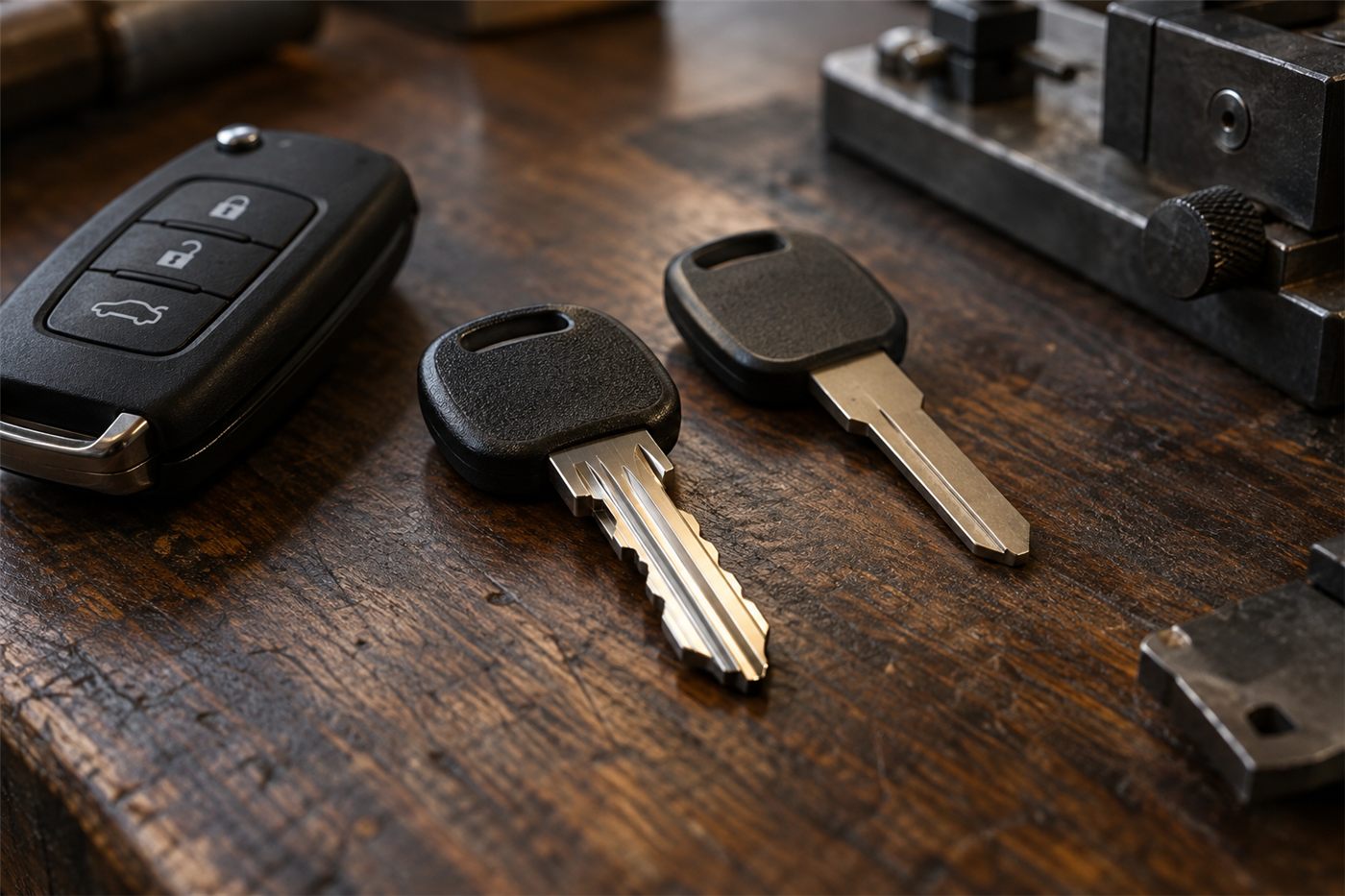
Car keys wear out. Every time the key goes into the ignition, the edges of its cuts rub against the wafers inside. Over years, the cuts round off and the key stops lifting the wafers to exactly the right height. At first the key needs a little jiggle. Later it needs a lot. Eventually it will not turn at all.
Look at the key closely in good light. Compare it with your spare, if you have one. If the cuts on your everyday key look rounded or shallow compared to the spare, or if the key is visibly bent, the key is the problem. Try the spare. If the spare turns normally, you have your answer.
A heavy key ring makes this worse. The weight of a large bunch of keys hanging from the ignition key pulls on it every time you drive over a bump, wearing both the key and the ignition. Keep the ignition key on a light ring, or detach the rest of the keys while driving.
If the key is worn, the fix is a new key cut to the vehicle's original code, not a copy of the worn key. A copy reproduces the wear. On most cars built in roughly the last couple of decades, the new key will also need its transponder chip programmed to the car before it will start the engine, though the metal blade alone will turn the ignition. The transponder key guide explains why. Our car key replacement service covers cutting and programming together.
Check four
The ignition cylinder.
If the steering wheel moves freely, the shifter is in park, and neither your main key nor a good spare will turn, the problem is likely inside the ignition cylinder. The wafers, small flat pieces of metal that the key lifts into line, can wear, stick or break. Their springs can weaken. Dirt and debris can build up and stop them moving.
Some drivers try spraying lubricant into the ignition. A small amount of a dry lubricant made for locks may help a sticky cylinder temporarily, but it will not fix worn wafers. Heavy oils and general purpose sprays collect dirt and can make things worse over time. And tapping the key with a hammer, a tip that circulates online, can damage the key, the wafers and the cylinder all at once.
A worn ignition cylinder usually gives warning. The key needs more and more jiggling, it works on some days and not others, it sticks in cold weather. If you notice these signs, get the ignition looked at before it fails completely, ideally somewhere convenient rather than in a parking lot at night.
Depending on the vehicle, a worn ignition can often be repaired by replacing the wafers and cutting a new key to match, or the cylinder can be replaced. A locksmith can usually do this at the car, which avoids a tow. Our ignition repair page covers the options.
Do and do not
What helps and what makes it worse.
| Action | Verdict |
|---|---|
| Wiggle the steering wheel while turning the key gently | Do this first. It solves most cases. |
| Move the shifter out of park and back | Safe and often effective on automatics. |
| Try your spare key | Safe, and tells you whether the problem is the key or the ignition. |
| A small amount of dry lock lubricant | Can help a sticky cylinder. Will not fix worn wafers. |
| Pliers on the key head for more leverage | Do not. This is how keys snap in ignitions. |
| Tapping the key with a hammer | Do not. It can damage the key and the cylinder. |
| Heavy oil or general spray in the ignition | Avoid. It collects dirt and gums up the wafers. |
| A screwdriver in the ignition | Never. It destroys the cylinder. |
If the key snaps in the ignition
Leave it alone. Do not try to turn the broken piece with pliers or a screwdriver, and do not try to glue it. A snapped key can usually be extracted cleanly with the right tools, and the ignition may be fine afterward. The broken key guide explains what happens next.
When the key turns but the car will not start
It is worth separating two problems that drivers often describe the same way. A key that will not turn is a mechanical problem: the steering lock, the interlock, the key or the ignition cylinder. A key that turns but the engine does not start is usually something else.
If the key turns to the start position and nothing happens, or the engine cranks but does not fire, the likely causes are the battery, the starter, the fuel system, or the car's immobilizer not recognizing the key. On most modern cars, the key contains a transponder chip that the car must recognize before it will allow the engine to run. A security light on the dashboard that flashes or stays on when you try to start may point to an immobilizer problem.
A key that has been dropped, soaked or cracked can have a damaged transponder, and a newly cut key that has not been programmed will turn the ignition but not start the engine. If your car cranks but will not start with one key, try the spare. If the spare starts the car, the problem is the first key's chip. If neither starts it, the problem may be the car rather than the key, and a mechanic may be the right call.
We can test whether the car recognizes a key, program new keys and replace damaged ones. We cannot fix a failed starter or a fuel problem, and we will tell you so if that is what we find.
Delaware conditions
Weather and driving that wear ignitions.
Cold mornings. Winter in New Castle and Kent counties can bring sharp cold snaps. Cold thickens any old lubricant in the ignition and makes worn wafers stickier. A key that turns with a little jiggle in summer may refuse on a January morning. That is a warning sign worth acting on.
Humidity. Summer humidity and coastal air can encourage corrosion in neglected cylinders, especially in older vehicles that sit outside.
Heavy use. Work trucks, delivery vehicles and high mileage commuter cars along Route 1 and I-95 see many ignition cycles a day, and their keys and cylinders wear faster than average. Fleet owners in particular benefit from checking keys regularly. Our fleet and work van keys page covers that side.
Parking on slopes. Hilly streets in parts of Wilmington and driveways on slopes across the area make steering lock binding more common. Straightening the wheels before switching off, or turning the wheel slightly to relieve tension before removing the key, helps.
Prevention
Keeping the ignition healthy.
- Keep the ignition key on a light ring. Heavy key bunches wear the key and the cylinder with every bump.
- Straighten the wheels before turning off. It reduces steering lock tension the next time you start.
- Use the spare occasionally. It keeps you aware of how the original compares, and confirms the spare works.
- Replace worn keys early. A new key cut to code is much cheaper than a new ignition.
- Act on early warning signs. Jiggling, intermittent sticking and cold weather trouble mean the cylinder is wearing.
- Never force it. If it does not turn with normal pressure, something is wrong. Stop and check.
- Get a spare if you only have one. A worn single key is a lockout waiting to happen. See the spare car key guide.
Related
If this turns into a bigger job.
If you are deciding where to get a replacement key, the dealer versus locksmith guide covers the honest differences.
 Most requested
Ignition Repair
Worn wafers or a failed cylinder, fixed at the car.
 Keys
KeysCar Key Replacement
New keys cut to code and programmed.
ChipsTransponder Keys
When the key turns but the car will not start.
ProgrammingCar Key Programming
Getting a new key recognized by the car.
ExtractionBroken Key Extraction
If the key snapped in the ignition.
All car workAutomotive Locksmith
Everything we do for vehicles in both counties.
Where we do this
Ignition help across both counties.
Questions
About ignitions that will not turn.
Why will my key not turn in the ignition?
The most common reason is the steering lock holding under tension. Gently turn the steering wheel left and right while turning the key. Other common causes are the shifter not fully in park, a worn key, or worn wafers inside the ignition cylinder.
Can a dead battery stop the key from turning?
On some vehicles with an electrical shift interlock, a dead battery can stop the key turning to certain positions or coming out. If the dashboard lights are dim or off, charge or jump the battery and check your owner's manual for a manual shift lock release.
Should I spray lubricant into the ignition?
A small amount of dry lock lubricant can help a sticky cylinder, but it will not fix worn wafers. Avoid heavy oils and general purpose sprays, which collect dirt and make the problem worse over time.
My spare key works but my main key does not. Why?
Your main key is worn or bent. Use the spare for now and have a new key cut to the vehicle's code, not copied from the worn key. On most modern cars the new key will also need its chip programmed before it starts the engine.
Can a locksmith fix an ignition at the car?
In most cases, yes. Depending on the vehicle, worn wafers can be replaced and a new key cut to match, or the cylinder can be replaced. Doing it at the car avoids a tow.
The key turns but the car will not start. Is that the ignition?
Usually not. It could be the battery, the starter, fuel, or the immobilizer not recognizing the key's transponder chip. Try the spare key. If the spare starts the car, the first key is the problem.
Is it safe to drive with an ignition that sticks sometimes?
It will usually keep working for a while, but it will get worse, and it tends to fail at inconvenient times. Have it checked before it leaves you stuck somewhere.
What if my key breaks in the ignition?
Leave the broken piece alone and call. A snapped key can usually be extracted cleanly, and the ignition may be fine afterward. Forcing the broken piece with tools often damages the cylinder.