

Why locks become a problem later in life
Most people never think about the effort a lock takes until it starts to take more than they have. A round knob that has to be gripped and twisted. A deadbolt that needs a firm turn because the door has settled. A small key that is hard to hold and hard to aim at a keyway in poor light. Each of these is a minor inconvenience at forty and a daily struggle at eighty, especially with arthritis, reduced grip strength, tremor or failing eyesight.
When a lock becomes difficult, people adapt, and not always safely. They stop using the deadbolt because it is too stiff. They leave the back door unlocked so they do not have to deal with the key. They hide a spare under the mat for the day they cannot get the key to work. They hand out keys to anyone who helps, because it is easier than getting up to answer the door. All of these are understandable, and all of them make the home less secure.
The good news is that most of these problems have simple solutions. The right handles, the right keys, a well adjusted door and sometimes a keypad can make the home easier to live in and more secure at the same time. This guide is written for older adults and for the family members helping them, and it covers the practical choices we see make the most difference.
Easier to use
Handles, keys and doors that do not fight back.
Small changes that reduce effort every single day.
Lever handles instead of round knobs. A lever can be pushed down with a palm, a wrist or an elbow. It needs no grip and no twist. Replacing knobs with levers on exterior and frequently used interior doors is one of the most helpful changes for anyone with arthritis or weak hands. Levers suitable for exterior doors are widely available and can be keyed to match existing locks.
A door that closes easily. Many stiff deadbolts are not lock problems at all. The door has dropped slightly on its hinges, and the bolt rubs against the strike. Adjusting the door or the strike can make a deadbolt that needed two hands turn with two fingers. This is often the first thing we look at, because it costs little and makes a big difference.
Keys that are easier to hold. Large-head key covers, or key turners that add a bigger handle, give more leverage and a better grip. Colored key caps make it easy to tell the front door key from the back without reading small print. Fewer keys on the ring help too.
Better light at the door. A motion sensor light over each entry lets a person find the keyway without fumbling in the dark. A lighted keyhole ring is a small addition that helps.
Thumb turns that are easy to grip. Some deadbolts come with larger inside thumb turns. On a lock that has to be operated many times a day, a bigger turn is a real help.
Options
Choosing the right lock for the person.
| Need | Helpful option | Things to consider |
|---|---|---|
| Weak grip or arthritis | Lever handles, large thumb turns, key turners | Keep a deadbolt on exterior doors. Levers are for the latch. |
| Poor eyesight | Lighted keyways, colored key caps, keypads with large lit buttons | Tactile marks on keypads help too. |
| Memory difficulties | Keyed locks with one key for all doors, or a simple keypad code | Codes can be forgotten. A keyed backup with family is essential. |
| Frequent visitors or caregivers | Keypad with individual codes | Remove codes when caregivers change. Avoid sharing one code with everyone. |
| Risk of falls | A way for help to get in quickly, such as a key lockbox or keypad | Discuss emergency access with family and local services. |
| Risk of wandering | Door alarms or chimes, discussed with care professionals | Never lock someone in a way that blocks escape in a fire. |
| Living alone | Door viewer, good exterior lighting, a strong deadbolt | Security against unwanted visitors matters as much as ease of use. |
Keypads
When a code is better than a key.
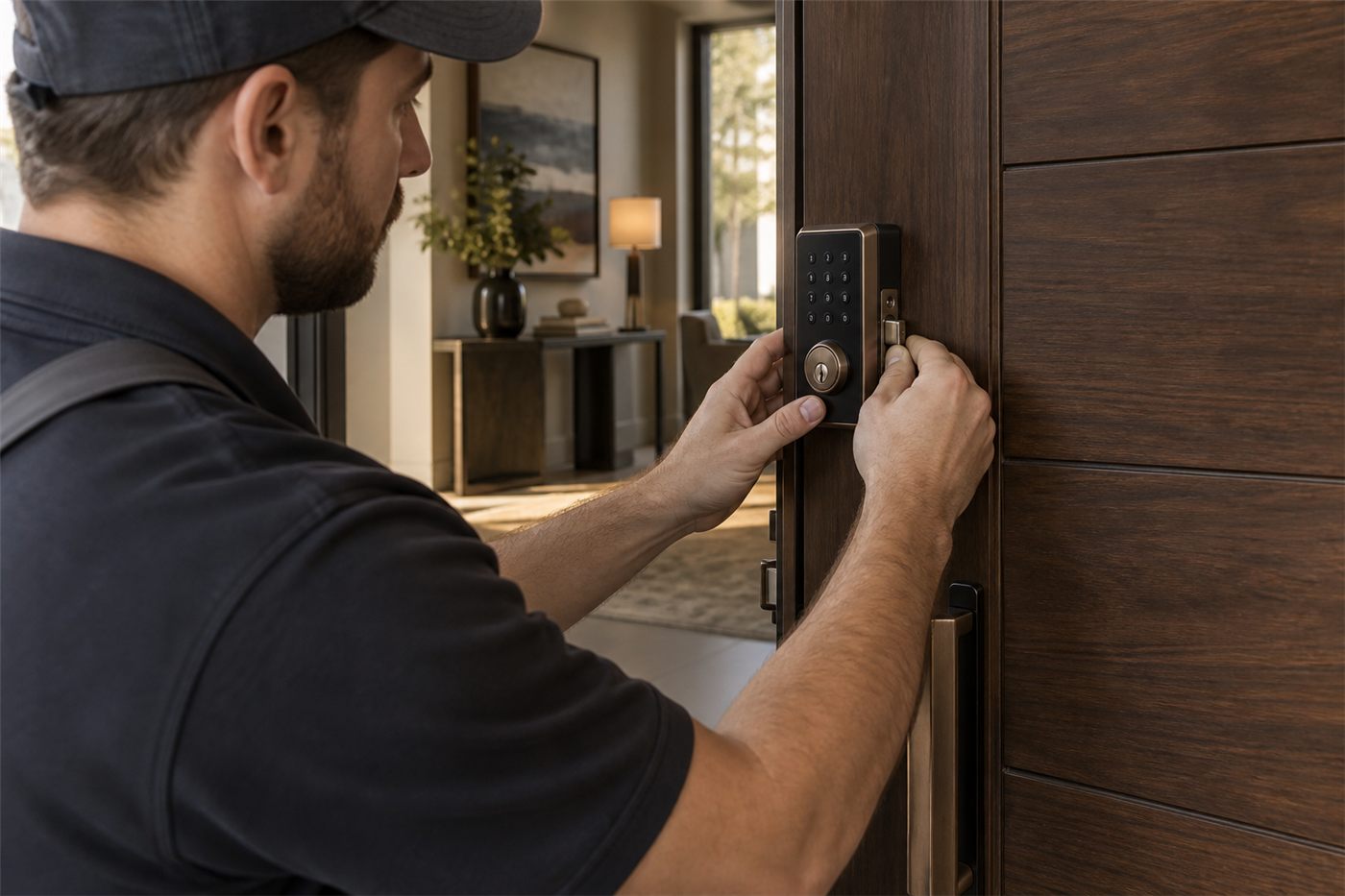
For many older adults, a keypad deadbolt removes the hardest part of the lock entirely. No key to find, no keyway to aim at, no twisting. Pressing a few buttons is easier for most people than using a key, especially with limited dexterity or vision.
Keypads also solve the access problem. Each family member and caregiver can have their own code. When a caregiver leaves, their code is deleted, with no need to recover a key or change the lock. Some models record when each code was used, which can give family members peace of mind that visits are happening as planned.
There are cautions. A code can be forgotten, especially by someone with memory difficulties. A keypad lock with a dead battery may not open electronically. And a code written on a note by the door defeats the purpose. So choose a model with a mechanical key override, keep that key with a family member or in a secure lockbox, change batteries on a schedule rather than waiting for a warning, and pick a code that is memorable for the person but not obvious to others.
Choose a keypad with large, well lit buttons that give a clear click or beep when pressed. Touchscreen keypads can be difficult for people with tremor or dry skin. Test it with the person who will use it before committing. Our keypad lock installation page covers what we fit, and the keyless entry guide covers the broader tradeoffs.
Emergency access
If help needs to get in.
One of the biggest worries for families of an older adult living alone is what happens if they fall or become unwell and cannot reach the door. If emergency responders arrive and the door is locked with a strong deadbolt, they may have to force it, which takes time and damages the door.
There are several ways to plan for this. A trusted neighbor with a key who can be called quickly is the simplest. A keypad lock with a code that family can share with responders in an emergency is another. A secure key lockbox mounted near the door, with the code held by family, is a third. In some areas, emergency services or local programs offer ways to register a lockbox or access arrangement, so ask your local fire company or senior services office what is available where you live.
Whatever arrangement you choose, make sure it is known to the right people and not to anyone else. A lockbox code shared too widely, or a key hidden in an obvious spot, creates the opposite problem. Medical alert systems, which let a person call for help at the press of a button, work well alongside an access plan, since the people responding need a way in.
Avoid chains and extra bolts that a responder cannot open from outside, unless the person uses them only when someone else is at home. A door chain on at night is a sensible security measure for many people living alone, but it also blocks family with a key. Discuss it together and decide what makes sense.
Keys, caregivers and trust
As more people help an older adult, more keys tend to go out. A home health aide, a cleaner, a neighbor who checks in, a grandchild who helps with shopping, a handyman. Each is a reasonable choice at the time, and over a few years it adds up to a large number of keys held by people who may no longer be involved.
Most people who help are honest. But keys given out informally are rarely collected, and older adults living alone are unfortunately more likely to be targeted by people who take advantage. A few simple habits help a great deal.
- Keep a list of who has keys or codes. A family member should hold it and review it every few months.
- Use individual codes on a keypad for caregivers. When a caregiver changes, delete their code the same day.
- Rekey when the list becomes uncertain. If nobody is sure how many keys are out, a rekey resets it without replacing the lock.
- Never hide a key outside. Hidden keys are found. Use a proper lockbox if a spare needs to be outside.
- Install a door viewer or a doorbell camera. So the person can see who is at the door before opening it.
- Agree a rule about opening the door. Unexpected visitors, especially those claiming to be from a utility or a contractor, should be asked to come back when a family member can be present.
Our lock rekeying service is often the first step when a family takes over helping a parent and discovers nobody knows how many keys exist.
Memory and wandering
A careful balance.
Families caring for someone with dementia sometimes ask about locks to stop them leaving the house alone, particularly at night. This is a real and serious concern, and it is also where lock choices can become dangerous if handled carelessly.
The safest approach usually starts with alerting rather than locking. Door chimes, alarms that sound when an exterior door opens, and door sensors connected to a caregiver's phone let someone respond without the person being trapped. These are often recommended as a first step because they keep every exit usable in an emergency.
Some families add locks mounted higher or lower than usual, where they are less likely to be noticed, or locks that need a two step action. Any such lock must still be quick for a caregiver to open in an emergency, and it should never be used when the person is alone in the house. A person with dementia locked in alone during a fire is in grave danger.
These decisions are best made with the advice of the person's doctor, a care professional or a dementia support organization, who can help weigh the risks for that individual. Once you know what approach suits your situation, a locksmith can fit the hardware properly and make sure it works the way you intend.
A home walk-through
What to check at a parent's house.
| Check | What you are looking for |
|---|---|
| Each exterior door | Does the deadbolt turn easily with the door closed? Watch the person use it. |
| Handles | Round knobs that are hard to grip. Consider levers. |
| Keys | Too many keys, keys that are hard to tell apart, worn keys that stick. |
| Hidden spares | Keys under mats, in planters or on ledges. Remove them and make a better plan. |
| Lighting | Can the keyway be seen at night? Is there a light over each door? |
| Door viewer or camera | Can the person see who is at the door without opening it? |
| Emergency access | If they fell, how would help get in? Who knows? |
| Who has keys | Make a list. If it cannot be made with confidence, consider a rekey. |
| Windows | Ground floor window locks that work and are easy to operate. |
Watch, do not just ask
Many older adults will say their locks are fine, because they have adapted to them or do not want to be a bother. Watch them lock and unlock the door. If it takes two hands, a shoulder against the door, or several tries, there is something worth fixing.
Doorstep scams and the front door
Older adults are often targeted by people who arrive at the door with a story: a utility worker who needs to check something, a contractor who noticed a problem with the roof, someone who needs to use the phone. Some are distraction schemes, where one person keeps the resident talking while another enters through a back door that was left unlocked.
Locks cannot solve this on their own, but they help. A door viewer or camera doorbell lets the person see who is there. A door chain or a limiter that lets the door open only a few inches allows a conversation without letting anyone in. Keeping the back and side doors locked during the day, not just at night, closes the second door in a distraction scheme. And a simple family rule, that nobody is let in unless they were expected, is the strongest protection of all.
The same caution applies to locksmiths. Unfortunately, there are operators who quote one price on the phone and demand much more at the door, or who drill locks that could have been opened without damage. Our guide to spotting a locksmith scam is worth sharing with an older relative. The same rules apply to any contractor who turns up unannounced.
Delaware homes
What we see across the two counties.
Long-owned homes in Brookside, Wilmington Manor and Claymont often still have original hardware, round knobs and deadbolts that have not been adjusted in decades. Simple lever and adjustment work makes a noticeable difference here.
Retirement and age-restricted communities around Middletown, Smyrna, Dover and Milford tend to have newer hardware but many caregivers and visitors. Keypad locks with individual codes are popular for good reason.
Rural homes across Kent County can be a long way from family and neighbors. Emergency access planning matters more when nobody lives close enough to bring a key quickly.
Condos and apartments may have limits on changes to the unit door. Check with the association or landlord before replacing hardware, and ask whether lever handles or a keypad are allowed. Many will approve changes made for accessibility.
Related
Useful services and guides.
 Most requested
Keypad Locks
No key to hold, individual codes for caregivers.
 Key control
Lock Rekeying
When nobody knows how many keys are out.
Easier useLock Change
Round knobs replaced with levers, keyed to match.
 Adjustment
Lock Repair
Stiff deadbolts made easy to turn again.
ConnectedSmart Lock Installation
Remote access for family, with a mechanical backup.
FamiliesChildproofing Guide
The same balance for the youngest members of the family.
Where we do this
Accessible lock work across both counties.
Questions
About locks for older adults.
Are lever handles as secure as knobs?
The handle itself is not what secures the door. The deadbolt is. A lever latch set paired with a good deadbolt is as secure as a knob set with a deadbolt, and much easier to use for anyone with weak hands.
Is a keypad lock a good idea for someone with memory problems?
It can be, with care. Choose a simple code, keep a mechanical key with a family member, and do not write the code by the door. For some people a single keyed lock is easier to remember. Try it before committing.
How can paramedics get in if my parent falls?
Plan ahead with a trusted neighbor holding a key, a keypad code family can share in an emergency, or a secure key lockbox. Ask your local fire company or senior services office whether there is a local program for emergency access.
My mother's deadbolt is very stiff. Does it need replacing?
Often it does not. Stiff deadbolts are commonly caused by the door dropping on its hinges so the bolt rubs the strike. An adjustment can make it turn easily. If the lock itself is worn, replacement is the honest answer.
Should I rekey after a caregiver leaves?
If they held a key and you cannot be sure no copies exist, yes. If they had a keypad code, delete the code. Keeping a list of who holds keys and codes makes these decisions easier.
Can locks stop someone with dementia from wandering?
Door alarms and chimes are often the safest first step, because they alert without trapping anyone. Any lock added must be quick for a caregiver to open and never used when the person is home alone. Discuss the approach with a care professional first.
What is a key turner?
A plastic or rubber handle that fits over the head of a key and makes it bigger and easier to grip and turn. It is a simple aid for people with arthritis or weak hands.
Is a door chain a good idea?
For many people living alone, a chain or limiter lets them speak to visitors without opening the door fully. It also blocks family with a key, so agree on when it is used and make sure it can be released quickly from inside.