

Why a rental is different
When you own and live in a house, security is a personal matter. You decide what locks to fit, who gets a key, and when to change them. When you rent that house out, the same decisions affect somebody else's safety and belongings, and they are made less often and with less information. You are not there. You do not see who comes and goes. You may not know that a previous tenant's partner kept a copy, or that the handyman you used three years ago still has a key on his truck ring labeled with your street name.
That is the heart of rental security. A property owner in Delaware can fit excellent hardware and still have a weak property, simply because nobody knows how many working keys exist. The reverse is also true. A property with ordinary, well installed locks and tight key control is in much better shape than one with expensive hardware and a drawer of unlabeled keys.
This guide is written for small landlords: someone with a single family rental, a few townhouses, a duplex in Elsmere or a small building in Wilmington. Larger operators will recognize the same principles at a bigger scale. It covers hardware, key control, vacancies, turnovers, short-term rentals and the requests tenants make. It does not attempt to cover your legal obligations, which depend on your lease and on Delaware's landlord tenant rules, and which are worth reviewing with someone qualified to advise on them.
The baseline
What every rental door should have.
A standard you apply to every unit, so nothing depends on memory.
The best thing a landlord can do is decide on a standard and apply it to every door in every unit. That removes guesswork, makes turnovers faster, and means a tenant in one unit is not less protected than a tenant in another.
A sensible baseline for exterior doors is a good residential deadbolt on every door that leads outside or into a shared space, a reinforced strike plate with long screws into the framing, a knob or lever set that is in good working order, and hinges that are tight and fixed with at least one long screw each. Sliding doors need a working latch and a secondary lock or anti-lift fix. Windows on the ground floor need working locks.
Standardizing the brand and keyway across your properties makes life much easier. If every cylinder you own takes the same keyway, a locksmith can rekey any of them from the same stock, keys can be cut from the same blanks, and you can keep a spare cylinder or two on hand for a quick swap. Mixed hardware from whatever was on sale at each turnover is slower and more expensive to manage.
It is also worth deciding on your standard for interior doors that lock, such as a bedroom in a shared house or a utility closet you want to keep for yourself. Owner access to a locked closet is a legitimate need, but be clear in the lease about what the tenant can and cannot access.
Document the condition of every lock at move-in, alongside the rest of the inspection. A photo of each door, a note that every lock was tested and worked, and a record of how many keys were handed over, with key numbers if you use them. It takes a few minutes and settles most disagreements at move-out before they start. It also gives you an honest picture of which doors are wearing out, so you can budget for replacements instead of reacting to failures.
Exterior lighting belongs on the same checklist. A back door in darkness is a door someone can work on unseen. A working light over each entry, ideally on a sensor or timer, supports every lock you fit and costs very little to maintain.
Key control
The record you should be keeping.
| Record | What it contains | Why it matters |
|---|---|---|
| Key register | Every key issued, to whom, on what date, and when returned | Without it, you cannot know how many working keys exist. |
| Cylinder log | Each lock, its location, and the date it was last rekeyed | Shows at a glance which doors are overdue. |
| Key code or bitting record | Stored securely, not on the key tags | Lets keys be cut accurately and a rekey be planned in advance. |
| Contractor access log | Who was given a key or code for a job, and when it came back | Contractor keys are the ones most often never returned. |
| Code log for electronic locks | Codes assigned, to whom, and when deleted | A code nobody removed is the same as a key nobody collected. |
| Tenant requests | Lock issues reported and how they were resolved | Useful for maintenance and as a record that concerns were handled. |
Never label keys with addresses
A ring of keys with tags reading the street and unit number is a burglary kit if it is lost or stolen. Use a code on the tag that only your register can translate. The same applies to lockboxes: do not mark them with the unit they serve.
If a labeled key ring has already gone missing, treat every lock on it as compromised and rekey. Our landlord rekey service is set up for exactly this kind of batch job.
Between tenants
The turnover is the moment to reset.
The simplest and most important rule in rental security is this: every new tenancy starts with locks the previous tenant's keys do not open. It does not matter how trustworthy the previous tenant was or how many keys they handed back. You cannot know how many copies were made, who else they were given to, or whether one is sitting in a drawer in their new home with your address still attached to it in their memory.
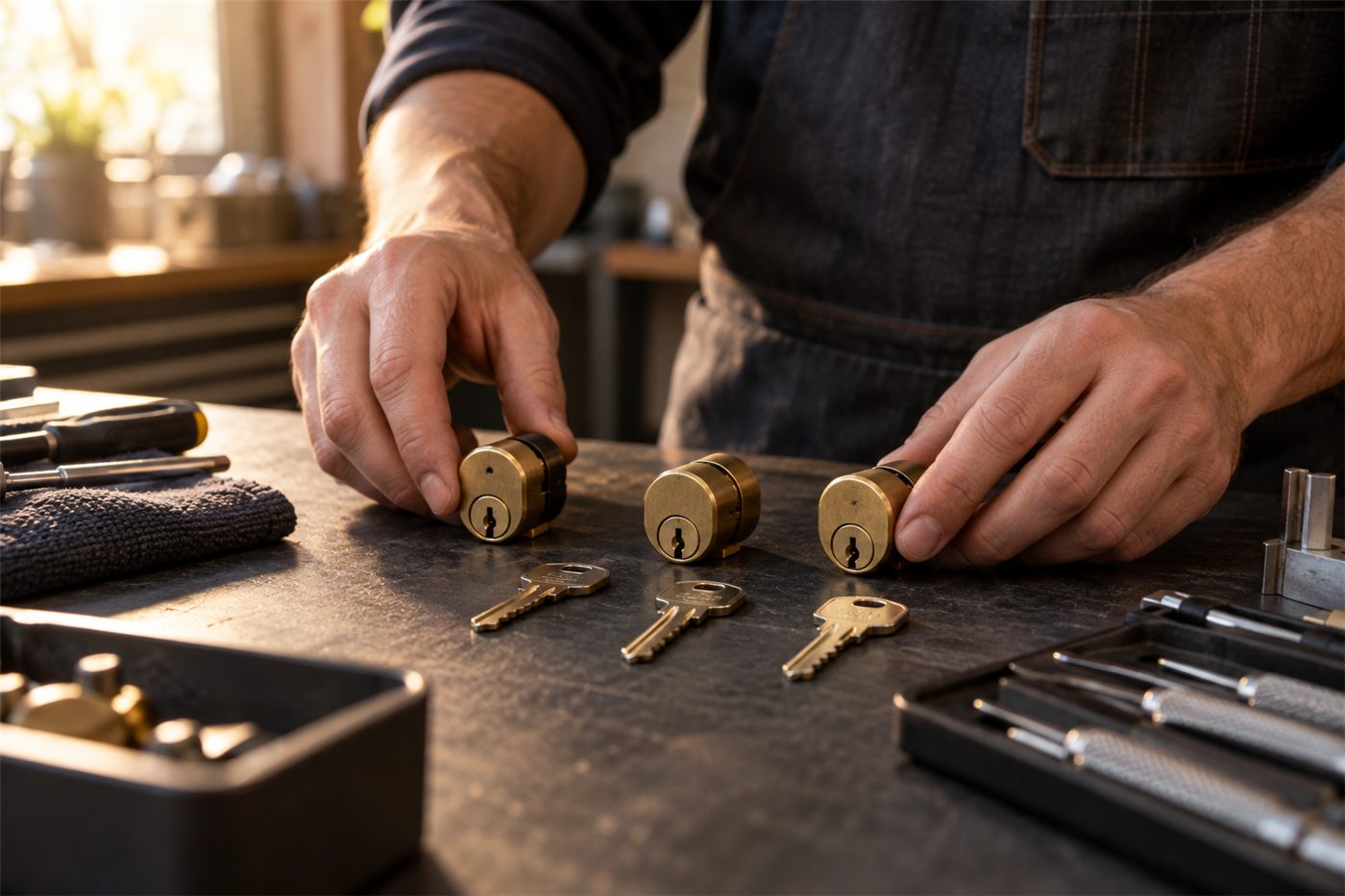
Rekeying at turnover is fast and inexpensive compared to replacing locks. The hardware stays, the pins inside change, and every old key stops working. If you have several units turning over in the same season, or several doors in one unit, batching them into one visit keeps the cost down.
Some landlords keep a small stock of spare cylinders already keyed differently, and simply swap them at each turnover. The removed cylinders get rekeyed at leisure and go back into the stock. This works very well with standardized hardware and is worth discussing if you manage more than a handful of doors.
A turnover is also the moment to check everything else. Test every lock with the door closed. Check sliding door latches actually catch. Look at strike plates and screws. Confirm window locks work. Replace batteries in any electronic locks and delete all old codes. The detailed walkthrough is in the tenant turnover guide, which pairs well with this one.
Vacant units
An empty unit is its own risk.
Vacant properties attract attention. An empty house with overgrown grass, mail piling up and no lights at night looks exactly like what it is, and unoccupied units can be targets for theft of appliances, copper and fixtures, for squatting, and for vandalism. The locks need to be at their strongest when nobody is there.
- Rekey or swap cylinders as soon as the previous tenant leaves. Do not wait for the new tenant, since the unit is exposed the whole time it sits empty.
- Secure every door, not just the front. Basement doors, rear doors and garage side doors are where vacant unit break-ins usually happen.
- Use a lockbox carefully. If agents and contractors need access, a lockbox is convenient, but change its code between users and do not leave it on the front door in plain view.
- Keep it looking occupied. Timers on lights, grass cut, mail collected. The lock is the last line, not the first.
- Visit on a schedule. Check doors and windows every week or so, and after storms. A broken window left for a month invites more than weather.
- Record every key given out during the vacancy. Showings, repairs and cleaning can generate more keys in a month than a tenant does in a year.
Electronic locks
Keypads and smart locks for rentals.
| Advantage | Caution |
|---|---|
| Codes can be changed between tenants without a locksmith visit | Only if someone actually changes them. Old codes left active defeat the purpose. |
| No keys to collect or lose | A mechanical override key still exists and must be controlled like any other key. |
| Temporary codes for contractors | Delete them when the job ends, and do not reuse the same contractor code across properties. |
| Some models keep an access log | Tenant privacy matters. Be clear in the lease about what the lock records and who can see it. |
| Remote management across several properties | Depends on a working connection and account security. Use a strong password and two-step login. |
| Batteries warn before failing | Warnings often go to the tenant, not you. Agree who replaces them and when. |
For a closer look at models and features, see the smart lock buying guide and the keyless entry pros and cons.
Short-term rentals
Guests change every few days.
A short-term rental, whether a whole house near the beach routes or a room in a Wilmington row home, turns over far more often than a long-term lease. Physical keys become almost impossible to control. Guests lose them, copy them, forget to return them, and the owner has no practical way to know.
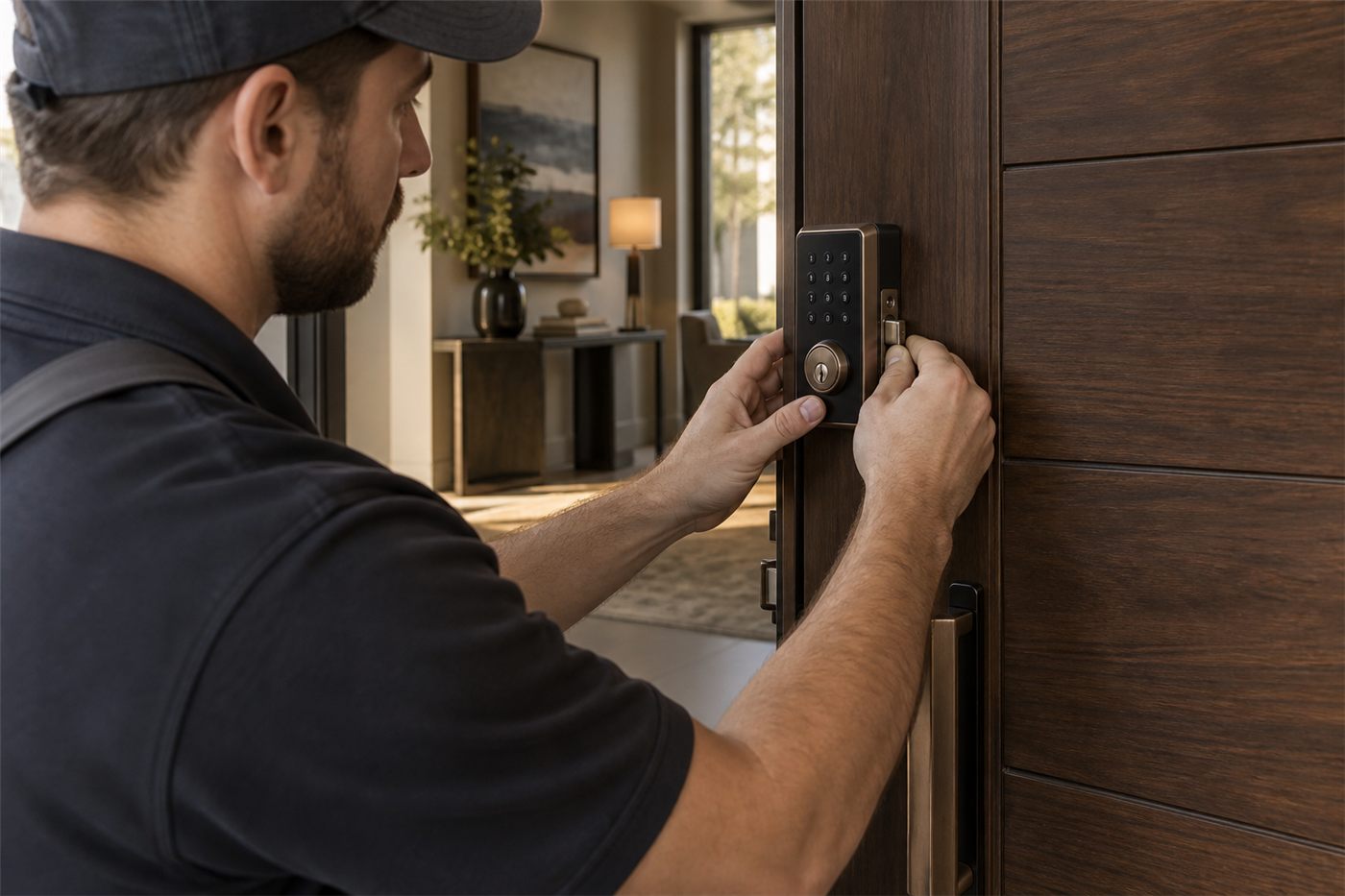
For short-term rentals, an electronic deadbolt with unique codes per guest is almost always the right answer. Each booking gets its own code, active only for the dates of the stay. When the guest leaves, the code stops working without anyone having to do anything. Cleaners and maintenance staff get their own codes, which can be removed when they stop working for you.
Keep a mechanical backup. Every electronic lock should have a key override or a second keyed deadbolt on another door, and those keys should be held by you and a trusted local contact, not left under the mat. Plan for the day the battery dies or the internet goes down during a guest's arrival.
Interior owner closets are common in short-term rentals, where the owner stores linens, supplies or personal items. A good keyed lock or a separate keypad on that closet door keeps guests out without needing to hide a key in the unit.
Tenant requests
When a tenant asks about locks.
A tenant asks to change or add a lock. Many leases address this directly, often requiring the landlord's permission and a key for the landlord. If yours does not, it is worth deciding on a policy. A tenant who has a genuine safety concern, such as a former partner with a key, needs a quick answer. Rekeying promptly, and giving the tenant the new keys while keeping one for yourself, usually satisfies everyone.
A tenant reports a lock that is hard to use. Treat it as a real repair. A stiff lock becomes a snapped key, or a tenant who stops locking the door because it is a nuisance. Our maintenance schedule helps prevent most of these.
A tenant is locked out. Decide in advance whether you provide lockout help, whether there is a charge, and whether you want tenants calling you or a locksmith directly. Tell tenants the policy at move-in. A locksmith will usually ask for proof that the person lives at the address before opening a door.
A tenant asks for a smart lock. Some owners welcome it, some prefer to control the hardware. If you allow it, require that the original lock be kept and reinstalled at move-out, or agree that the new lock stays and its codes are handed over.
For the tenant's side of these conversations, our apartment lock rights guide explains how we handle requests from renters.
Small buildings and shared entrances
Duplexes, triplexes and small apartment buildings add a layer: the shared entry door, the basement laundry, the mail area and sometimes a back door to the parking lot. These doors carry much more traffic than any single unit door, and every tenant has a key to them.
A small master key system is often the right answer. Each tenant's key opens their own unit and the shared doors. The owner's master opens everything. When a tenant leaves, only their unit cylinder needs rekeying, not the whole building. When a building key is lost, the shared doors can be changed without touching the units. The master key systems page explains how these are planned, and restricted keyways can stop tenants copying building keys at a hardware counter.
Shared doors should close and latch on their own. A door closer that has stopped working turns a secure entrance into an open one, and tenants rarely report it. Check closers at every visit, and see our door closer repair page if one is slamming or failing to latch.
Mailboxes are part of this too. Individual unit mailbox locks should be changed at turnover in the same way as the unit door, since mail theft is an easy route to identity theft. The mailbox locks page covers the common types.
Related
Other guides for property owners.
If you run a business as well as rentals, the business key control policy guide applies the same thinking to a workplace.
 Most requested
Landlord Rekey Service
Batch rekeys at turnover, planned around your schedule.
 Buildings
Master Key Systems
One owner key, separate tenant keys, shared doors covered.
After court processEviction Lock Change
Lock changes once possession has been lawfully returned.
 Keyless
Keypad Locks
Codes that change between tenants without a visit.
Small itemsMailbox Locks
Changed at turnover along with the unit.
BaselineDeadbolt Installation
The standard every exterior door should meet.
Where we do this
Rental property work across both counties.
Questions
About rental property locks.
Do I really need to rekey between every tenant?
We recommend it for every tenancy. You cannot know how many copies the previous tenant made or who they gave them to. A rekey makes every old key useless and costs far less than replacing hardware. Many landlords consider it part of the basic cost of each turnover.
Is it cheaper to rekey or swap cylinders?
For a single door, a rekey is simple. For owners with several properties on standardized hardware, keeping spare cylinders already keyed and swapping them at turnover can be faster, with the removed cylinders rekeyed later. We can help you decide which suits the size of your portfolio.
Should I use a master key system for a small building?
For a building with shared entrances, usually yes. It lets each tenant open their unit and the common doors while you keep one key for everything. When a tenant leaves, only their unit needs attention. Planning it properly at the start avoids problems later.
Can a tenant change the locks?
That depends on the lease and on the rules that apply to your tenancy, so check both. In practice, most landlords do better by responding quickly to a genuine safety concern with a rekey and keeping a key for themselves, rather than having tenants arrange their own changes.
Are smart locks a good idea for a long-term rental?
They can be, especially for changing access between tenants without a visit. They only help if codes are actually managed. Keep a mechanical override, decide who replaces batteries, and be open with tenants about any access logs the lock keeps.
How should I store spare keys for my rentals?
In a locked key cabinet or safe, with tags that use a code rather than the address. Keep a register of what is in it and who has taken keys out. A labeled key ring is one of the most damaging things a landlord can lose.
Will you change locks after an eviction?
Yes, once the court process has returned possession to you and you can show that it has. We do not change locks to remove a tenant outside of that process. Our eviction lock change page explains what we ask to see.
What should I check on a vacant unit?
Rekey promptly, secure every exterior door and ground floor window, keep the unit looking occupied, control lockbox codes and contractor keys, and visit regularly. Vacant units are most at risk through the doors nobody looks at.