

The basics
What is actually inside a key fob
Two jobs, often in one plastic shell.
Remote and immobilizer
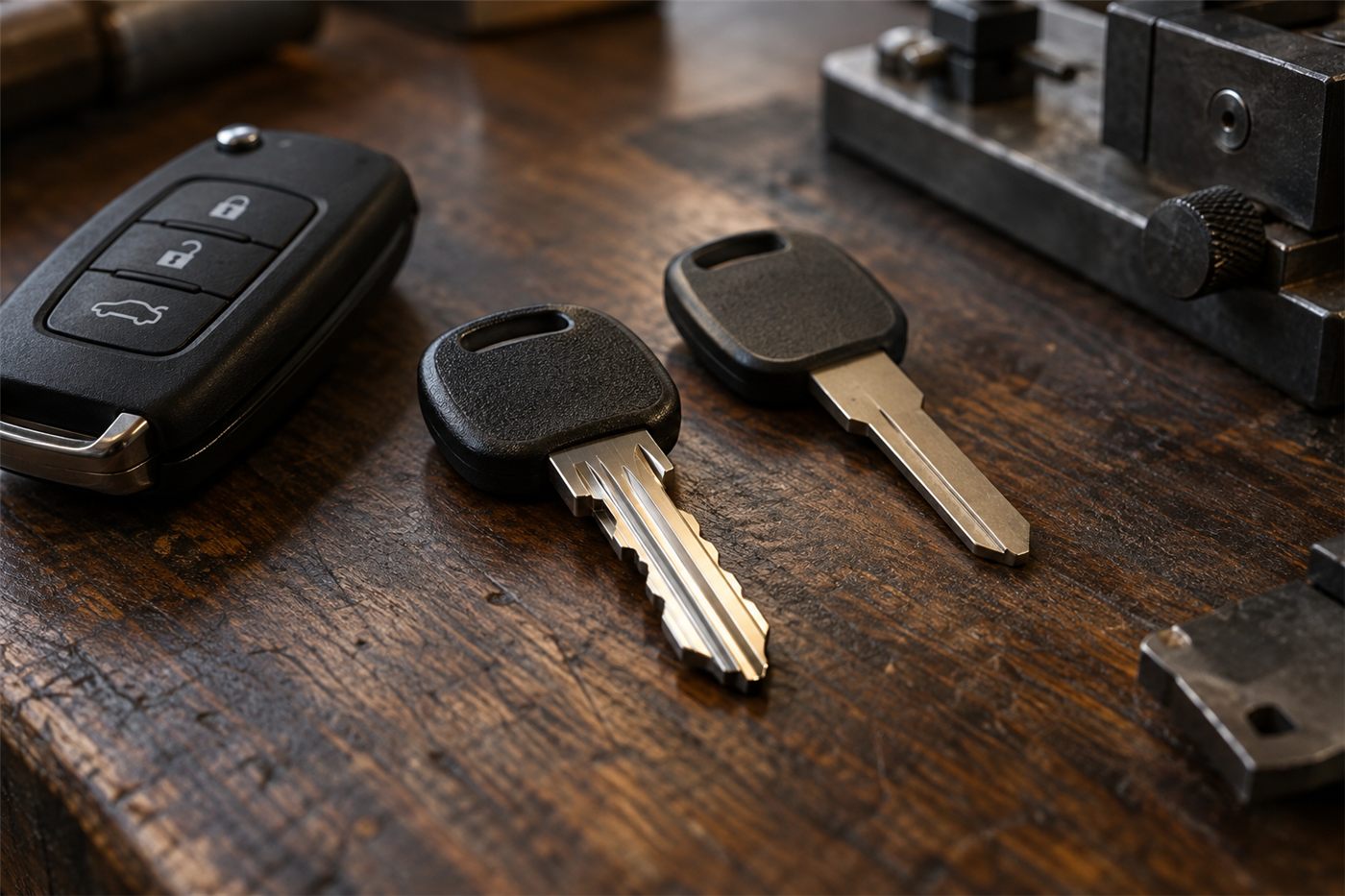
Most modern car keys do two separate things. The first is remote keyless entry, the buttons that lock, unlock, open the trunk or set off the panic alarm. That is a small radio transmitter powered by a coin cell battery. The second is immobilizer authentication, which tells the car that a genuine key is present so the engine is allowed to start. That is handled by a transponder chip, or on smart key cars by an electronic exchange between the fob and antennas in the vehicle.
The two systems are often programmed separately. It is entirely possible for a fob to unlock the doors and not start the car, or start the car while the buttons do nothing. When people buy a fob online, program the buttons with an owner procedure and then find the car still will not start, this is usually why. The remote was paired, but the immobilizer never learned the new key.
Understanding that split makes sense of most fob problems, and it explains why a proper replacement involves the right hardware for your vehicle and the right programming equipment for both functions.
Fob types
The kinds of fob you may have
Separate remote and key
Many older vehicles use a metal key with a transponder chip in the head, plus a separate remote on the key ring for the locks. Replacing the remote alone is often simpler, and a lost remote does not stop the car starting as long as the key is still there.
Remote head key
The key blade and the remote buttons share one head. The transponder chip sits in the head as well. These are cut to the car's lock and programmed for both the remote and the immobilizer.
Flip key
A remote head key where the blade folds into the fob and springs out at the press of a button. Common on many European and some Asian and American vehicles. The flip mechanism is a frequent wear point, and a broken flip can sometimes be repaired by replacing the shell without replacing the electronics.
Smart key or proximity fob
Used on push button start vehicles. The car detects the fob nearby, unlocks when you touch the handle, and allows the engine to start with a button. There is usually an emergency blade hidden inside the fob for the door lock if the battery dies. Smart keys are the most involved to replace, because the fob must be programmed into the car's security system correctly.
Phone and card keys
Some newer vehicles support phone as key or card keys alongside or instead of a fob. Those are generally managed through the manufacturer's systems and are outside what a locksmith can supply, though many of those vehicles still use a physical fob that we can work with.
When to replace
Replace, repair, or just change the battery
Not every fob problem needs a new fob. Before replacing anything, it helps to work out what has actually failed.
- Buttons work only close to the car, or intermittently. Almost always a weak battery. Coin cells are cheap and on most fobs easy to change. Try this first.
- Car shows a key not detected message on a push button start vehicle. Often a weak fob battery too. Many cars let you start by holding the fob against the start button or placing it in a marked spot, which works even with a low battery.
- Case cracked, buttons worn through, flip key will not stay open. The electronics may be fine. A replacement shell, with the circuit board and chip transferred, can be enough.
- Fob went through the washing machine. Sometimes it recovers after drying thoroughly with the battery removed. Often it does not, and the board is damaged by corrosion.
- Fob lost or stolen. Replacement is needed, and the lost fob should be removed from the car's memory so it can no longer start or unlock the vehicle.
- Fob was dropped and now does nothing even with a new battery. A cracked board or a broken battery contact. Sometimes repairable, often a replacement.
The process
How we replace a key fob
Identify, cut, program, test.
Identify the vehicle and the key. We need the make, model and year, and ideally the VIN, which is visible through the windshield on the driver side and printed on the registration. That tells us which fob and which programming procedure the vehicle needs. Fobs that look identical can differ in frequency, chip type and internal part number, and a fob that looks right but is wrong will not program.
Cut the blade. If the fob has a blade, or a hidden emergency blade, it is cut to match your car's locks. Where you still have a working key, we can copy it. Where all keys are lost, the blade is cut from code or by decoding a lock on the vehicle.
Program the immobilizer. Using programming equipment connected to the car's diagnostic port, the new key is added to the vehicle's list of accepted keys. On some vehicles this requires a security access procedure or a waiting period built in by the manufacturer. We explain any waiting time before we start.
Program the remote. The buttons are paired, either as part of the same procedure or as a separate step.
Test everything. Lock, unlock, trunk, panic, remote start where fitted, door handle sensors on smart key cars, and of course starting the engine several times. We also test any existing keys you still have to confirm they still work, unless you asked for them to be removed.
Lost fobs
When a fob is lost or stolen, erase it
If a fob is lost somewhere it could be found, or stolen along with a bag or a jacket, the replacement is only half the job. The lost fob is still stored in the car's memory, and anyone who finds it with the vehicle can unlock and potentially start it.
On most vehicles, programming a new key is also the moment to clear keys that are no longer in your possession. Depending on the vehicle, the car either erases all keys and then relearns the ones present, or lets specific keys be removed. Either way, bring every key you still have to the appointment, because any key not present when the memory is cleared may stop working and need reprogramming.
If the fob was lost somewhere harmless, such as inside your own house, you may prefer to leave it in the car's memory in case it turns up. That is your choice, and we will ask.
All keys lost
No working key at all
Harder, still usually solvable on site.
Replacing a fob when you still have one working key is the simpler case. Programming a key when every key is gone is more involved, because on many vehicles the car expects an existing key during the procedure, and because the blade must be produced without an original to copy.
On a large number of vehicles, all keys lost programming is still possible on site with the right equipment. On some, particularly certain newer models with tighter security, it may take longer, need additional steps, or in some cases require dealer involvement. We will tell you which applies to your vehicle when you call, before anyone drives out.
Before we program any key with no existing key present, we confirm ownership with ID and the registration or title. Our all keys lost page explains the process in more detail.
Buying your own
Fobs bought online: what to know
Many people buy a fob online to save money and then ask a locksmith to cut and program it. Sometimes that works well. Sometimes it creates more cost than it saves. A few things to check before you order.
- Match more than the look. Fobs for the same model can differ by year, trim, market and frequency. The part number or FCC ID on the back of your existing fob is a far better guide than a photo.
- Used fobs may be locked. Some fobs, once programmed to a vehicle, cannot be programmed to another. A used fob from a salvage vehicle may be permanently tied to that car.
- Quality varies. Some aftermarket fobs have weak transmitters, poor buttons, or chips that do not program reliably. When a fob will not program, the time spent trying is still time.
- Blades may be uncut or wrong. A blank blade needs cutting, and a blade of the wrong profile cannot be cut to fit.
- Ask before ordering. Call us with the details and we will tell you whether the fob you are looking at is likely to work with your car.
We are happy to program a fob you supply where it is suitable, and we will be straightforward if it is not.
Dealer or locksmith
Why many people call a locksmith instead
A dealer can replace a key fob for any vehicle they sell. For many owners, a mobile locksmith is simply more practical. We come to where the car is, which matters most when there is no working key and the car cannot be driven to the dealer. We are often available on evenings and weekends when service departments are closed. And for many vehicles, we can supply and program the fob in one visit.
There are cases where the dealer is the better or only choice, including some very new models and certain vehicles where key programming is restricted to dealer systems. We will tell you honestly if yours is one of them. Our page on car key replacement covers the broader picture.
Spares
The best time to replace a fob is before you need to
One key is a single point of failure.
A surprising number of cars on Delaware roads have only one working key. The second was lost years ago, or never came with the car when it was bought used. As long as that one key works, everything seems fine. The day it is lost, the job becomes an all keys lost situation, which is more involved than adding a spare.
Adding a spare while you still have a working key is usually the simplest form of fob replacement there is. The car learns the new key alongside the existing one, and you have a backup at home. If you bought a car with one key, making a spare is one of the most useful things you can do in the first month of ownership.
Keep the spare somewhere safe at home, not in the car. A spare key in the glove box helps whoever breaks into the car more than it helps you.
Security
Smart keys and relay theft
Smart key vehicles unlock and start when the fob is nearby. That convenience has been exploited by thieves using relay devices that extend the fob's signal from inside a house to the car on the driveway. It is a known issue across many makes, and you may have heard about it in the news.
Some simple habits reduce the risk. Keep fobs away from the front door and exterior walls at night. Store them in a signal blocking pouch or a metal box if you are concerned. Check whether your vehicle or fob has a sleep mode or a setting that disables keyless entry, which some manufacturers provide. None of this requires a replacement fob, but it is worth knowing if you are replacing one anyway.
Fob care
Making a fob last
Most fobs die of small, avoidable things.
A fob lives a hard life. It is dropped on parking lots, sat on in back pockets, carried through rain, left on hot dashboards and swung on heavy key rings every time the car moves. A few habits noticeably extend how long one lasts.
Keep the key ring light. A heavy bunch of keys hanging from a fob, especially a remote head key that sits in an ignition, puts constant strain on the fob's case, the blade and even the ignition switch. Keep house keys on a separate detachable ring if you can.
Change the battery before it dies completely. Weak batteries give warning through reduced range. Changing the battery at the first sign of that avoids the day the fob stops responding at the worst moment. When you open the case, check the battery contacts for corrosion and make sure the new cell is the correct type and seated the right way up.
Keep it dry. Rain rarely harms a closed fob, but a soak in a washing machine, a pool or a puddle can corrode the board. If it gets wet, take the battery out straight away and let everything dry fully before reassembling.
Scenarios
Key fob situations compared
| Situation | Usual answer |
|---|---|
| Buttons weak or intermittent | Change the coin cell battery first |
| Case broken, electronics fine | New shell with the board and chip transferred |
| Want a spare, one key still works | New fob cut and programmed alongside the existing key |
| Fob lost, other key at home | New fob programmed, lost fob erased from memory |
| Every key lost | Blade cut from code, all keys lost programming, ownership confirmed |
| Fob bought online will not program | Check part number and compatibility, or supply a correct fob |
| Remote works, car will not start | Immobilizer programming for the new key |
Local factors
Key fob replacement across New Castle and Kent County
In New Castle County, key fob calls come from commuters in Wilmington and Newark, from families in Middletown, Bear and Glasgow with two or three vehicles and a shortage of spare keys, and from University of Delaware students who lost their only fob on campus. Parking garages and apartment lots are common places we program fobs.
In Kent County, we see more trucks and SUVs, more used vehicles bought with a single key, and more calls from rural addresses where getting a car to a dealer without a key would mean a tow. Around Dover, military families often need spares before a move, and sometimes after one when keys are lost in the shuffle.
Wherever the car is, the process is the same: identify the right fob, cut it where needed, program both functions, test everything, and clear out lost keys so they can no longer be used.
Questions
Frequently asked
My fob unlocks the car but it will not start. Why?
The remote and the immobilizer are separate systems. The buttons have been paired, but the car has not learned the key's chip or smart key signal. Immobilizer programming fixes that.
Can you program a fob I bought online?
Often, yes, if it is the correct part for your vehicle and has not been locked to another car. Call with the part number before you order and we will tell you whether it is likely to work.
Do I need to bring all my keys?
Yes. On many vehicles, programming clears keys that are not present. Bringing every key means they can all be kept working.
Can a lost fob still open my car?
Yes, until it is removed from the car's memory. When we program a replacement, we can erase lost keys so they no longer work.
What if I have lost every key?
On many vehicles we can still cut and program a new key on site. Some newer models need more steps or dealer involvement. We will tell you which applies when you call.
Can a broken fob case be fixed?
Often. If the circuit board and chip are undamaged, a new shell can be fitted and the electronics transferred.
Do you come to me?
Yes. We program fobs at homes, workplaces, parking lots and roadsides across New Castle and Kent counties.
Do I need to prove the car is mine?
Yes. We check ID against the registration or title before cutting or programming any key.
Need a new key fob?
Tell us the make, model and year. We will tell you what fob it takes and how programming works on your car.