

The basics
Three ways to make a key
Copying the key in your hand is only one of them, and often not the best.
Tracing, code cutting and decoding
Tracing a key is what most people picture when they think of duplication. The existing key is clamped in a machine, a guide follows its edge, and a cutter reproduces the shape on a new blank. It is quick and works well when the original key is in good condition. Its weakness is that it copies everything, including wear, small bends and errors from earlier copies.
Cutting to code ignores the old key's shape entirely. Every lock is built to a set of depths, and those depths can be expressed as a code. When the code is known, from a stamp on the key, a tag that came with the lock, or paperwork from the manufacturer, a code machine cuts each position to its exact factory depth. The result is a key that matches the lock as it was built, not as the old key has worn.
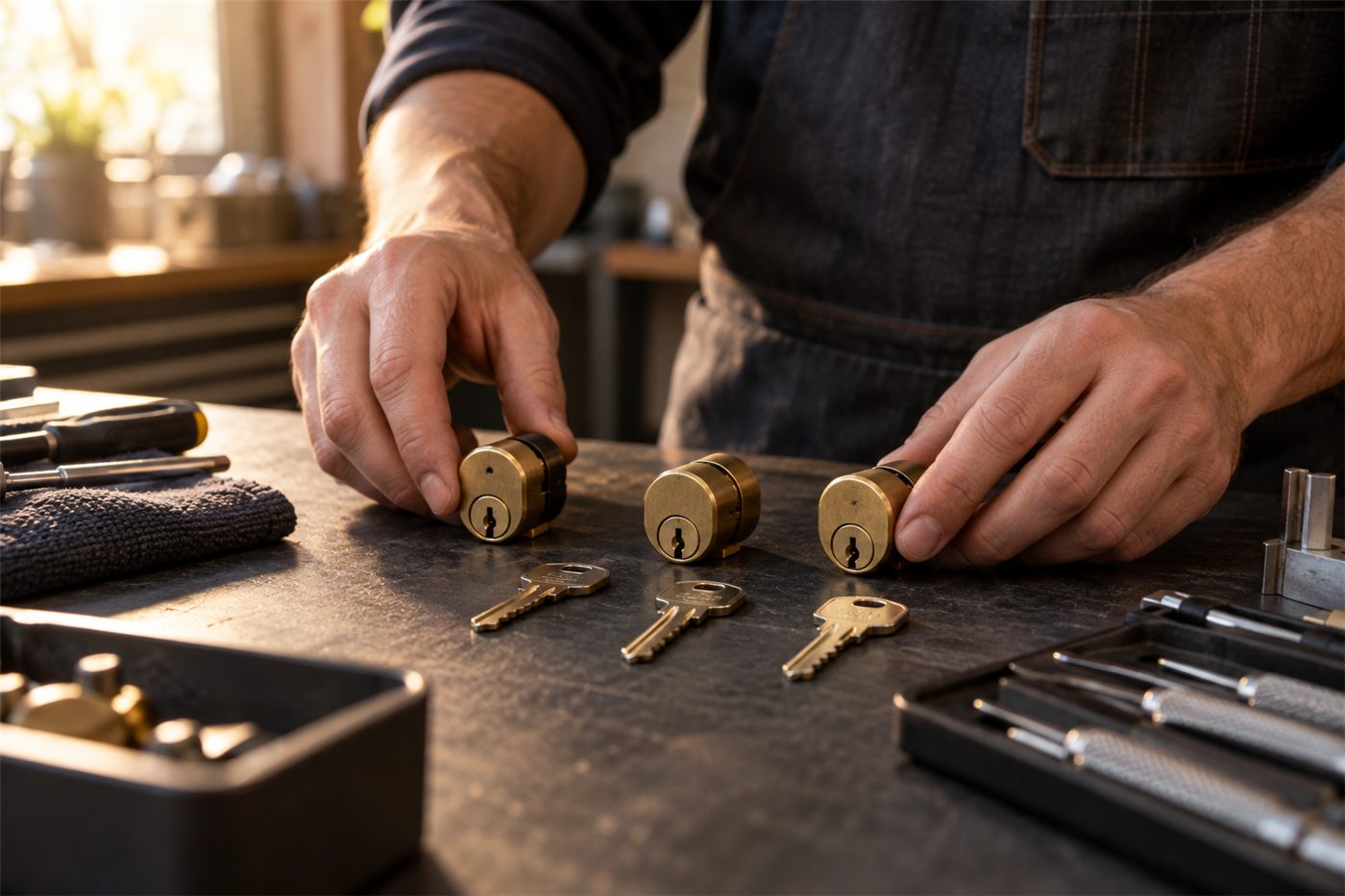
Decoding the key or the lock is the middle path. We measure the cuts on the existing key with a gauge, compare them with the depths the manufacturer uses, and work out what each position was meant to be. Where a key is too worn or damaged to measure, we can often read the lock itself. Either way, the new key is cut to the intended depths.
For a key in good condition, tracing is fine. For a key that has been in daily use for years, or a key that is a copy of a copy, code cutting or decoding produces a better result, and it is what we prefer when the lock matters.
Blanks and keyways
Why the right blank matters as much as the cuts
Before any cutting happens, the key needs the right blank. A blank is an uncut key with a specific profile, the pattern of grooves along its side that lets it slide into a particular keyway. Hundreds of keyways exist, and many look similar at a glance. A blank that is almost right may slide in most of the way, or go in and bind, or wear the lock over time because the fit is loose.
Identifying the keyway comes first. We look at the profile, the shape of the head, any brand stamping and the lock the key belongs to. Where a key has lost its markings, we compare it against known profiles. Getting the blank right means the key slides in smoothly and seats fully, with its shoulder resting against the face of the lock, which is where the cuts line up correctly with the pins.
Blank quality matters too. Cheap blanks made from soft metal wear quickly and can bend or snap. Good blanks made from brass or nickel silver last for years. For keys that will be used every day, like a front door or a business entry, we use durable blanks.
Some keyways are restricted, meaning the blanks are not sold to general key shops. Those keys belong to high security or controlled systems, and copies are available only through authorized channels. We explain more on our high security locks page. If you bring us a restricted key and ask for a copy, we will tell you how copies of it are properly ordered rather than trying to improvise one.
What we copy
Keys we duplicate, and what each one needs
- House keys. Front and back door deadbolts, knob locks and levers. Most use common residential keyways and can be cut from the key, from the code or from the lock.
- Business keys. Storefront, office, warehouse and back door keys. Many are part of master key systems, which means a copy has to match the system and should be authorized by the owner or manager.
- Mailbox keys. Compartment keys for cluster boxes and wall mounted mailboxes. Thin blanks and small locks make accurate cutting important.
- Cabinet, desk and file keys. Often wafer locks with short keys and code numbers stamped on the lock face, which lets us cut to code even when no key exists.
- Padlock keys. From simple padlocks on sheds to heavier locks on gates and trailers.
- Car keys. Mechanical blades are cut the same way as other keys, but most modern car keys also contain a transponder chip or a remote that needs programming. That is covered below.
- Worn and broken keys. A key that is cracked, bent or rounded can often be decoded and cut fresh, which gives a better result than copying it as is.
Vehicles
Duplicating a car key is not the same as duplicating a house key
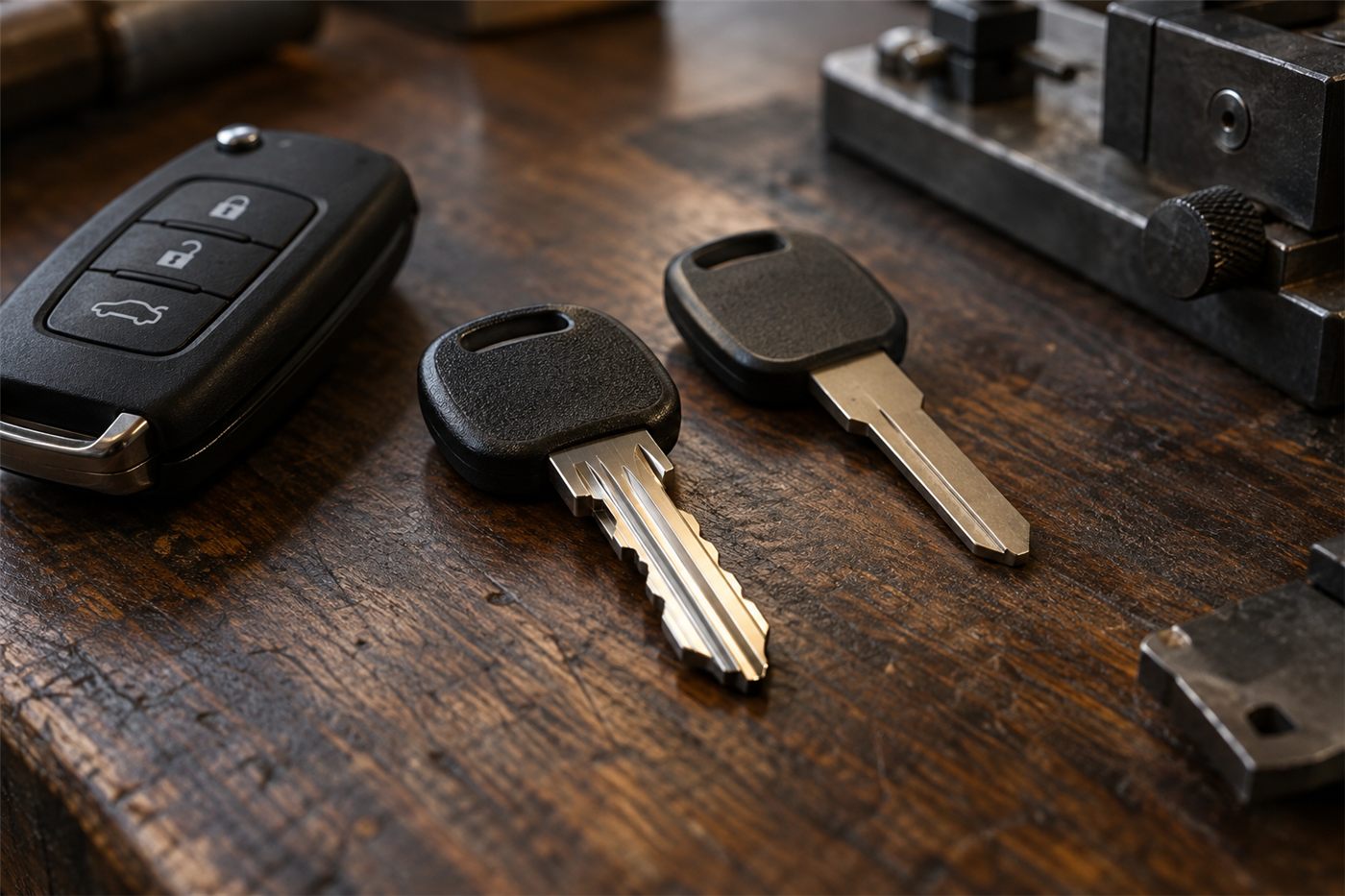
On an older vehicle with no immobilizer, a car key is just a cut blade, and it can be duplicated like any other key. On most vehicles built in the last few decades, the key also carries a small transponder chip that the car must recognize before the engine will run. A copied blade without the right chip opens the door and turns the ignition, and then the engine stops or never starts.
There are two common ways to add a working car key. The first is to program a new transponder key into the vehicle, which registers it as an authorized key. The second, on some vehicles, is to clone the chip from an existing key onto a new one, so the vehicle sees the copy as the original. Cloning works on certain chip types and not others, and it has trade offs, since the vehicle cannot tell the clone and the original apart. Programming a new key is the more complete solution when the vehicle supports it.
Remote fobs and smart keys add another layer. The remote buttons are programmed separately from the immobilizer on many vehicles, and smart keys that start the vehicle with a push button must be registered with the vehicle's security system. For those, duplication really means adding a key, and it is done at the vehicle. Our car key programming and transponder keys pages explain the details.
If you are not sure whether your car key has a chip, check the head. A plastic head that is thicker than the metal inside it often hides a chip. A key with buttons certainly has electronics. When in doubt, tell us the year, make and model, and we will tell you what a working copy requires.
How it works
What happens when we cut a key
Identify, cut, deburr, test.
We identify the keyway and choose the right blank. We look at the existing key for wear, bends and cracks, and check whether a code is stamped on it or available from the lock.
We decide how to cut. A clean original key can be traced. A worn key is decoded and cut to the intended depths. A key with a known code is cut to code. Where no key exists at all, we can read the lock and cut from that.
After cutting, we remove the small burrs left by the cutter. Burrs catch on pins, feel rough in the lock and wear the cylinder. A smooth key slides in and out cleanly.
Then we test. A key that has not been tried in its own lock has not been proven. Because we come to you, we can test every new key in the lock it is meant for, with the door open and closed, before we call the job finished. If a key needs any adjustment, it gets it on the spot.
Worn keys
Why your new copy works worse than the old key
It is a familiar story. The old key works, if you wiggle it. You have a copy made. The copy barely works at all. It seems backward, but it makes sense once you know what happened.
Over years of use, the tips of each cut on the old key wear down. The lock's pins wear a little too, and the two wear together, so the old key still works in that lock, just barely. When a copy is traced from the old key, the machine reproduces the worn shape, plus a small amount of error of its own. The copy is now slightly further from the lock than the old key was, and it has not worn in alongside the pins. It sits just outside the range where the lock will open.
The solution is to go back to the source. Cutting to the original code or decoding the intended depths produces a key that matches the lock's design. In most cases that key works better than the old one did. If the lock itself is badly worn, the new key may reveal it, and then the lock needs repair or rekeying with fresh pins.
This is also why we suggest keeping one good key aside. An original key that is rarely used, kept in a safe place, is the best template for future copies. When the daily key wears, the copy comes from the good one, not from the worn one.
Choosing
Which method fits your situation
| Situation | Best way to make the key |
|---|---|
| Clean original key, lightly used | Trace the original |
| Old daily key, visibly worn | Decode the intended depths and cut fresh |
| Code stamped on the key or lock | Cut to code |
| No key at all, lock accessible | Read the lock and cut from it, or rekey to a new key |
| Restricted or high security key | Order through the authorized channel with the owner's approval |
| Car key with a chip or remote | Cut the blade and program or clone as the vehicle requires |
Key control
Copies you should think about before making
A key copy is easy to make and hard to take back. Before handing out another key, it is worth asking who really needs one. A neighbor watching the house for a week might need a key. A contractor who will be in and out for a day might be better served by someone letting them in. A dog walker who comes three times a week might be a good case for a keypad code rather than a key.
For businesses, the question is sharper. Every key copy is another person who can enter after hours. Master keys and keys to sensitive rooms should be copied only with the owner's approval. When we are asked to copy a key that is clearly part of a business system, such as a key stamped with a master key designation, we ask who authorized the copy. That protects the business, and most owners appreciate it.
For landlords, copies made by tenants are one reason to rekey between leases. A tenant may hand back two keys at move out and still have a third. Rekeying makes that third key useless without having to know it exists.
Label keys by what they open, not by address. A key tagged with a house number and street name tells whoever finds it exactly where to use it. A colored cap or a simple code that only you understand is safer.
Getting a household or office onto fewer keys
A duplication visit is a good moment to look at the whole key ring, not just the key you called about. Many households carry a separate key for the front deadbolt, the front knob, the back door and the garage entry, simply because those locks were bought at different times. If the locks share a compatible keyway, they can often be keyed alike so a single key opens all of them. That turns four keys on every ring into one, and it makes future copies simpler too.
Offices collect keys the same way. A small business may have a front door key, a back door key, an office key and a supply closet key, each copied several times over the years for different employees. Before cutting another round of copies, it can make sense to decide which people really need which doors. A simple arrangement where managers carry a key that opens more than staff keys is the beginning of a master key system, and it is often easier to set up than people expect.
It also helps to retire keys that no longer open anything. Most drawers hold a few keys to locks that were replaced long ago, cars that were sold and padlocks that were lost. Testing them and throwing away the dead ones means that the next time a key is needed in a hurry, the right one is easy to find.
Finally, think about where copies are kept. One good spare with a trusted neighbor or relative is worth more than several spares in a kitchen drawer, because the drawer is behind the locked door on the day you need it.
Local factors
Key copies in New Castle and Kent
Moves, rentals, businesses and families.
Student rentals around Newark produce a steady need for copies each semester, as roommates arrive and landlords need to hand out keys that actually work. Worn keys from older rental locks are common there, and decoding them saves repeated trips.
Businesses in Wilmington, Christiana, Dover and along Route 13 need keys for new staff, often within master key systems where accuracy and authorization both matter.
Families across Middletown, Smyrna, Camden and the surrounding areas often call when a teenager starts driving or a grandparent needs a house key. That is a good moment to check whether all the keys in the family's hands still work well, and to replace the worn ones with fresh keys cut to the lock.
Questions
Frequently asked
Why does my copied key not work?
Usually the original was worn and the copy reproduced the wear with a little extra error. It can also be the wrong blank. We fix this by decoding the intended depths or cutting to code, so the new key matches the lock rather than the worn key.
Can you make a key without the original?
Often, yes. If a code is available, we cut to code. If not, we can read the lock and cut a key from it. If that is not practical, rekeying the lock to a new key is another option.
Can you copy a key marked do not duplicate?
We treat that stamp as a sign that the owner wants control over copies. We ask who owns the lock and whether the copy is authorized. For restricted keys, copies must be ordered through the authorized channel.
Can you duplicate a car key with a chip?
Yes, but it needs more than cutting. The new key must be programmed to the vehicle or, on some vehicles, cloned from an existing key. Smart keys and fobs are added at the vehicle.
Do you test the keys you cut?
Yes. Because we come to you, every key is tried in the lock it belongs to before we leave, and adjusted if needed.
Can you copy a mailbox key?
Yes, for the compartment lock that belongs to you. Many mailbox locks have a code that lets us cut an accurate key even when the original is worn.
How many copies should I have?
Enough for the people who need daily access, plus one good spare kept safely. Fewer copies means fewer keys to lose track of. A spare with a trusted person is more useful than several in a drawer.
My new key is rough and sticks. Is that normal?
No. A properly finished key should slide in and out smoothly. Roughness usually means burrs were left after cutting. We remove them before handing over any key.
Need keys that actually work?
Call and we will cut to code or to the lock, and test every key where it belongs.