

The basics
How a sliding door lock works
A small hook, a small slot and very little room for error.
The hook latch and the keeper
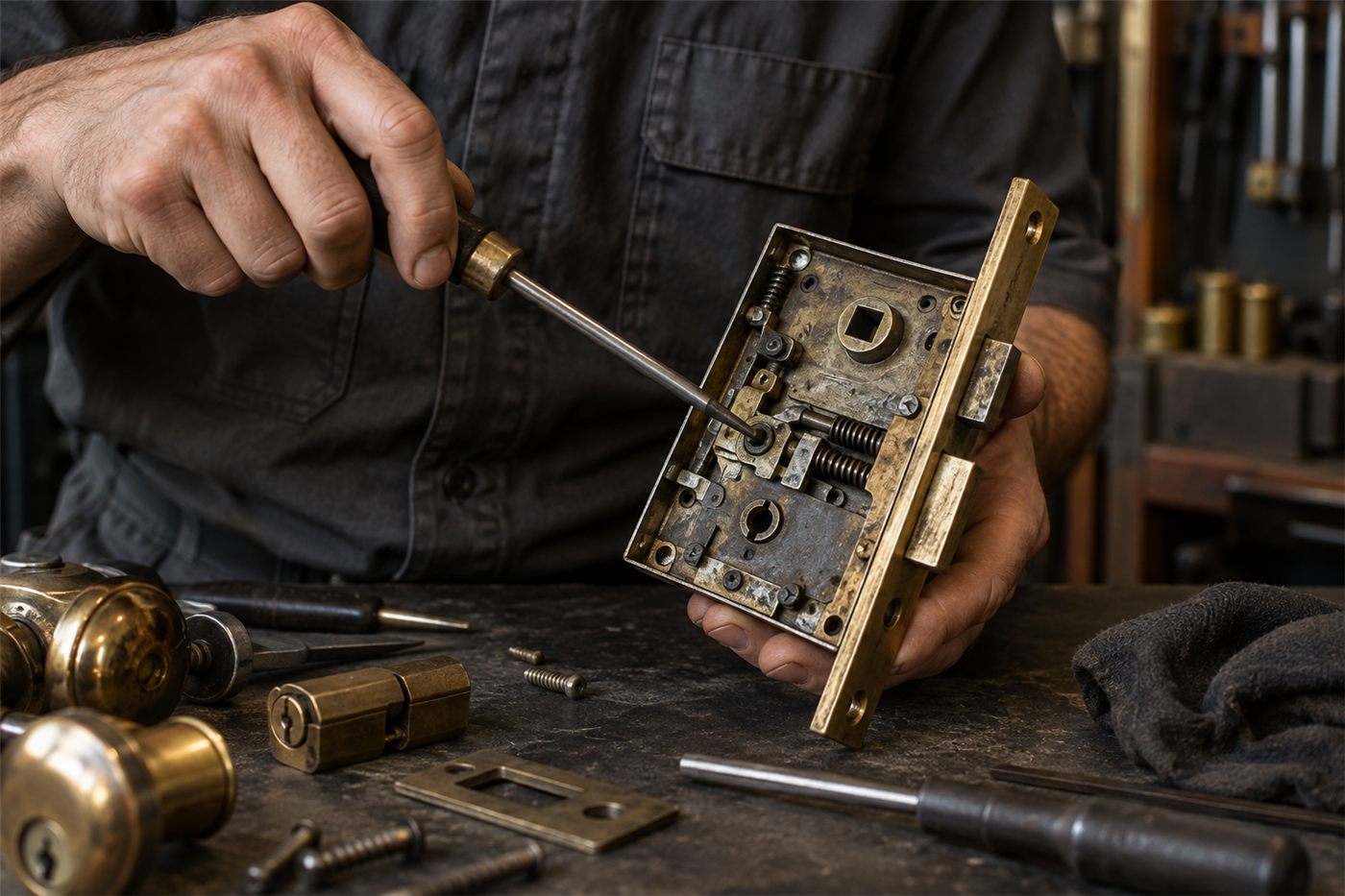
Most residential sliding glass doors lock with a hook latch. Inside the edge of the moving panel is a narrow mortise lock with a curved hook. When the lever or thumb turn on the handle is moved, the hook swings out and catches on a metal keeper mounted in the door frame. That catch is all that holds the door closed.
It is a simple arrangement, and it works well when everything lines up. The trouble is that the hook and the keeper have to meet within a small margin. If the panel sits a little lower than it used to, a little further from the frame, or a little out of plumb, the hook swings past the keeper or catches only its tip. The handle moves, the door feels locked, and a firm pull opens it.
Many people discover this only after a scare. They find the patio door open in the morning, or they test it after hearing about a neighbor's break in, and it slides open with the lever in the locked position. The lock may be perfectly fine. The door has moved.
Why they fail
The usual reasons a sliding door will not lock
- Worn rollers. The moving panel rides on small rollers at its bottom edge. As they wear, the panel sinks, and the hook drops below the keeper. Worn rollers also make the door hard to slide, grind in the track and pull the panel out of line.
- Roller height out of adjustment. Many sliding doors have adjustment screws at the bottom of the panel that raise or lower each roller. If they were never set properly, or have drifted, the panel may tilt so one side is lower.
- A keeper that has shifted. The keeper is held by screws in the frame. Screws loosen, and in wood and vinyl frames the holes can strip. The keeper moves a little, and the hook no longer meets it.
- A worn or broken mortise latch. The hook is moved by small internal parts that wear or crack. A latch that feels loose, a hook that does not swing fully out, or a lever that moves with no resistance points to the latch itself.
- A damaged track. Dents in the bottom track, often from furniture or dropped items, cause the rollers to jump and the panel to rise and fall as it slides.
- Frame movement. Houses settle, and frames can move with seasonal humidity. A door that locked well in the dry months may struggle in a damp summer.
- Debris in the track. Dirt, leaves, pet hair and sand build up in the track and lift the panel unevenly. Cleaning alone sometimes solves a latching problem.
How it works
What happens when we service a sliding door lock
We start by testing the door as it is. We slide it, lock it, and try it from outside with a firm pull. We watch where the hook meets the keeper, and we look at the gap between the panel and the frame from top to bottom. That tells us whether the problem is the latch, the keeper, the rollers or the panel's position.
Next we clean the track and look at the rollers. If the rollers are adjustable and in good condition, we set the panel height so it rides level and the hook meets the keeper at the right height. If the rollers are worn out, cracked or seized, we discuss replacing them, which usually means lifting the panel out of the frame. Replacing rollers on a heavy glass door is a two person job and one of the most common reasons a patio door that will not lock gets fixed properly.
Then we adjust or reset the keeper. That can mean tightening its screws, moving it slightly, filling and redrilling stripped holes, or replacing it with a sturdier keeper. We check that the hook catches the keeper fully, not just by its tip.
If the mortise latch is worn, we replace it with one that fits the door. Sliding door latches vary in size, hook shape and the spacing between the screw holes, so the replacement has to match the door's make and dimensions. We measure carefully before ordering, and where an exact match is not available, we choose a compatible latch and adjust the fit.
Finally we test the lock again from outside, with a firm pull and a lift. A sliding door is not finished until it resists both.
Keeping a sliding door working between visits
Most of what keeps a patio door locking well is simple housekeeping. Vacuum the bottom track every few weeks during the seasons when the door is used most, and wipe it with a damp cloth to lift the fine grit a vacuum leaves behind. Grit is what wears rollers, and worn rollers are what drop the panel below the keeper.
Use a silicone based lubricant on the track and the roller area if the manufacturer allows it, and avoid heavy grease, which collects dirt and turns into a paste. The latch itself rarely needs lubrication, but a small amount of dry lubricant on the hook pivot can help a latch that has become stiff.
Check the keeper screws once or twice a year. If a screw spins without tightening, the hole has stripped, and the keeper will slowly work loose. That is an easy fix while it is just one screw.
Finally, test the lock the way someone outside would. Lock the door, go outside, and pull firmly on the handle. Then try lifting the panel. If the door moves at all, the latch is not catching the way it should, and a small adjustment now prevents a larger problem later. It takes less than a minute and it tells you more about your patio door than any amount of looking at the lever from the inside.
Lifting
Why a locked sliding door can still be lifted out
The lock holds the door closed. It does not always hold it down.
Sliding panels are installed by lifting them up into the top track and then lowering them onto the bottom track. That same method can remove them. On many doors there is enough space above the panel for it to be lifted until the rollers clear the bottom track, at which point the hook can slip off the keeper and the panel can be pulled away, even while locked.
The fix is to reduce the space above the panel. Anti lift blocks or screws installed in the top track, set so they clear the panel by only a small margin, stop the panel from rising high enough to come out. They do not interfere with sliding, and they are removable if the panel ever needs to be taken out for service.
The fixed panel matters too. Many people assume it cannot move, but on some doors it is held only by a few screws or clips. We check that it is secured to the frame properly.
For a full look at patio door security, including glass and lighting, see our sliding glass door security guide.
Extra locks
Secondary locks that add real protection
The hook latch is the main lock, but it should rarely be the only one. Secondary locks are inexpensive, simple and effective, and several can be used together.
Security bars fit in the bottom track or mount across the middle of the door, blocking the moving panel from sliding. A bar that folds down from the frame is easy to use daily. A cut length of wood in the track works on the same principle, though it is less convenient.
Foot locks mount at the bottom of the moving panel and drop a pin into the floor or track when stepped on. They are quick to engage and release and hold the panel firmly at its base.
Pin locks go through the frame of the moving panel into the frame of the fixed panel, so the two panels cannot separate. They also help resist lifting.
Keyed auxiliary locks mount on the panel or frame and require a key to release. They are useful for doors that are left locked for long periods, such as when a family travels, but everyone in the house must be able to leave quickly in an emergency, so we avoid anything that makes the door hard to open from inside when people are home.
Keyed handle sets let the door be locked and unlocked from outside with a key. They are convenient for households that use the patio door as a main entrance, but the latch behind them still needs to line up with the keeper.
Frame materials
Aluminum, vinyl, wood and fiberglass doors
Older sliding doors in Delaware are often aluminum. They are durable, but the frames can bend, the tracks dent and the thin metal holds screws poorly once holes have been reused. Keepers on aluminum frames need solid fastening, sometimes with backing or larger screws.
Vinyl doors are common in newer homes and replacement projects. Vinyl frames are hollow in places, and screws into hollow sections hold only in thin plastic. When we mount a keeper or secondary lock on vinyl, we aim for reinforced areas or add support. Vinyl also expands and contracts with temperature, which can change the latch alignment between summer and winter.
Wood and wood clad doors are heavier and more stable, but wood swells with humidity and can shift over the years. Their latches and keepers are often specific to the manufacturer, which matters when parts need replacing.
Fiberglass doors are stable and strong. Like wood clad doors, they often use manufacturer specific hardware.
Many sliding door handles and latches are made for a specific manufacturer and model. The handle's screw spacing and the latch's dimensions must match. When the original maker is unknown, we identify the hardware by measurement and choose parts that fit.
Other sliding doors in the house
Patio doors are the sliding doors people worry about, but they are not the only ones. French style sliding doors, where two wide panels look like hinged French doors but slide, often use multipoint locks that engage at the top, middle and bottom of the panel. When one of those points stops engaging, the door may still feel locked while one corner is loose. Those mechanisms are specific to their manufacturer, and the fix is usually adjustment of the keepers or replacement of a worn gearbox inside the panel.
Interior pocket doors and closet sliders use simple hook or privacy latches. They are not security locks, but a pocket door latch that will not catch is a daily annoyance in a bathroom or bedroom, and it is usually a quick fix during a visit for another door.
Sliding doors on sunrooms and enclosed porches deserve the same attention as a patio door if the room connects to the house. A sunroom slider is often the least secure door in the home, because it was treated as an interior door when the room was added.
Commercial sliding doors, such as automatic entrance doors on storefronts, use very different locking hardware. If your business has a manual sliding door on a storefront or an office suite, we can look at its locks as part of storefront door lock service.
Diagnosis
What the symptom usually means
| Symptom | Likely cause |
|---|---|
| Lever moves but the door still opens | Hook missing the keeper because of panel height or keeper position |
| Door hard to slide and grinds | Worn rollers or debris and dents in the track |
| Lever loose or floppy | Worn or broken mortise latch |
| Locks well in winter, not in summer | Frame or panel movement with humidity and temperature |
| Panel can be lifted while locked | Too much clearance above the panel, no anti lift blocks |
| Key on the outside handle does nothing | Broken connection between the keyed cylinder and the latch |
Avoid these
Sliding door mistakes that leave a gap
- Trusting the lever position. A lever in the locked position does not prove the hook caught the keeper. Test with a pull.
- Replacing the handle without checking the latch. A new handle on a door whose hook misses the keeper looks better and locks no better.
- Forcing a sticky door. Forcing a door on worn rollers damages the track and the rollers further. Fix the rollers.
- Leaving the track dirty. Grit lifts the panel unevenly and wears the rollers. Vacuum the track regularly.
- Relying on the hook latch alone. Add a bar, a foot lock or a pin lock.
- Making the door hard to escape through. Secondary locks should release quickly from inside. The patio door may be an escape route in an emergency.
Local factors
Patio doors across New Castle and Kent
Humidity, sand, pets and decks.
Delaware's humid summers make vinyl and wood patio doors move, and we see a rise in sliding door latching problems each July and August. A door adjusted in spring may need a small correction by midsummer.
Homes with decks and pools in Middletown, Bear, Pike Creek and Smyrna put heavy traffic through the patio door, which wears rollers faster. Sand and grass carried in from the yard end up in the track.
Ground floor apartments and townhouses in Newark, Glasgow and Dover often have sliding doors facing shared lawns or parking, which makes the lock and the anti lift protection more important. If you rent, check with your property manager before adding hardware that needs screws in the frame.
Questions
Frequently asked
Why does my sliding door open even when it is locked?
Usually the hook latch is missing the keeper because the panel has dropped on worn rollers or the keeper has shifted. Adjusting the rollers and resetting the keeper typically fixes it. Sometimes the latch itself is worn and needs replacement.
Can you replace the lock on my patio door?
Yes. We measure the latch and handle, identify compatible parts and install them. Because sliding door hardware is often manufacturer specific, measurement matters more than brand name.
What are anti lift blocks?
They are small blocks or screws in the top track that limit how high the moving panel can rise, so it cannot be lifted off its track while locked. They do not affect sliding.
Do I need a security bar if my door locks properly?
We recommend one or another secondary lock. The hook latch is small, and a bar, foot lock or pin lock adds protection at little cost.
My sliding door is very hard to open. Is that the lock?
Rarely. A hard to slide door usually has worn rollers or a dirty or damaged track. Fixing the rollers often fixes the latching problem at the same time.
Can a keyed lock be added to a sliding door?
Yes. Keyed handle sets and keyed auxiliary locks are available. Make sure everyone inside can still open the door quickly in an emergency.
Do you work on sliding screen doors?
Screen door latches are light and mainly keep pets and insects in or out. We can adjust or replace them during a visit, but they are not a security lock.
I rent. Can I add a lock to my sliding door?
A bar in the track needs no screws and is usually fine. Anything that fastens to the frame should be cleared with your landlord first.
Patio door not locking?
Call and we will fix the rollers, the keeper and the latch so the door holds when it says it is locked.