
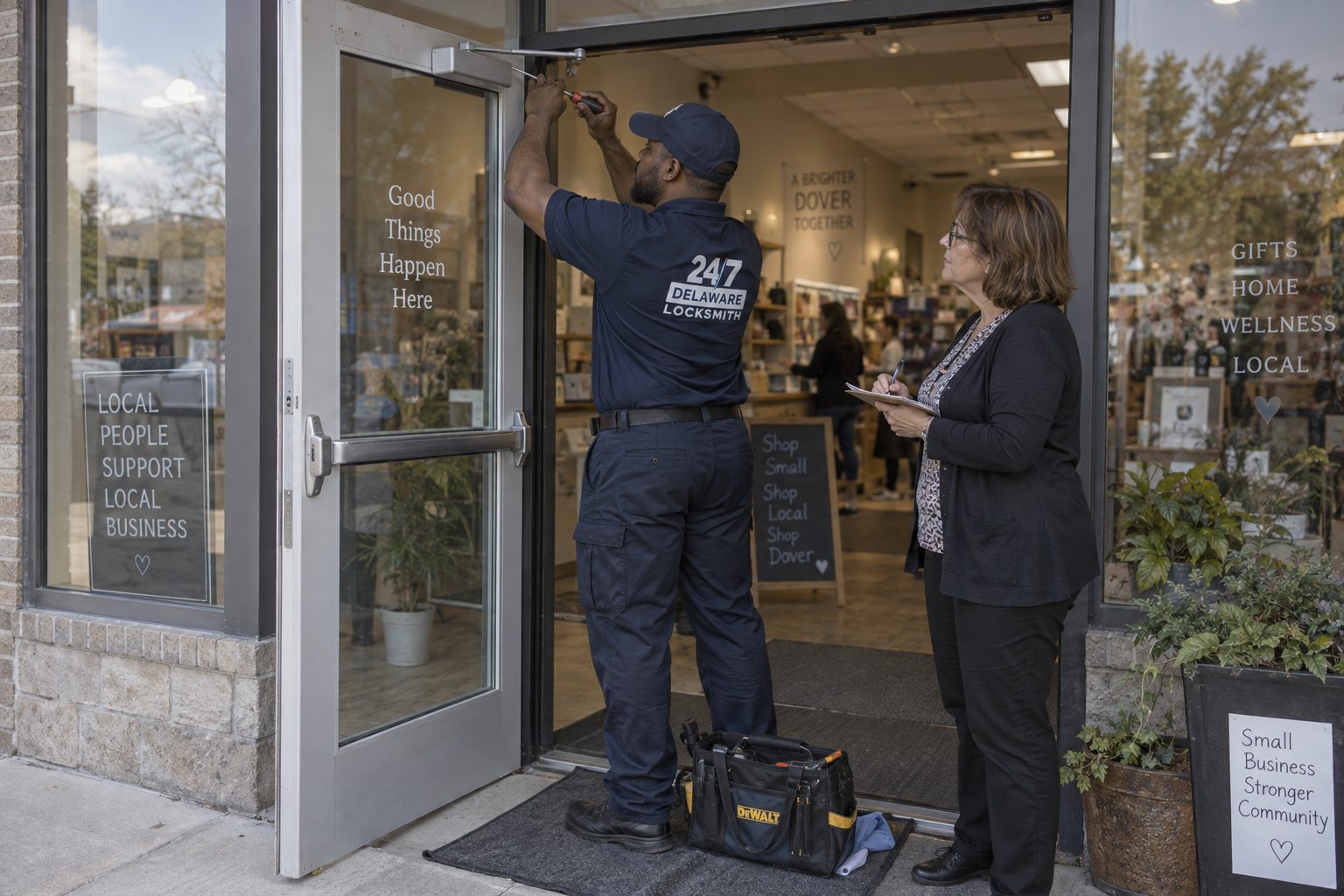
Why it matters
A closer is a security device pretending to be a convenience
If the door does not come home hard enough to latch, nothing else on it counts.
Latching is its real job
People think a closer exists so the door does not stand open. Its actual job is to deliver the door to the frame with enough energy that the latch engages every single time. A closer that shuts the door gently enough to look polite but not firmly enough to latch produces a door that appears closed and is not locked. That is the failure mode nobody notices.
It works harder than anything else
On a commercial entrance the closer takes every single opening, several hundred a day, in every temperature. Nothing else on the door does that much work, which is why it is usually the first thing to drift out of adjustment and the last thing anyone looks at.
It damages the door when wrong
Set too fast and it slams, which destroys latches, wears strikes, cracks glass seals and eventually loosens the frame. Set too slow and the door hangs open long enough for anyone to walk in behind you. Both extremes cost money elsewhere on the door.
And it is adjustable
This is the part worth knowing. Most closers have several independent adjustments, all of them accessible, and the overwhelming majority of closer complaints are solved by turning screws rather than buying hardware. A closer that has never been adjusted is not broken, it is unset.
The adjustments
What can actually be tuned
Most closers have four or five of these, and most have never had any of them touched.
Closing speed
How fast the door travels through most of its arc. The main adjustment and usually the one that has drifted.
Latching speed
The last few inches, deliberately separate. This is the one that determines whether the latch actually engages, and it is the one most often set too gently.
Backcheck
Slows the door near the end of its opening arc so it does not slam into a wall or a person. Protects the closer, the door and the wall behind it.
Delayed action
Holds the door open a few extra seconds before closing, for people carrying things or using a wheelchair. Present on many closers and switched off on most.
Spring power
How much force the closer applies overall. Set for the door width, weight and the wind it faces, not to a default.
Hold open
A mechanical or electromagnetic function that keeps the door open deliberately. Correct on some doors, prohibited on fire doors.
Symptoms
What you are seeing, and what it usually means
The door slams
Closing speed set too high, or spring power set heavier than the door needs. Both are adjustable in minutes. A slamming door is not a door with a strong closer, it is a door with a badly set one, and every slam is damaging the latch and strike it lands on.
The door does not latch
Latching speed too low. The door arrives at the frame without enough energy to drive the latch home, so it rests against the strike looking shut. This is the single most consequential closer fault because the building reads as secure and is not.
The door stands open
Spring power too low for the door, or the closer has lost fluid. If it used to close and now does not, and there is oil visible on the body or the door beneath it, the closer has failed rather than drifted, and that is one of the genuine replacement cases.
The door drags or catches near the end
Often not the closer at all. A door that catches in the last few inches is usually meeting a frame that has moved or a threshold that has risen. Adjusting the closer to force through it treats the symptom and accelerates the wear.
It changed with the season
Closer fluid thickens in cold weather, so a door that closed properly in September can become sluggish in January and then recover in spring. Some closers have temperature compensation, many do not. A seasonal change is usually not a fault.
It is leaking oil
A hydraulic closer that is losing fluid is finished. This is not adjustable and it does not recover. It is also the minority of calls, despite being what people assume when a door misbehaves.
Check it yourself
A one-minute test anyone can do
- Open the door fully and let go. Do not push it, do not slow it. Watch what happens.
- Time the swing roughly. A commercial door should take several seconds, not one and not fifteen.
- Watch the last few inches specifically. Does it accelerate slightly into the frame, or drift and stop?
- Listen for the latch. You should hear it engage. No sound usually means no latch.
- Push the door gently after it closes. If it opens without turning anything, it did not latch.
- Do this ten times, not once. Intermittent latching is the common fault and a single test will miss it.
- Look under the closer and on the door below it for oil. That changes the answer from adjustment to replacement.
What we do
A closer visit, in order
Adjustment first. Replacement only when it is genuinely finished.
Watch it before touching it
Ten cycles, letting the door close on its own each time, before any tool comes out. Most of the diagnosis happens here, and it is why we do not arrive with a replacement closer assumed.
Check the door and frame first
A closer cannot fix a door that has dropped or a frame that has moved. If the door is fighting the frame, adjusting the closer to overcome it will work briefly and destroy the latch. The door gets checked before the closer gets adjusted.
Then tune, in the right order
Spring power for the door, then closing speed, then latching speed, then backcheck. Adjusted out of order they interact and you end up chasing your own changes.
Then confirm the latch
Ten more cycles, watching for the latch to engage every time without help. That is the test the job passes or fails on.
Replacement, honestly
If it is leaking, if the body is cracked, if the arm is bent, or if it is a size that was never right for the door, it gets replaced and we say why. Otherwise it gets set up properly and you keep the one you have.
Getting the size right
When a closer genuinely does need replacing
Size is a real specification
Closers come in sizes matched to door width and weight, and a closer that is undersized will never latch the door properly no matter how it is adjusted. This is common on doors that were replaced without changing the closer, or where a heavier door went into an existing frame.
Exterior doors face wind
A door on a street corner or an exposed elevation needs more power than the same door in a sheltered lobby, because the closer is fighting the wind as well as the door. Specifying from the door alone and ignoring the exposure produces a door that latches in still weather and stands open in a gale.
Accessibility pulls the other way
There are limits on how much force it is reasonable to require to open a door, and a closer set heavy enough to defeat any wind can also be heavy enough to defeat some of the people using it. Getting this balance right, rather than defaulting to maximum, is most of the skill in specifying one.
Surface, concealed and floor spring
Most commercial closers sit on the surface where you can see them. Some are concealed in the frame or the door, and some are floor springs set into the ground under the pivot. Each is a different job and a different cost, and knowing which you have changes the conversation entirely.
Questions
Frequently asked
Our door slams. Do we need a new closer?
Almost certainly not. That is closing speed or spring power, both adjustable, usually in minutes. A slamming door is a badly set closer rather than a failing one.
The door closes but does not lock. Is that the lock?
Usually not. It is normally the latching speed on the closer, the last few inches of travel, set too gently to drive the latch home. It is the most common closer fault and the one with the biggest consequence.
How often should a closer be serviced?
On a busy commercial entrance, a check once a year is reasonable and takes very little time. Most closers we see have never been checked since installation.
Can a closer be adjusted to hold the door open?
Some have a hold open function, and on many doors that is fine. On a fire rated door it generally is not, because the door has to close and latch to do its job. That distinction matters.
Why is our door fine in summer and slow in winter?
Hydraulic fluid thickens as it cools. Some closers compensate for temperature, many do not. A seasonal change of this kind is usually normal rather than a fault, though it can be adjusted for.
There is oil on the door under the closer.
That closer is losing fluid and it is one of the genuine replacement cases. Fluid loss does not recover and cannot be adjusted around.
The propped door
The problem behind most closer damage
Why doors get propped
Almost never laziness. It is a delivery arriving every twenty minutes, a kitchen that is too hot, a staff room round the back, a smoking area, a corridor that becomes a bottleneck at shift change. Somebody had a real problem and a wedge solved it. That is worth understanding before removing the wedge, because removing it without solving the problem just means a different wedge tomorrow.
What it does to the closer
Holding a closer at full extension for hours, day after day, keeps the spring compressed and the seals loaded in a way they were not designed for. Closers held open habitually fail years earlier than closers that are allowed to work normally, and the failure is usually fluid loss, which is not repairable.
The proper answers
A hold open arm where the door is permitted to stand open. An electromagnetic hold open tied to the alarm where it is a fire door and the code allows it. A door alarm where the door should not be open at all and you need to know when it is. A second door where the real problem is that people need a route the building does not provide.
The one thing not to do
Wedge a fire door. It is the most common wedge and the most serious one, because that door exists specifically to be closed when it matters. If a fire door is being propped every day, the reason needs solving, not the wedge removing.
Delaware specifics
What the local building stock and weather do to closers
Two counties, two different sets of closer problems.
Older Wilmington and Newark entrances
Original closers, some of them decades old, many of them still serviceable and a few genuinely obsolete. The variable here is parts. Establishing early whether a given closer can still be sourced changes whether the plan is adjustment, repair or replacement, and it is worth asking before anyone starts.
Exposed and coastal elevations
Wind is the underrated force on a commercial door. A closer specified for the door and not for the exposure will latch reliably in still weather and fail on the windy days, which are exactly the days a door standing open matters most.
Winter
Fluid thickens, doors slow down, and the last few inches lose the energy needed to latch. A building that latches reliably in September and intermittently in January has usually not developed a fault, it has developed a season. It is still worth adjusting for, because an unlatched door in January is as open as one in July.
Summer
Swollen frames and expanded thresholds mean the door meets more resistance in the last inch than it did in spring. The temptation is to increase the closing force, which then slams the door for the rest of the year. Adjust the door, not the closer.
Where closers sit in a building
The doors that have one, and what each needs
The main entrance
The hardest working closer in the building and the one most people notice. It needs backcheck so it does not slam into whatever is behind it, delayed action if anyone arrives carrying things, and a latching speed set firmly enough to secure the door every time. This is the closer worth getting exactly right.
The rear or staff door
Almost always neglected, almost always the one being propped, and frequently the door with the oldest hardware in the building. It is also the door most likely to be standing open at the end of the day, which makes it the one where latching speed matters most and gets checked least.
Internal fire doors
These exist to close and latch when it matters, and they are the doors where a hold open function is generally not acceptable unless it releases automatically. A fire door that does not latch is not performing its function, and a wedge under one removes it entirely.
Toilet and corridor doors
Low stakes, but they are where excessive spring power shows up as a door that is genuinely hard for some people to open. Lighter is usually correct here, and it is the easiest place to improve a building for very little effort.
Doors that should not have one
Occasionally a closer has been fitted to a door that does not need to self-close at all, where it does nothing but make the door harder to use. Removing it is a legitimate answer and worth saying out loud.
Coverage
Where we work
Shops, offices, warehouses and any building with a door that needs to close itself.
Door not latching on its own?
Watch it close ten times and tell us what happens in the last few inches. That is usually the whole diagnosis.
Hinges, frames and floors that work against the closer
A closer can only do its job if the door moves freely, and a surprising number of closer complaints trace back to the door itself. Loose or sagging hinges let the door drop slightly, so the top corner drags against the frame or the latch edge rubs the strike. The closer then works harder, wears faster, and still fails to close the door fully. Before touching the closer, we check the hinges, tighten what can be tightened, and see whether the door swings smoothly by hand.
The surroundings matter too. A threshold that has risen, a floor that has settled, or a door mat that catches the bottom edge will all stop a door short of latching. Wind in an exposed entry can push against the door, and an air handling system in a building can create pressure that holds a door open or slams it. We try to understand these forces rather than simply turn a screw. It is a slower way to work, but it gives a repair that holds through the seasons.
If you want to help, watch what the door does and note when. Does it close fully in the morning but not by afternoon? Does it stop an inch short? Does it slam in wind? Tell us whether the door has been rehung, repainted, or had weatherstripping added recently, since those changes alter how it sits. Call us to describe the door and to confirm availability. The scope and any quote are explained before work begins, so you know what is being adjusted and why.
Adjusting a closer through the changing seasons
A closer filled with fluid behaves differently as the temperature changes. In cold weather the fluid thickens and the door can close slowly or stop short of the latch. In warm weather it thins and the door can close faster than it should. This is why a closer that seemed perfectly set in spring may seem wrong in winter. Small seasonal adjustments are normal, and they do not always mean the closer is failing. Understanding that saves people from replacing a unit that simply needs a tweak.
When we adjust a closer, we work on the speed stages in order: the main sweep, the latch speed that controls the final few inches, and in some models the backcheck that cushions a door thrown open. Each is changed in small steps with the door tested after every change. Making large turns at once is how a closer ends up slamming or hanging. We also check the arm, brackets, and mounting screws, because vibration loosens them over time and a loose bracket mimics a weak closer.
A sensible habit is to check the door when the seasons change. Open it and let go, then watch whether it latches with a firm click and without slamming. If you notice leaking fluid, a bent arm, or a door that will not hold shut, that is a sign the unit may be reaching the end of its life. Call us to describe what you see and to confirm availability. The scope and any quote are explained before work begins. Taking a few minutes to describe the situation properly usually makes the whole visit smoother for everyone.