

The short answer
Get out and stay out until police have checked the house. Report it. Photograph everything before you tidy. Secure every door and window before you sleep. Then rekey, repair the frame, and fix the specific weakness they used.
That is the whole sequence. The details below explain each step, why the order matters, and what people commonly forget. None of it replaces what police or your insurer tell you. Where their instructions differ from ours, follow theirs.
One thing to hold onto in the first hour: what was taken can mostly be replaced, and the house can be made secure again tonight. The practical steps are manageable, and working through them in order helps.
Step one
Do not go in. Call the police from outside.
You do not know whether anyone is still there.
If you arrive home and see a door forced open, a window broken, or anything that suggests someone has been inside, do not go in to look. Whoever did it may still be in the house or nearby. Walk back to your car, a neighbor's house, or somewhere public and call the police emergency line.
If you discover the break in while you are already inside, leave quietly if you can and call from outside. Do not confront anyone. Nothing in the house is worth an encounter with an intruder.
While you wait, note what you see without touching anything: which door or window was used, whether there are vehicles you do not recognize, and the time. Police will ask. If neighbors are around, ask whether they saw or heard anything, or whether their cameras cover your street. Doorbell and driveway cameras have become one of the most useful sources of information after a break in.
When officers arrive, they will usually check the house before you go in. Let them.
Step two
Document before you clean up.
The instinct to put things right is strong. Resist it for an hour. Once police have finished, and before you straighten anything, record the scene.
- Photograph the point of entry. The door, frame, strike, lock and any tool marks. Wide shots and close ups. If a window was used, the glass, frame and latch.
- Photograph every room that was disturbed. Open drawers, emptied closets, moved furniture. These images support an insurance claim and help you remember what was there.
- Make a list of what is missing. Start it now and keep adding for several days, since people notice missing items gradually. Include serial numbers, receipts and photos where you have them.
- Get the police report number. Your insurer will want it. Write down the officer's name and the case number.
- Check for missing keys. Spare house keys, car keys, office keys, mailbox keys, and anything with your address on it. This affects what needs to happen to your locks tonight.
- Check for missing documents. Passports, checkbooks, bank cards, tax papers, and anything with account numbers. These may need calls to banks and card issuers the same day.
Step three
Secure the house before you sleep.
A forced door usually will not lock properly again without repair.
Most residential break ins through a door do not defeat the lock at all. They defeat the frame. A kick or a pry splits the wood around the strike plate, and the deadbolt, still perfectly intact, simply comes away with a strip of frame. That means the door may close and even appear to lock, but it will not hold.
So the first job after police leave is to make every entry point actually secure for tonight. For a damaged door, that may mean a temporary strike reinforcement, a new strike set into sound wood, a temporary lock, or in a bad case a board up until the frame is repaired. For a broken window, it means covering the opening securely, not just taping plastic over it.
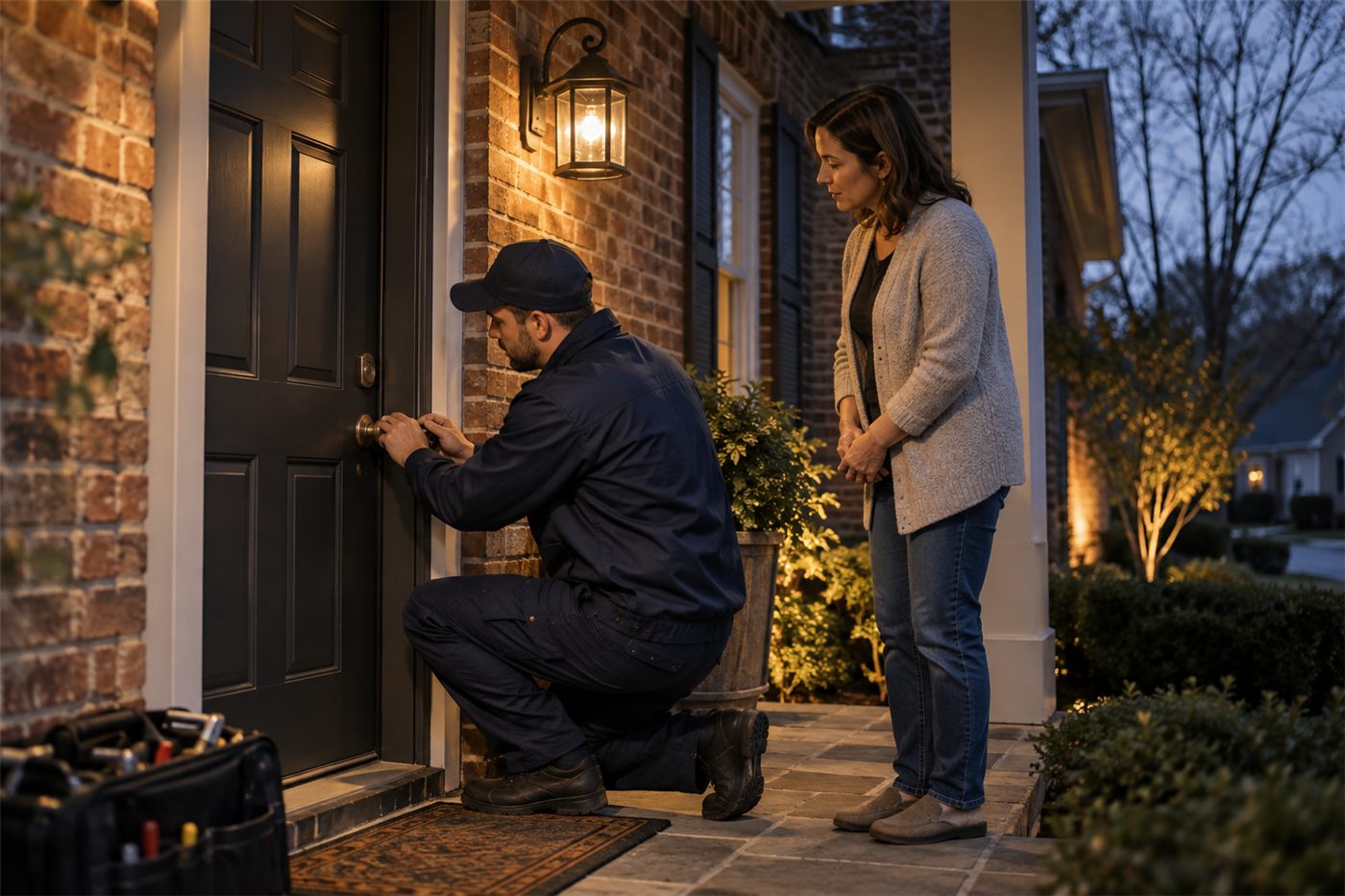
This is the part we are called for most often after a break in, at all hours. We secure the door that was attacked, check the others, and make sure the house can be locked properly tonight. The permanent repair can follow in daylight. Our emergency locksmith page explains how those calls work.
If you cannot make the house secure tonight, consider staying elsewhere. An obviously damaged door can attract a second visit.
Step four
Rekey, especially if keys were taken.
If any keys to the house are missing, rekey every lock those keys opened, tonight if possible. Thieves who take keys along with something showing your address, such as mail, a checkbook or an ID, have everything they need to come back when you are out.
Even when no keys are missing, rekeying after a break in is worth considering. You may not know whether a spare hidden outside was found and copied, whether a key was taken and later returned to the drawer, or whether someone who knows your household was involved. Rekeying removes those questions for a modest cost, and it can be done at the same visit that secures the door.
If car keys were taken, the car is at risk too. A thief with a working key and your address can find the car. Having the stolen key removed from the car's memory, and a replacement programmed, closes that off. Our car key programming page explains how lost keys are erased.
If office or business keys were on a stolen ring, tell your employer the same day. That may mean a commercial rekey at work too.
Entry points
How they got in, and what fixes it.
| Point of entry | What usually happened | The real fix |
|---|---|---|
| Front or back door kicked | The frame split around the strike | Frame repair, reinforced strike with long screws into the framing |
| Door pried open | A bar forced between door and frame | Strike reinforcement, door edge guard, better fit between door and frame |
| Door unlocked | A door left unlocked, often a side or garage entry | Habits, auto locking hardware, a keypad deadbolt that locks itself |
| Sliding glass door | Lifted off its track or latch forced | Anti lift blocks, a secondary lock, a bar in the track |
| Window | Unlatched window or broken glass near a latch | Window locks, laminated glass or film in vulnerable panes |
| Garage | Overhead door opened, then the house entry door | A deadbolt on the garage entry door, secure the overhead release |
| Key used | A hidden spare or a copied key | Rekey every lock, no hidden keys outside |
Step five
Repair the door properly.
Once the house is secure for the night, plan the permanent repair. If a door was kicked or pried, the damage is usually in the frame and sometimes in the door edge. A proper repair replaces or rebuilds the damaged section of frame, fits a heavy strike plate, and fastens it with long screws that reach through the jamb into the house framing behind it. That one change does more for a door's resistance to kicking than any upgrade to the lock itself.
If the door itself is split or the lock hole is torn out, a door edge reinforcement or a new door may be needed. Hollow core or thin doors used on exterior openings should be replaced with solid ones.
Check the hinge side too. Hinges fastened with short screws can be the weak point once the strike side is strong. Longer hinge screws are a quick improvement. Our door frame guide explains the whole door in more detail.
Finally, reconsider the lock. If the deadbolt was cheap, worn, or has a short bolt, this is a good time to replace it. Our deadbolt grade guide helps choose.
The first week
A checklist for the days after.
- Call your insurer. With the police report number, your photos and your list of missing items. Ask what they need and whether they want to inspect the damage before repairs.
- Call banks and card issuers if anything financial was taken. Cancel cards, stop checks, and ask about monitoring.
- Replace stolen identification. Photo ID cards, passports and any other identification.
- Change passwords if devices were taken. Laptops, tablets and phones may give access to email and accounts. Use remote lock or wipe features where available.
- Complete the permanent door and window repairs. Frame, strike, lock, glass.
- Walk the whole house for weak points. Not just the one they used. Side doors, basement doors, sliding doors, garage entries and ground floor windows.
- Talk to neighbors. Share what happened. Break ins in one house often mean other houses nearby were looked at too.
- Look after yourselves. It is normal to feel unsettled for a while. Children in particular may need reassurance and a clear explanation that the house is safe again.
Renters
If you rent your home.
The steps are the same. The phone calls are different.
If you rent, the first steps do not change: stay safe, report it, document it. After that, your landlord or property manager needs to know as soon as possible, ideally the same day. The door, frame and locks usually belong to them, and many leases say who arranges and pays for repairs after forced entry.
Call or message your landlord with the police report number and your photos. Ask how they want the door secured tonight. Some landlords have a locksmith they use and will arrange it. Others will ask you to arrange emergency securing and send them the invoice. If you cannot reach anyone and the door will not lock, getting it secured for the night is reasonable, but keep the landlord informed in writing and keep every receipt.
Ask for a rekey. If keys were taken, it is essential. Even if not, you may have no idea how many keys to your unit exist from earlier tenancies, and a break in is a fair moment to ask that question.
Your own belongings are usually covered by a renter's policy rather than the landlord's insurance. If you have one, call your insurer with the same documents. If you do not, this is often the moment people decide to get one.
Looking forward
Reducing the chance of a second time.
Homes that have been broken into are sometimes targeted again, because the thief knows the layout and what is inside and expects replaced items. That is a reason to take the improvements seriously, not a reason for alarm.
Make the house look occupied. Lights on timers, a car in the driveway, mail collected. Our vacation guide covers this in detail.
Light the entry points. Motion lights at side and back doors remove the dark corners most break ins use.
Remove hidden keys. A key under a mat or a fake rock is found quickly. A keypad deadbolt or a secure lockbox is a better answer for spare access.
Secure the sliding door. A bar in the track and anti lift blocks cost little. Our sliding door guide covers them.
Consider cameras and an alarm. Visible cameras and alarm signs deter some attempts, and recorded footage helps police.
Lock the doors you think of as inside. The door from the garage into the house deserves the same deadbolt as the front door.
Cost
What drives the cost of securing a house after a break in.
| Factor | Effect |
|---|---|
| Time of the call | Night and weekend emergency visits cost more than daytime appointments. Securing tonight and repairing in daylight often balances the two. |
| Extent of frame damage | A split strike area is a small repair. A shattered jamb or door is larger. |
| Number of locks to rekey | Each additional cylinder in the same visit adds modestly. |
| Lock replacement versus rekey | Damaged locks must be replaced. Sound ones can be rekeyed. |
| Car keys involved | Erasing a stolen car key and programming a replacement is a separate job. |
| Upgrades chosen | Reinforced strikes, door guards and better deadbolts add to the visit but prevent repeat damage. |
A note on insurance
Many homeowner and renter policies cover some or all of the cost of repairing forced entry damage and replacing locks after a theft, subject to the policy terms and deductible. Check with your insurer before large repairs, keep receipts, and ask whether they want to see the damage first.
Delaware specifics
What we see after break ins here.
Older homes in Wilmington, Elsmere and Newport. Wooden frames, sometimes softened by age, and strike plates held by short screws. Kicked doors are common, and the frame repair is usually the main job.
Suburban homes in Bear, Glasgow, Middletown and Pike Creek. Back doors and sliding patio doors facing wooded areas or fields, out of sight of the street. Sliding door security and back door frames are the usual focus.
Rentals near Newark and Dover. Tenants often find the lock was never rekeyed after the previous tenant. If you rent and have been broken into, tell your landlord straight away and ask for a rekey. Our landlord guide covers the owner side.
Rural Kent County. Detached garages, sheds and outbuildings are frequent targets, often for tools and equipment. Better padlocks, hasps and lighting help.
The short version, if you read nothing else
Stay out and call police. Photograph before cleaning. Make every door lock properly tonight. Rekey if keys may be out there. Then repair the frame with a reinforced strike, and fix the specific weakness they used.
Related
The neighbouring guides.
If keys were lost rather than stolen, see lost house keys. If you are choosing between rekeying and replacing the locks now, rekey or replace helps.
Where we do this
After break in calls across both counties.
Questions
After a break in.
Should I go inside to check what was taken?
No. Leave, call the police from somewhere safe, and wait for officers to check the house. Someone could still be inside or nearby.
Can you come tonight to secure the door?
Our phone is answered 24 hours across New Castle and Kent counties. Call, describe the damage, and we will tell you what we can do tonight and what should wait for daylight.
Do I need new locks or just a rekey?
If the lock was damaged, replace it. If it is sound, a rekey makes every old key useless, including any taken. Most forced entries damage the frame rather than the lock.
They kicked the door but the lock is fine. Why did it open?
Because the frame split around the strike plate. The fix is a frame repair and a reinforced strike with long screws into the framing behind the jamb.
My car keys were taken. What should I do?
Move the car somewhere secure if you can, and have the stolen key erased from the car's memory with a replacement programmed. Until then, the stolen key can unlock and start the car.
Will insurance pay for the locksmith?
Many policies cover forced entry damage and lock replacement after a theft, subject to terms and deductibles. Check with your insurer and keep receipts.
Should I clean up before the police arrive?
No. Leave everything as it is until police have finished, then photograph the scene before tidying.
How do I stop it happening again?
Fix the specific weakness they used, reinforce every exterior door frame, remove hidden keys, light the entry points, and make the house look occupied when you are away.