
The basics
What a commercial rekey covers
More door types, more keys, more people than a house.
Same idea, bigger scope
The principle of a commercial rekey is the same as at home: open each lock cylinder, replace the pins with a new combination, and issue new keys so that every old key stops working. What changes in a business is the variety of hardware, the number of people who hold keys, and the need to work around trading hours.
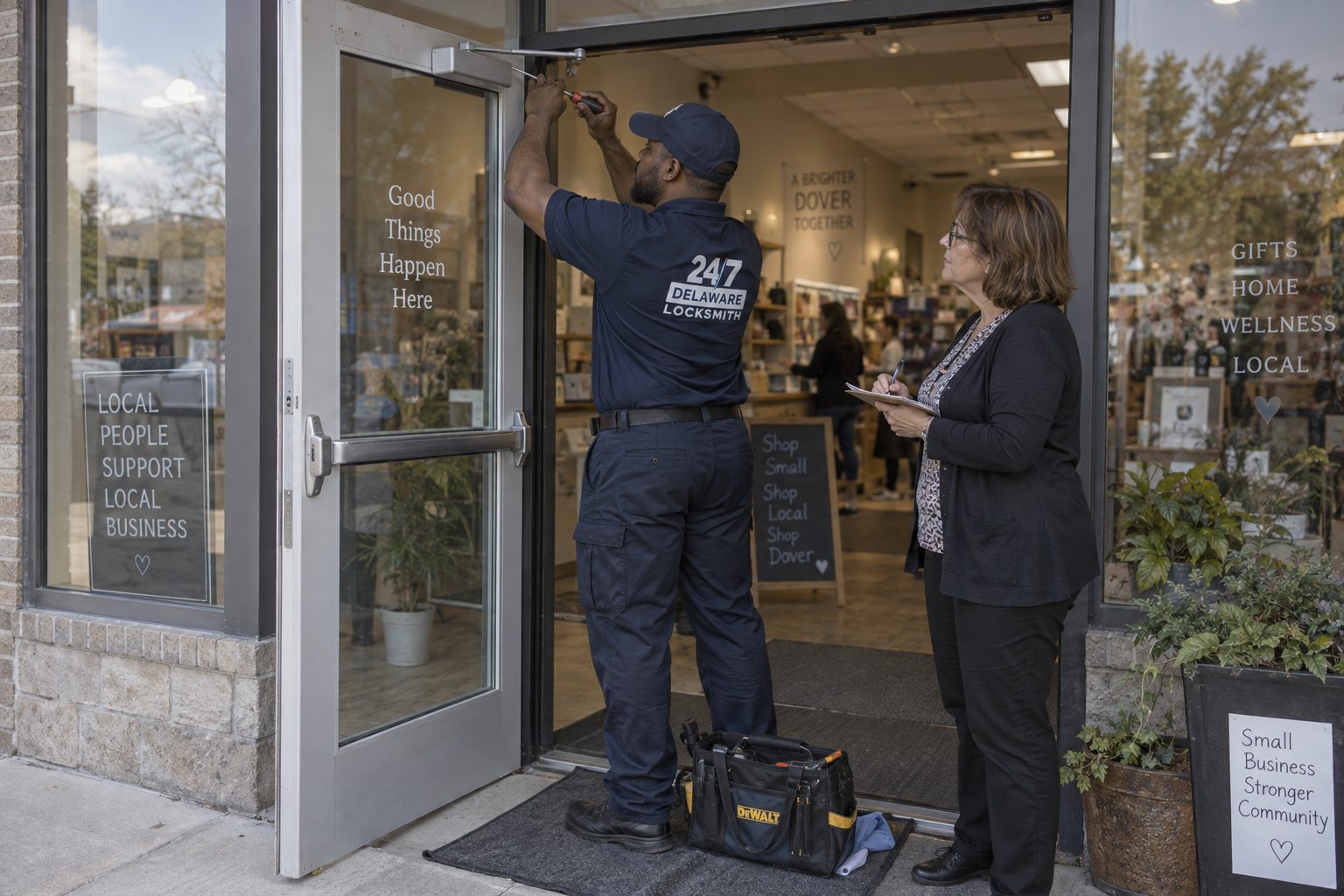
A typical small business might have an aluminum storefront door with a mortise cylinder, a rear steel door with a lever lock and deadbolt, an office door, a stock room, a cash office and perhaps an exit device on a fire door with a key override. Each of these uses a different cylinder type, and a proper rekey covers all of them in one visit so nobody is left carrying an old key that still opens something.
Larger properties add more: suites, restrooms, mechanical rooms, roof hatches, gates and key switches for alarms or elevators. The larger the property, the more important it is to start with a survey rather than a guess.
When to rekey
The moments a business should rekey
- An employee with keys leaves. Especially a manager, a keyholder who opened or closed, or anyone who left on poor terms. Returned keys do not account for copies.
- Keys are lost or stolen. A manager's keys taken from a car or a bag, particularly if they were with anything identifying the business, should trigger a rekey the same day.
- You take over a new lease. Previous tenants, their staff, their cleaners and the landlord's contractors may all hold keys to your new space. Rekey before you move stock or equipment in.
- You buy a business. Every key the previous owner issued comes with the premises. Rekey as part of the handover.
- A contractor project ends. Build outs and renovations spread keys among crews. Rekey once the last trade leaves.
- After a break in or internal theft. Rekey alongside any repairs, and consider whether the key arrangement itself needs to change.
- Nobody knows how many keys exist. If you cannot say who holds keys to your building, it is time to reset and start a key log.
Hardware
The cylinder types we rekey
Commercial doors use several different lock formats. Knowing what you have helps you understand the job, and helps us arrive with the right parts.
Mortise cylinders
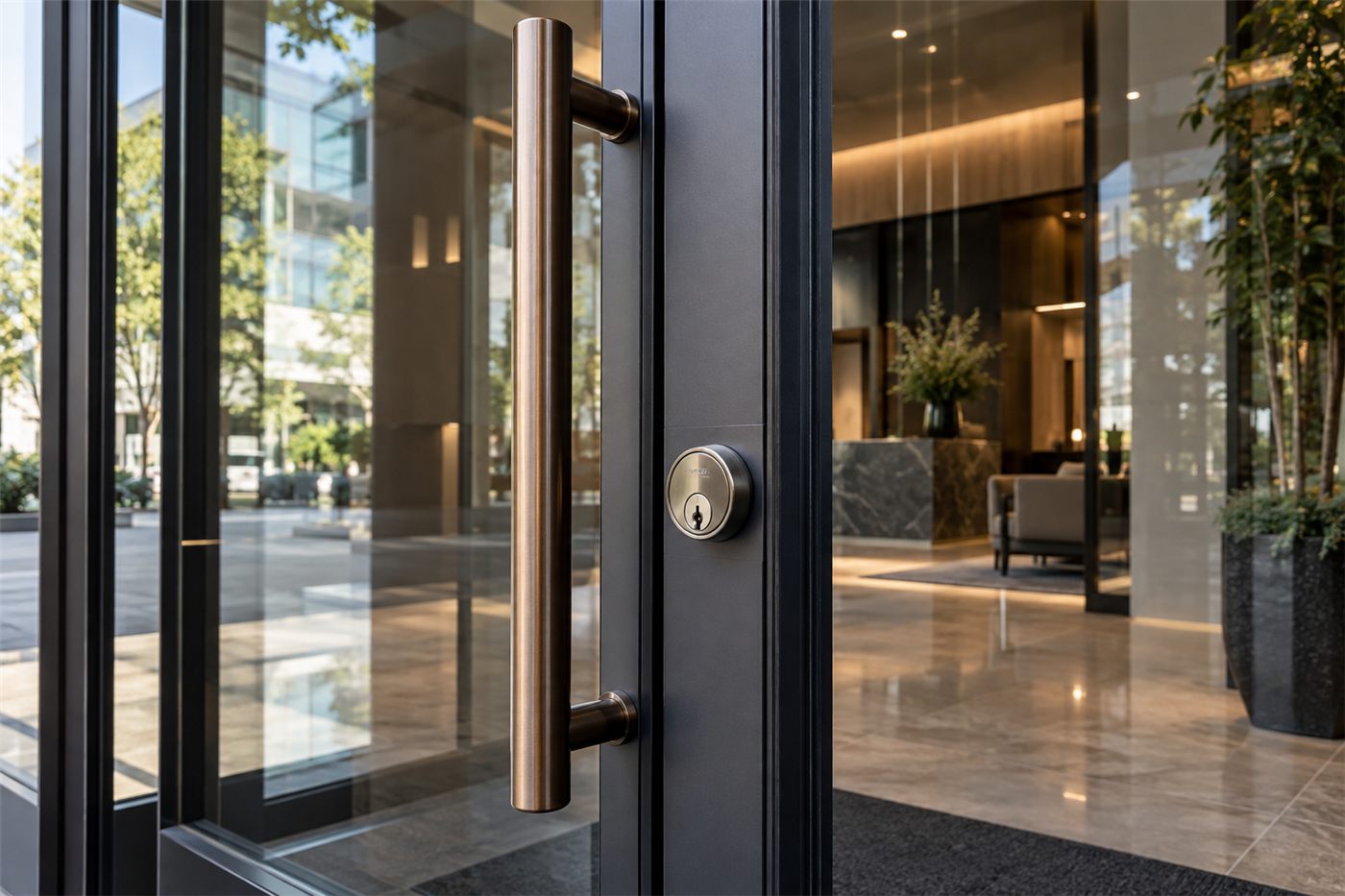
Threaded cylinders that screw into a mortise lock body or a storefront lock, held by a set screw. They are the standard on aluminum storefront doors and on many older commercial and institutional doors. Rekeying them is routine once the cylinder is removed.
Rim cylinders
Cylinders mounted on the outside of the door that operate a lock on the inside face, often used with exit devices and some older night latches. They are held from the inside by screws through a back plate.
Cylindrical lever and knob locks
The common bored lock on interior and many exterior commercial doors. The cylinder sits in the lever or knob. Rekeying involves removing the lever or knob to reach the cylinder.
Interchangeable cores
Some commercial hardware uses removable cores that can be taken out with a special control key and swapped in seconds. Rekeying these is often the fastest of all, since cores can be prepared in advance and exchanged at the door.
Key switches and specialty locks
Alarm key switches, elevator switches, cabinet locks, padlocks, gate locks and roll up door locks often get forgotten in a rekey. We ask about them so nothing is left on the old key.
Keeping the doors open
Working around your trading hours
A rekey should not close your business for a morning.
Most businesses cannot afford to have staff locked out of doors or customers blocked from entrances while locks are worked on. We plan commercial rekeys around your hours, which usually means one of three approaches.
Before opening. An early start so the building is rekeyed before staff arrive. New keys are ready for the manager who opens, and staff receive theirs as they come in.
After close. Work begins when the last customer leaves. This suits restaurants, bars and retail with late closing times, and it means the next day starts on new keys.
Door by door during the day. For offices and warehouses that can manage with one door out of service at a time, we work through the building while trading continues, keeping at least one entry on each route open.
Whichever approach you choose, the key handover is the critical moment. Decide in advance who receives new keys, how many each person gets, and who collects the old ones. We can prepare keys in labeled sets so distribution is quick.
An opportunity
Rekeying is the moment to fix the key arrangement
Many businesses grow their keys by accident. One key for the front, a different one for the back, another for the office, and a ring of twelve for the manager. Over time, keys are copied and handed around until nobody is sure which key does what.
A rekey is the ideal moment to reorganize. Because every cylinder is being opened anyway, it costs little more to set up a sensible arrangement while we are there.
- Key alike where the same people need the same doors. Front and back entrances, for example, can share one key so openers carry one key instead of three.
- Separate keys where access should differ. The cash office, the records room and the stock room may need their own keys, held only by the people responsible.
- A master key for owners and managers. A simple master key system gives managers one key to every door while staff keys open only what they need.
- Restricted keys for the doors that matter. A restricted keyway stops staff having copies cut at a kiosk, so the key count stays accurate.
- A written key log. Record every key issued, to whom and when. It turns the next staff change into a simple check.
Our master key systems and restricted keyway systems pages go deeper into both.
Tenants and landlords
Rekeying a leased space
Know whose locks they are before you change them.
In leased commercial space, the locks may belong to the landlord, the tenant, or a mix of both, and the lease usually says something about changing them. Many leases require the landlord's consent before locks are changed, and many landlords need a key to the space for emergencies, fire inspections or building systems.
Before booking a rekey in a leased space, check the lease and talk to the landlord or property manager. It is usually straightforward: the landlord approves the rekey and receives a key, or the space is rekeyed within the building's master key system so the landlord's master continues to work.
Common doors in a multi tenant building, such as shared entrances, corridors and restrooms, are almost always the landlord's responsibility. If you are concerned about who holds keys to those, raise it with the building owner, who may want to consider a restricted keyway or access control for the whole building.
If you are the landlord, rekeying between commercial tenants is just as important as it is for residential units, and often more so, since commercial tenants hand keys to staff, cleaners and vendors in larger numbers.
Condition check
What we look at while the locks are open
Every commercial rekey is also a chance to check the hardware. Locks in a business take far more use than locks at home, and small problems grow quickly.
We check that each lock latches and locks properly, that deadbolts throw fully, that the door closer brings the door to the latch without slamming or stopping short, and that exit devices release cleanly. We look for loose trim, worn cylinders, strikes that have shifted and doors that sag on their hinges. Where something needs attention, we tell you what we found and what fixing it involves. You decide what to do and when.
Some of the most common findings in Delaware businesses are storefront doors that no longer latch because the closer is out of adjustment, rear steel doors with a deadbolt that only half throws because the frame has moved, and exit devices that do not fully latch. None of these are rekey problems, but a rekeyed lock on a door that does not latch is not a secure door. Our door closer repair and storefront door locks pages explain those repairs.
Different businesses
What a rekey looks like by business type
Retail shops. Storefront mortise cylinders at the front, a steel rear door, a stock room and often an office with a safe. High staff turnover makes regular rekeying and restricted keys worthwhile. Work is usually done before opening or after close.
Restaurants and bars. Front and rear doors, walk in coolers with their own locks, liquor storage, the office and sometimes a dumpster enclosure. Late closing times suit after close work. Managers and closing staff often hold keys, so turnover is frequent.
Offices. Suite entrances, individual offices, file rooms and server closets. Keying arrangements matter more here, because different people need different access. Daytime work door by door is common.
Warehouses and industrial units. Personnel doors, roll up doors, gates, padlocks and sometimes yards. Large numbers of padlocks can be rekeyed or replaced to match the system so drivers and staff carry fewer keys.
Medical and dental practices. Entrances, treatment areas, records rooms and medication storage. Tighter control over records and medication areas is often a priority.
Churches and nonprofits. Many keyholders, many volunteers, and often decades of keys handed out. A reset with a key log is frequently the most valuable part of the job.
Urgent rekeys
When it cannot wait until the weekend
Some rekeys are planned. Some are not.
Most commercial rekeys are booked a few days ahead and fitted around the business. A few are urgent. A manager's keys are stolen from a car overnight along with a company badge. An employee is dismissed after a theft and did not return keys. A cash office key goes missing between shifts. In those situations, every night the old keys still work is a night the business is exposed.
Our phone is answered 24 hours, and urgent commercial rekeys are one of the reasons. When you call, we will ask which doors the missing keys open and prioritize those, so the most important locks change first. If the full building cannot be done at once, we secure the exposed doors immediately and return to complete the rest on a planned visit.
After an urgent rekey is a good time to look at what made it urgent. If one set of keys opened everything, a master key arrangement that limits what each key opens would have reduced the exposure. If keys were labeled with the business name and address, removing those labels is an easy change that costs nothing.
After the rekey
A short key policy that actually gets followed
A rekey resets the building. A simple written policy keeps it reset. It does not need to be long, and it works best when it fits on one page that managers actually read.
- Who approves new keys. Name the person or people who can authorize a key, and make clear that nobody else can.
- How keys are recorded. Every key issued goes in the log with a date and a signature from the person receiving it.
- What happens at departure. Keys are collected on the last day, checked against the log, and any missing key is reported that day.
- What happens when a key is lost. The holder reports it immediately, and the owner decides whether a rekey is needed based on what that key opens.
- No copies without approval. Staff may not have keys copied. With a restricted keyway, they cannot.
- No labels with the address. Keys are tagged with a code from the log, never with the business name or address.
A policy like this, combined with a sensible key arrangement, means the next rekey is a planned decision rather than a reaction.
Scenarios
Commercial rekey situations compared
| Situation | Usual approach |
|---|---|
| Manager left with keys | Rekey every door that manager could open, same day where possible |
| New lease on a previously occupied unit | Rekey with landlord consent before moving in |
| Twelve keys on the manager ring | Rekey into a simple master key arrangement |
| Staff keep having copies made | Rekey onto a restricted keyway with a key log |
| Business purchased from previous owner | Full rekey as part of handover |
| Rekeyed lock on a door that does not latch | Adjust closer or strike during the same visit |
| Many padlocks on gates and containers | Rekey or replace to match the system |
Avoid these
Mistakes businesses make with rekeying
- Rekeying only the front door. Rear doors, office doors and padlocks carry the same risk. Every lock the old keys opened needs to change.
- Handing new keys to everyone who had old ones. A rekey is a chance to reduce the number of keyholders. Issue new keys only to people who genuinely need them.
- No record of who got what. Without a key log, the next staff change starts the same guessing game.
- Forgetting the landlord. Changing locks in leased space without consent can breach the lease and leave the landlord without emergency access.
- Waiting for a convenient time. When a keyholder leaves on bad terms or keys are stolen, the convenient time is today.
- Ignoring the doors themselves. A lock that is rekeyed on a door that does not latch reliably is not solving the problem.
Local factors
Commercial rekeys across New Castle and Kent County
In New Castle County, commercial rekeys come from shopping centers along Route 202, Kirkwood Highway and Route 40, from offices in Wilmington and along the riverfront, from restaurants in Newark and Wilmington, from warehouses and distribution sites near New Castle and the airport, and from medical offices around Christiana. Lease turnover in strip centers produces a steady stream of rekeys for incoming tenants.
In Kent County, we see retail and restaurants along Route 13 in Dover, Camden and Smyrna, state and county offices, farm and agricultural businesses, and small industrial units around Dover and Milford. Many are family businesses with keys that have been handed around for years, and a reset with a proper key arrangement is often the most useful thing we do.
Wherever the business, the goal is the same: every old key dead, new keys in the right hands, and a record that makes the next change easy.
Questions
Frequently asked
Can you rekey our business without closing?
Yes. We work before opening, after close, or door by door during the day, depending on what suits your business.
Do we need new locks, or can the existing ones be rekeyed?
Most commercial locks can be rekeyed. Replacement is only needed when the hardware is worn, damaged or unsuitable for the door.
Can you rekey storefront doors?
Yes. Storefront doors usually use mortise cylinders, which are routine to rekey once removed.
Can all our doors work on one key?
Yes, where the cylinders allow. We can key doors alike, or set up a master key system so managers carry one key and staff carry less.
Do we need the landlord's permission?
Check your lease. Many commercial leases require consent and a key for the landlord. It is usually straightforward to arrange.
What about padlocks and key switches?
Tell us about them. Padlocks, alarm key switches and gate locks can often be rekeyed or replaced to match the new system.
How do we stop staff copying the new keys?
A restricted keyway system limits key cutting to authorized requests, and a key log shows who holds each key.
Will you check the doors while you are there?
Yes. We check latching, closers and deadbolts and tell you what we find. You decide what to fix and when.
Need your business rekeyed?
Tell us the doors and your hours. We will plan the rekey so your business keeps running.