

The first minute matters more than anything after it
Stop turning, stop pushing, and do not put anything else into the keyway yet. That is the whole of the emergency advice, and it is the part people skip. When a key breaks, the fragment is usually sitting loose in the plug with its cuts still resting against the pins. Left alone, it can often be drawn straight back out. Pushed further in, it wedges against the back of the plug or tilts sideways, and a five minute job becomes a much longer one.
Take a breath and look at what you have in your hand. The piece you are holding tells you a lot. If the break is right at the shoulder, where the blade meets the bow, most of the blade is in the lock and there may be a sliver of metal visible at the face of the cylinder. If the break happened partway down the blade, the fragment is shorter and deeper, and you probably cannot see it at all. Keep the broken half. It is useful later, both to confirm the key cuts and to show whether the break was clean or the metal had been cracking for a while.
Next, notice the position of the plug. Did the key snap while the lock was in the normal upright position, the one where a key goes in and comes out? Or did it snap partway through a turn? That one detail changes everything about how the fragment comes out, and it is the first question a locksmith will ask you on the phone. A key that broke in the neutral position is usually straightforward. A key that broke with the plug rotated is holding the pins in a split state, and the plug has to be brought back to neutral before the piece will release.
If the door is secure and you are on the inside, there is no urgency beyond convenience. If you are outside, the door is locked, and the only key is now in two pieces, it is a lockout, and the sensible path is to call rather than improvise. Either way, the calmer you are about the first minute, the cheaper the next hour tends to be.
Why keys break
It was not bad luck. It was usually years coming.
Keys almost never snap on the first bad day. They fail at the end of a long run of small warnings.
A house key is a thin strip of brass or nickel silver that spends its whole life being twisted. Every time you turn a stiff lock, the blade flexes a little at its narrowest point, which is usually the deepest cut nearest the shoulder. Brass does not bend back and forth forever. Tiny cracks form, grow a little with each hard turn, and one morning the key parts in the lock with a small click. The break looks sudden. It was not.
The most common cause we see is a lock that has been getting harder to turn for months, and a household that has been compensating by turning harder. A lock that needs force is telling you something is wrong: a dry cylinder, a bolt dragging against a strike that has shifted as the house settled, a deadbolt that only throws if you push the door with your hip. The key becomes the weakest part of that system and it is the part that gives up first.
Copies cut from copies are the second cause. Each generation of duplication loses a little accuracy, and a key that does not quite lift the pins to the shear line has to be jiggled and forced. That jiggling is exactly the flexing that fatigues metal. A household where every family member carries a copy of a copy of the original is more likely to end up with a snapped blade in the front door.
Third is using a key as a lever. Pulling the door closed by the key, carrying heavy bags hung from a key ring, a car key with a heavy fob swinging from it on a bumpy road, all of it adds stress in directions the blade was never designed for. Cold matters as well. Winter mornings in Kent County can make a lock stiff at exactly the moment you are in a hurry, and a cold brass blade under hard torque is a bad combination.
Understanding the cause matters because extraction only fixes the symptom. If the lock was stiff enough to snap a key, pulling the fragment out and handing you a new key leaves the stiffness in place, and the new key starts its own slow march toward breaking.
Do and do not
What helps and what makes it worse.
| The idea | Verdict | Why |
|---|---|---|
| Pull the fragment out with tweezers | Only if a good length is sticking out | If you can grip a clear edge without pushing, a straight steady pull can work. If you have to press in to grip it, stop. |
| Superglue on the broken half, press it to the fragment | Do not | Glue runs into the keyway, bonds the pins and the plug, and turns a simple extraction into a cylinder replacement. |
| Spray lubricant into the lock first | A light dry lubricant can help | Graphite or a dry PTFE spray can ease a fragment that is binding. Heavy oil collects grit and is best avoided. |
| A hairpin, paperclip or small screwdriver | Do not | These push more often than they pull, and they bend pins or leave a second broken piece in the keyway. |
| Try the spare key on top of the fragment | Never | It drives the broken piece deeper and can jam the plug in a turned position. |
| Take the lock off the door yourself | Only if you are comfortable and the door is open | Removing the cylinder lets a locksmith push the piece out from behind, but a deadbolt taken apart on a closed door can leave you worse off. |
| Call and describe it | Yes | Tell us where it broke, whether the plug was turned, and whether the door is open. That decides what gets brought. |
How extraction works
What actually happens at the door.
It is less dramatic than people expect, and it should not involve a drill in most cases.
A key extractor is a very thin strip of hardened steel with small hooks or barbs along one edge. It slides into the keyway alongside the broken blade, on the side where the key cuts are, hooks into one of those cuts, and draws the fragment out. A locksmith will usually use two, one on each side, to keep the piece straight as it comes. The whole thing happens without forcing anything, because the goal is to move the fragment the way the key was designed to move, straight back along the keyway.
Before any of that, the plug has to be in its neutral position. If the key broke while turned, the technician uses a tension tool or a flat pick to bring the plug gently back to vertical. Only then do the pins drop into their resting positions and release their grip on the blade.
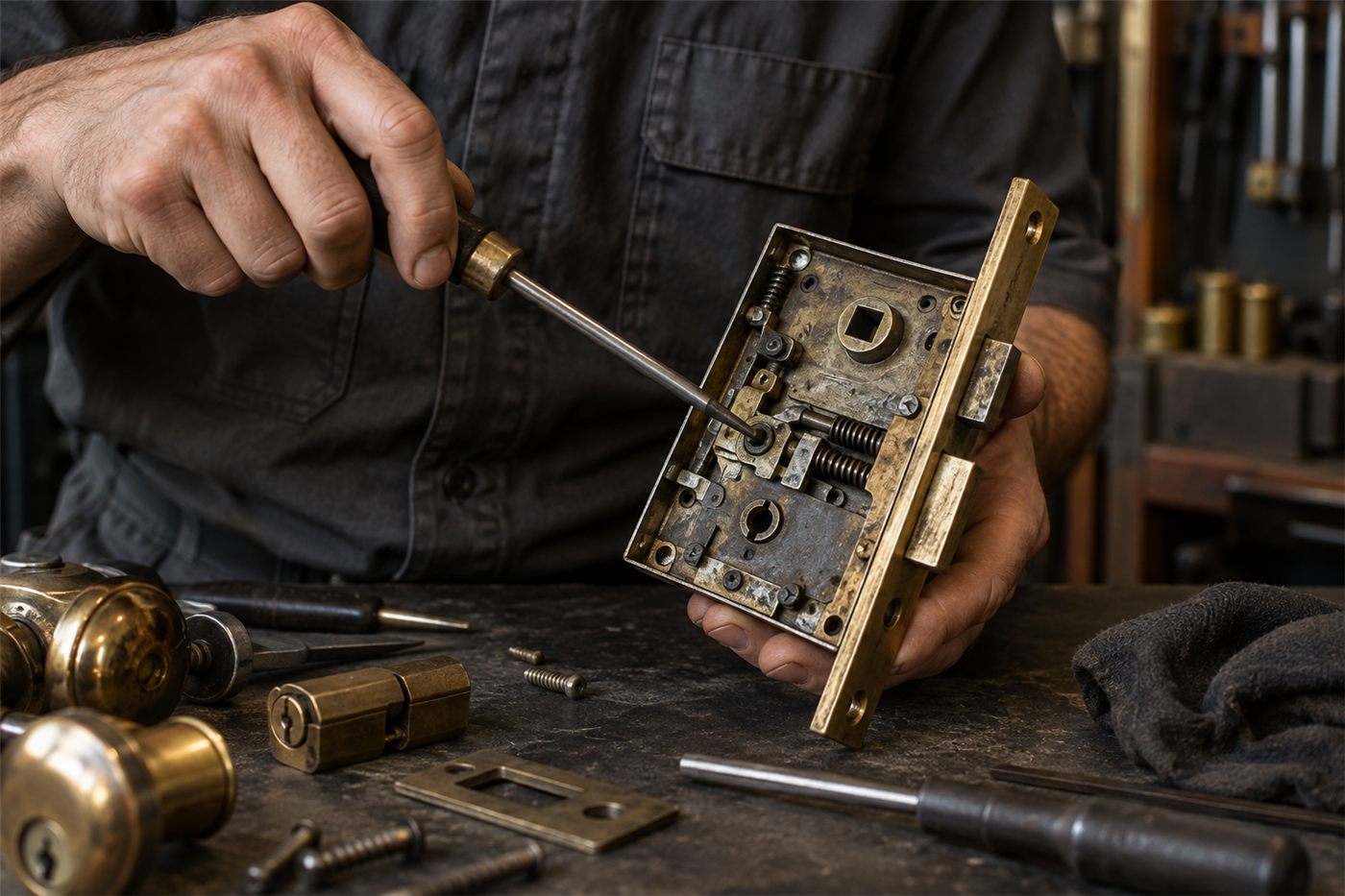
Sometimes the fragment is wedged hard. It might have been pushed in by a well-meaning attempt, or the break might have left a burr that catches on the keyway walls. In those cases a little dry lubricant, patience and a different extractor profile usually does it. On occasion the cylinder has to come off the door so the piece can be pushed out from the back with a follower. That is still a non-destructive job, and the cylinder goes back in afterward.
Drilling is the last resort and should be rare. It destroys the cylinder, so the lock has to be replaced or at least re-cored. If somebody arrives and proposes drilling a lock with a simple broken key and no glue involved, it is fair to ask why extraction will not work first. There are good reasons sometimes, and a good technician will be able to tell you exactly what they are.
Once the fragment is out, the job is not quite done. The technician should check that every pin is moving freely, that the plug turns smoothly with a correctly cut key, and that whatever caused the break has been dealt with. Handing you a fresh key and leaving is the incomplete version of the job.
Afterward
What to decide once the fragment is out.
| What we find | Usual next step |
|---|---|
| Clean break, lock turns smoothly after extraction | Cut a new key to the lock's code rather than copying the broken one, and you are done. |
| Lock is stiff even with a good key | Clean and lubricate the cylinder, and check the bolt against the strike before cutting anything. |
| Deadbolt only throws when the door is pushed | Adjust or move the strike. This is the most common hidden cause of snapped keys. |
| Pins damaged by an earlier attempt | Repin or rekey the cylinder so it works reliably again. |
| Glue in the keyway | Usually the cylinder has to be replaced, since glued pins rarely free up properly. |
| Old, worn hardware at end of life | Replacement is the honest answer, and a good moment to consider a better grade. |
| Unsure who else has copies anyway | A rekey while the lock is already open is simple to add. |
Cut from the lock, not from the pieces
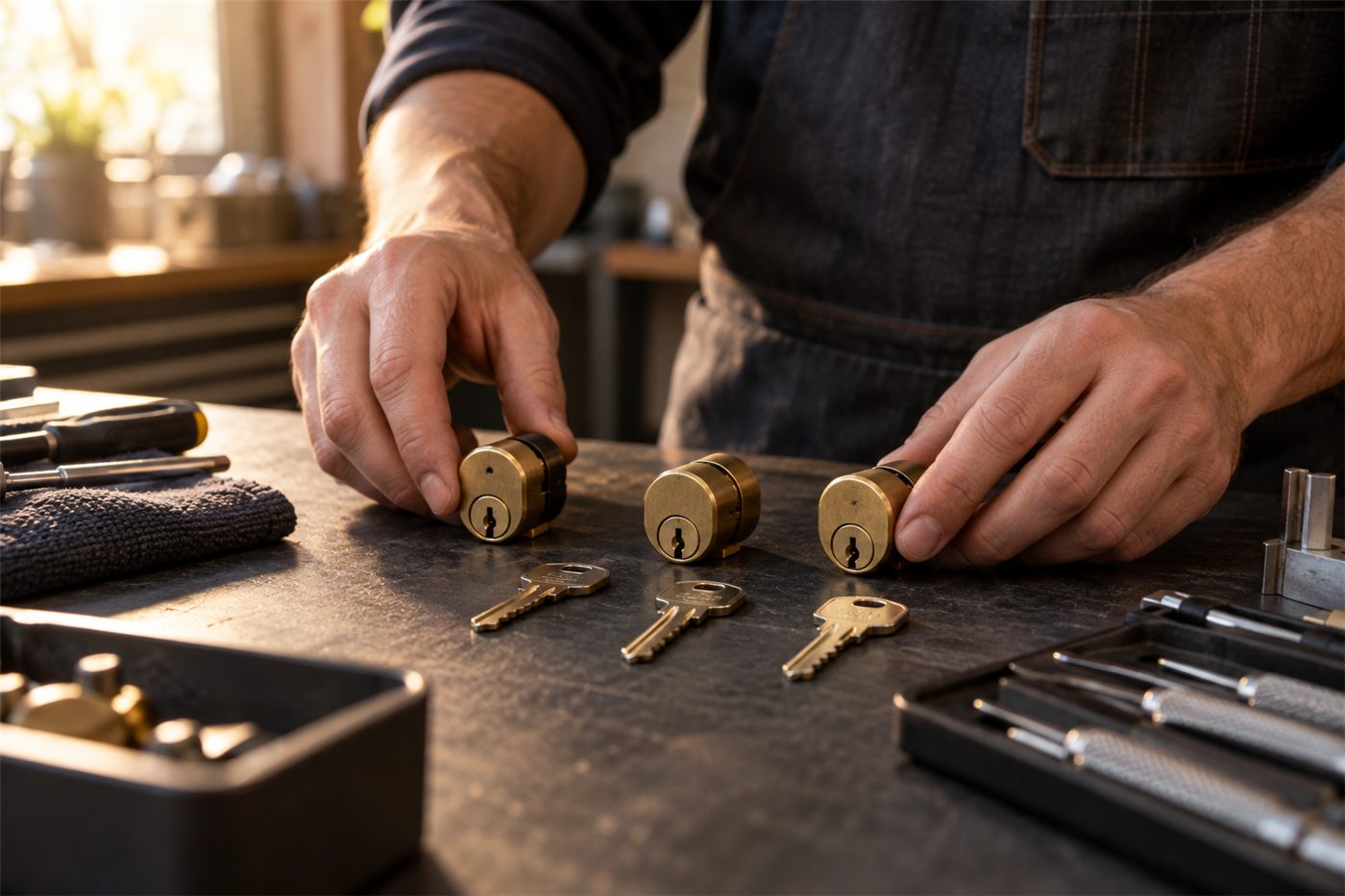
It is tempting to tape the two halves together and ask a hardware counter to copy it. The copy will reproduce every bit of wear on the old blade, plus whatever error the tape adds. A key cut to the original code, or decoded from the lock itself, is a better key than the one that broke.
This is also the moment to stop the copy of a copy cycle in your household. One well cut key becomes the master you copy from, and the old worn copies go in the bin.
In the car
When the key breaks in a door, trunk or ignition.
Car keys break in the same way house keys do, and for similar reasons, but the stakes are a little different. A fragment in a door lock is an inconvenience. A fragment in the ignition is a car you cannot start, and possibly a steering wheel locked in place.
Door or trunk lock. Most modern vehicles can be opened with the remote, so a key broken in the door lock is often not urgent. The fragment can be extracted at your convenience, and the lock is usually fine. If the remote battery is dead or the car is older and has no remote, it becomes a car lockout with the extra step of extraction.
Ignition. Ignition cylinders use wafers rather than pins, and they sit behind a shroud that makes access harder. A key that snapped in the ignition while turned to the run position can leave the car in an odd electrical state, so turn off anything you can and keep the battery from draining. Do not try to start the car with the broken half, and do not push a screwdriver in to turn the wafers. Ignition extraction is a precise job, and a damaged ignition cylinder is a far bigger repair than a clean extraction.
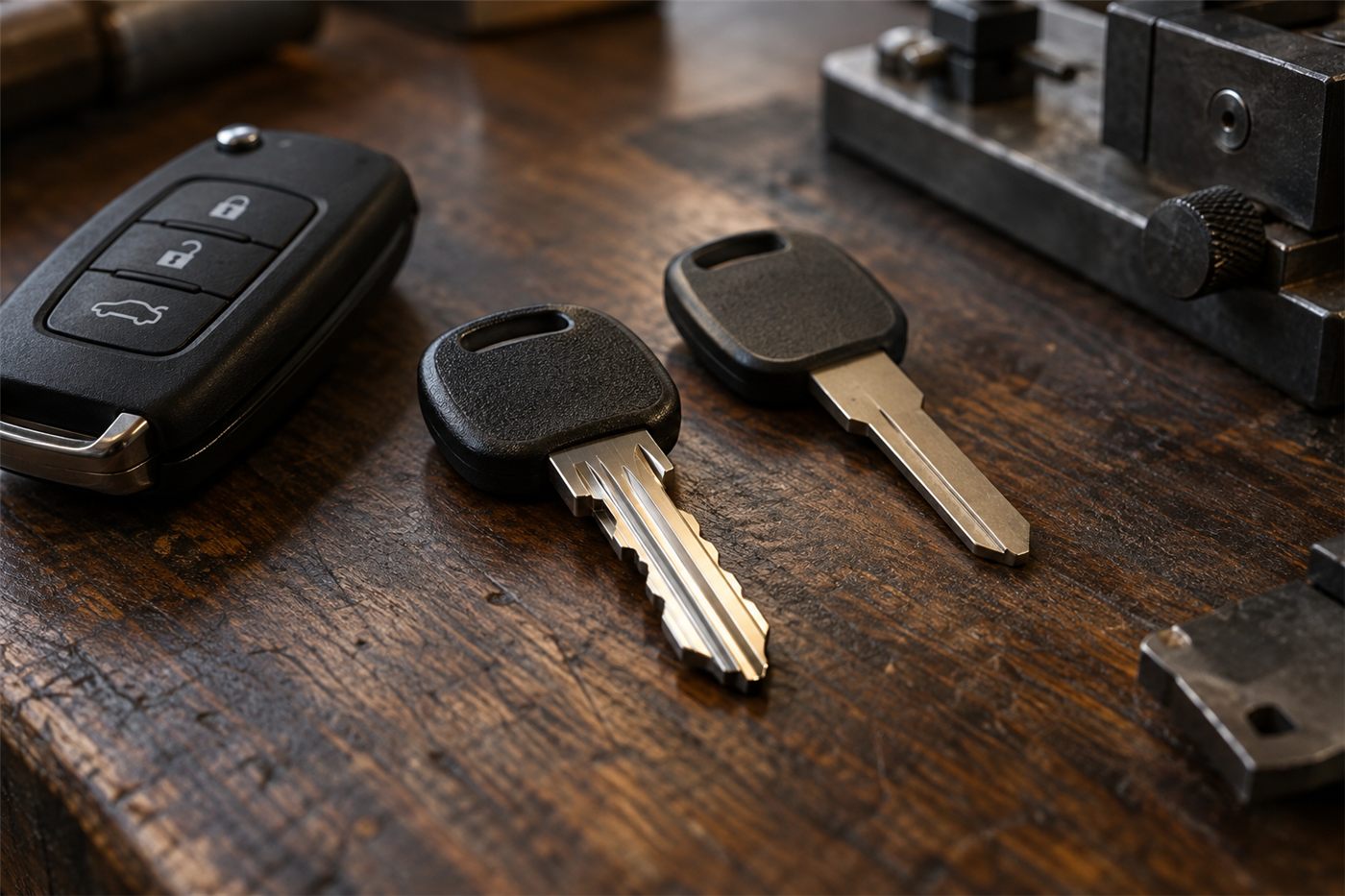
The key itself. Many modern keys are not just metal. A transponder key has a chip in the head that the car must recognize, and a remote head key or a flip key has electronics as well. If the blade snapped but the head is intact, sometimes the head can be reused with a new blade. If the head was damaged, the replacement has to be programmed to the vehicle. Our car key replacement page covers how that works, and the transponder key guide explains why a plain copy will not start most cars built in the last couple of decades.
A broken car key is also a strong hint that you need a spare. If that snapped key was your only one, you were one bad moment away from an all keys lost situation, which is the slowest and most involved version of car key work.
Warning signs
How to tell a key is about to break.
- Look along the blade in good light. A faint line or a slight bend near the shoulder or near the deepest cut is fatigue. That key should be retired today.
- Feel for a twist. Lay the key flat on a table. If it rocks, the blade has already been bent and straightened, and it has lost strength.
- Notice when you use force. If you have started turning the key with two fingers and a wrist, the lock needs attention before the key does.
- Check your copies against the original. If the original works smoothly and the copies do not, the copies are the problem, and they will be the ones that break.
- Watch the deadbolt with the door open. If it throws easily with the door open and fights you with the door closed, the strike is misaligned. That is a door problem, and it will keep breaking keys until it is fixed.
- Listen for grit. A crunchy feel as the key goes in means dirt in the keyway. Dry lubricant and a cleaning usually fix it.
- Replace keys that are simply old. Keys worn smooth after a decade of daily use have little metal left at the cuts. A fresh key cut to the code is inexpensive insurance.
Delaware doors that eat keys
Certain kinds of doors in our area break keys more than others, and it is worth knowing if yours is one of them.
Older row homes and twins in Wilmington and Elsmere often have heavy mortise locks set into thick wooden doors. The mechanisms themselves are sturdy, but over decades the doors swell and shrink with the seasons, the bolt starts to drag, and residents turn harder and harder until the key gives up. A clean and an adjustment to the strike usually make these locks feel new again.
Newer builds in Middletown, Townsend and around Smyrna tend to have builder-grade locksets that were fitted quickly. When the house settles over its first couple of years, the deadbolt and strike drift out of line. A lock that worked perfectly at closing may bind a year later. Owners rarely connect the two, and a snapped key is often the first sign anyone notices.
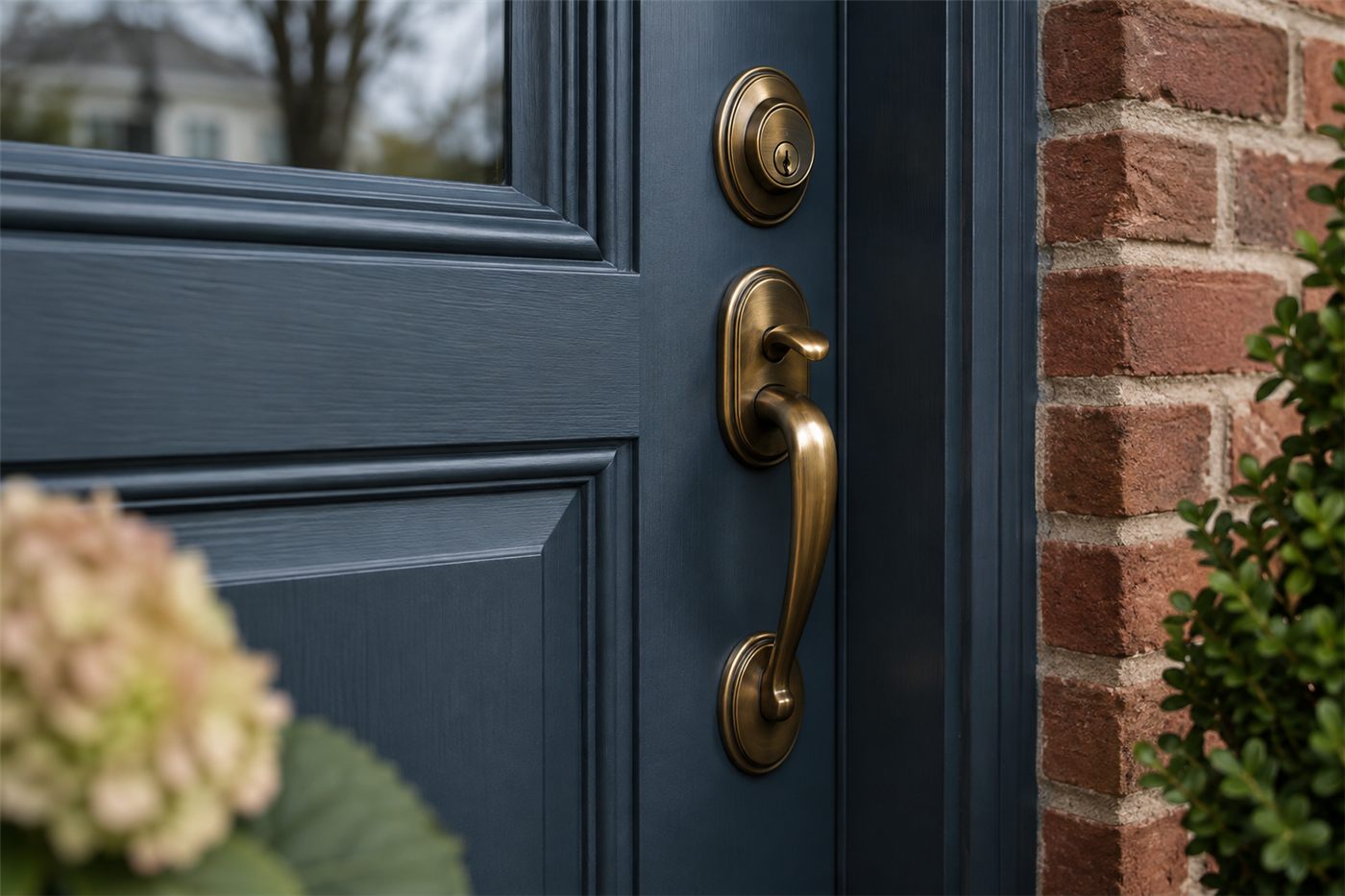
Coastal humidity and winter cold both play a role across Kent County. Damp air lets a thin film of corrosion build inside neglected cylinders, and cold thickens any grease that was put in them. The fix is not heavier oil. It is a proper clean and a dry lubricant that does not gum up.
Rental and multi-unit buildings see more broken keys than single homes, partly because of copied keys and partly because common entry doors see heavy traffic. If you manage a building where tenants keep breaking keys in the front entry, that is a hardware and alignment issue worth having looked at, not a string of unlucky tenants.
Whatever kind of door you have, the lesson is the same. A lock that turns easily does not break keys. A lock that fights you eventually will.
Related
If this is part of a bigger problem.
If the key would not turn before it broke, the key will not turn guide covers the causes. If a stiff lock is a recurring nuisance, the lock maintenance schedule is worth ten minutes of your time.
 Most requested
Broken Key Extraction
Fragment out cleanly, lock checked, new key cut to the lock.
 Repair
Lock Repair
Stiff, gritty or misaligned locks put right before they break another key.
KeysKey Duplication
Accurate keys cut from a good original or from the lock code.
 Security
Lock Rekeying
Worth adding while the cylinder is already open.
 Vehicle
Ignition Repair
When the key broke in the ignition or the cylinder is worn.
LockoutHouse Lockout
When the broken key was the only way in.
Where we do this
Broken key extraction across both counties.
Questions
About broken keys.
Can I still use the lock after the key is extracted?
Usually yes. In most cases the fragment comes out cleanly and the pins are undamaged, so the lock works exactly as before with a correctly cut key. The exceptions are locks where glue was used, where a screwdriver or pin bent something inside, or where the cylinder was already worn out. Those need repair or replacement, and you should be told which applies before any work is done.
Will extracting the key damage my lock?
A proper extraction should not. The tools are designed to draw the fragment out along the keyway the way a key normally moves. Damage tends to come from earlier attempts with household tools, or from a drill used when extraction would have worked. If drilling is proposed, it is reasonable to ask why before agreeing.
Should I try superglue on the broken end?
No. It is the most common piece of advice online and one of the most expensive to follow. Glue flows into the keyway, sets around the pins and the plug, and can make the whole cylinder unusable. A broken key is normally a quick extraction. A glued key is often a replacement.
The key broke while the lock was turned. Is that worse?
It is a little more involved but still routine. The plug has to be brought back to its neutral position before the fragment will release, which takes a tension tool and some care. Tell us on the phone which position it was in, because it changes the approach.
Can you make a new key from the broken pieces?
Often, but it is better to cut the new key from the lock or its code where possible. The broken key carries all its accumulated wear, so a copy reproduces the problem. A key decoded from the lock matches the pins as they were meant to be matched.
My car key broke in the ignition. Can I drive once it is out?
If the ignition is undamaged and you have a working key, yes. If your only key is the broken one, the car will need a new key, and on most modern vehicles that key has to be programmed to the car. Leave the ignition alone until it can be looked at, since forcing it can damage the cylinder.
Why did my key break when it was not even old?
Age matters less than stress. A newer key used in a stiff or misaligned lock can fatigue quickly, and a poorly cut copy that needs jiggling flexes more than a good one. The lock or the door alignment is usually the real cause, which is why it is worth checking after the extraction.
Is a broken key an emergency?
It is if you are locked out, if the door is stuck unlocked and you cannot secure the house, or if it is a car you need right now. If you are inside and the door is closed and secure, it can usually wait for a convenient time, which is often less expensive than a late night call.