

Why so many people have only one key
New cars are usually sold with two keys. Somewhere along the way, one of them tends to go. It was left in a jacket that went to the charity bin, handed to a teenager who lost it at a game, dropped in a parking lot, or kept by the previous owner of a used car. Many used vehicles on Delaware roads change hands with a single key, and the new owner often does not notice until the day it matters.
A single key works perfectly well, right up until it does not. The day it is lost, stolen, locked in the car, dropped in the Brandywine or cracked beyond repair, the owner discovers that a car without a key is a very expensive object that cannot move. And the process of getting a new key from nothing is a different job from getting a second key while the first one still works.
That is the whole argument of this guide. A spare made now is quicker, simpler and nearly always less disruptive than a replacement made in an emergency. We are not saying that to sell spare keys. We are saying it because we see both kinds of call, and the all keys lost ones are the ones where people wish they had called us sooner.
The difference
Adding a key versus replacing the last one.
Same car, same technician, very different job.
When you still have a working key, the new key can often be cut by copying the existing blade, and the car can be told to accept an extra key while it already recognizes one. On many vehicles, adding a key is quick and straightforward. You drive the car to wherever is convenient, or the technician comes to your driveway, and in a short visit you have two working keys.
When every key is gone, the job gets longer. The blade has to be cut without a pattern, either from the vehicle's key code, if it can be obtained, or by decoding a lock on the car. On some vehicles, gaining access to program a key without a working key involves extra steps, and on some models it can mean resetting the car's key memory and programming every key from scratch. If you are somewhere inconvenient, add the stress of being stranded. If the car must go to a dealer, add a tow.
The all keys lost page explains that process in full. It is entirely solvable, and we do it regularly. But nobody who has been through it wants to do it twice, and the simplest way to avoid it is to have a second key before you need one.
Who needs one most
If any of these sound familiar, now is the time.
| Situation | Why a spare matters |
|---|---|
| You bought a used car with one key | Very common. You have no backup, and the previous owner may still have a key you do not know about. |
| A teenager is starting to drive | New drivers lose keys. A second key means the family car is not stranded by one lost set. |
| Two drivers share one car | Handing a single key back and forth is how keys get left in the wrong bag or the wrong house. |
| You live far from a dealer | In rural Kent County, an all keys lost situation can mean a long tow. |
| Your key is worn or cracked | A key that is failing is a lost key waiting to happen. Get a new one while the old one still works. |
| You drive for work | A car without a key is lost income. A spare in the office or at home keeps you moving. |
| You travel with the car | Losing the only key on a trip is far harder to fix than losing it at home. |
| You have a smart key or push button start | These are the most involved to replace from nothing. A spare fob is especially worth having. |
Key types
What kind of spare to get.
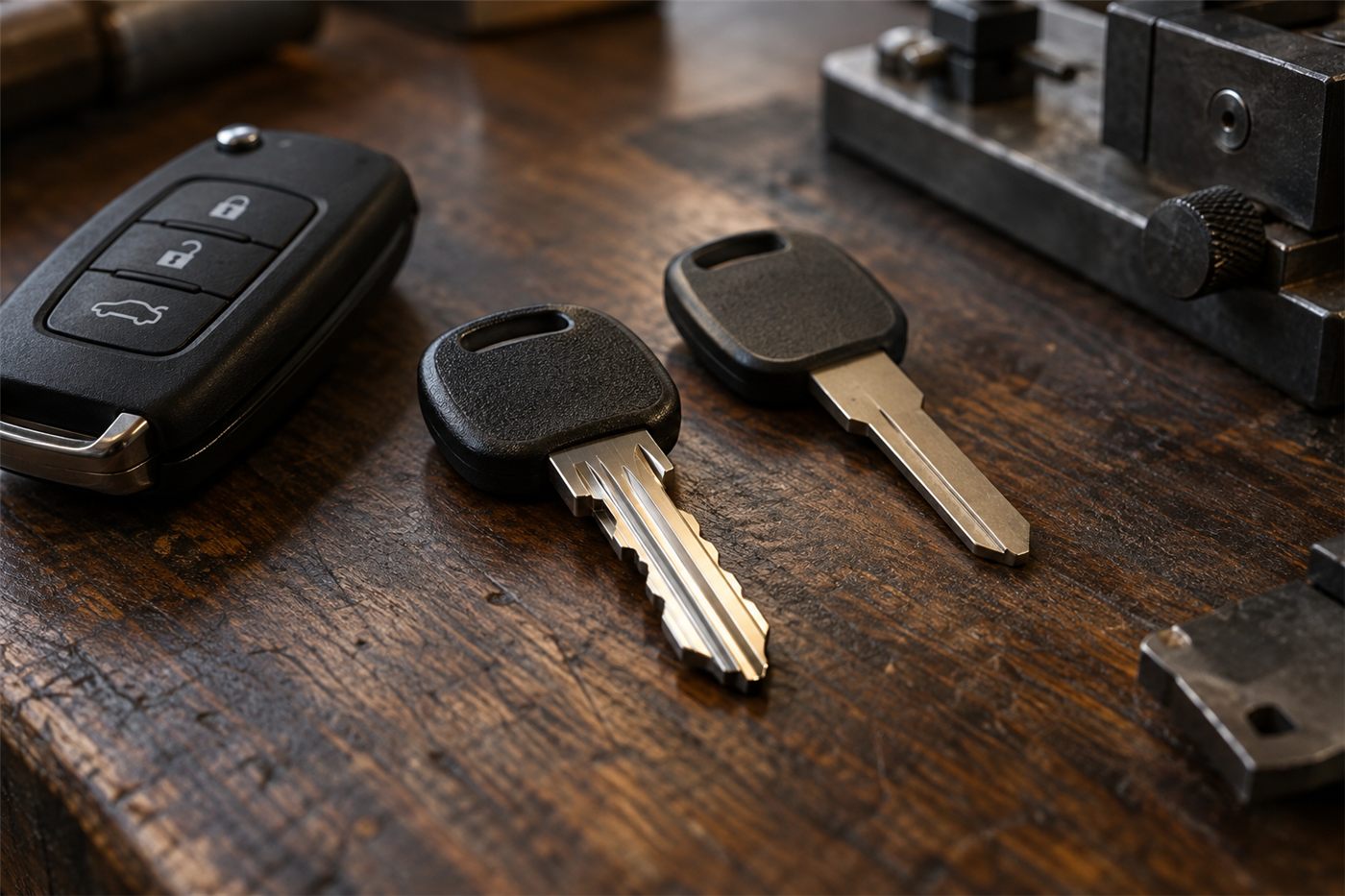
What your spare should be depends on what kind of key your car uses. Across the vehicles we see in New Castle and Kent counties, there are four broad types, and many models have used more than one across their production years.
A plain mechanical key. Older vehicles, generally before transponder systems became common, use a key that is only metal. A spare is just a well cut copy. If your car is this old, a spare is simple and there is no reason not to have one.
A transponder key. The key looks like a plain key with a thicker plastic head, but inside the head is a small chip the car must recognize before the engine will run. A spare needs to be cut and its chip programmed to the car. A copy cut at a hardware counter without programming will open the doors but will not start the engine. The transponder key guide explains why.
A remote head key or flip key. The blade and the remote buttons are combined in one unit. The spare needs cutting, chip programming and remote programming. Some owners choose a simpler spare, a transponder key without remote buttons, which starts the car but does not lock and unlock remotely. That is a legitimate, often less expensive choice for a spare that lives in a drawer.
A smart key or proximity fob. Used with push button start. The car detects the fob nearby. A spare must be programmed to the car, and usually includes a small emergency blade hidden inside for the door. Smart fobs are the type where having a spare makes the biggest difference, because replacing the last one from nothing is the most involved job. See key fob replacement for more.
Where it lives
A spare in the car is not a spare.
A surprising number of people have a spare key and keep it in the car. In the glove box, in the console, in a magnetic box under the bumper. It feels sensible, because the spare is always with the car. But think about when you need the spare. If you are locked out, the spare is locked in with the original. If the car is stolen, the thief now has two keys. A magnetic box under the bumper is one of the first places anyone looks.
- Keep the spare at home, somewhere you will remember. A drawer everyone in the house knows about, or a key cabinet.
- If you commute, consider a second spare at work. Particularly useful if you drive far from home each day.
- A trusted person nearby can hold one. A family member or neighbor who can bring it if you lock yourself out in town.
- Do not label it with the car or the address. A tagged key found by the wrong person is an invitation.
- Check the spare works occasionally. Try it every few months. Spare fob batteries go flat in drawers too.
- Replace the battery in a spare fob every year or two. A spare with a dead battery may still work with the emergency blade and the car's backup detection, but it is better not to find out at night.
Bought a used car? Two reasons to act this week
If you bought your car from a private seller or a used lot and received only one key, there are two separate reasons to deal with keys soon.
The first is the reason in the rest of this guide. You have no spare, and a single lost key turns into an all keys lost job.
The second is security. You do not know where the other key went. It might have been lost years ago. It might be sitting in the previous owner's kitchen drawer. It might be with someone the previous owner lent the car to. On many vehicles, when new keys are programmed, keys that are not present can be erased from the car's memory so they will no longer start the engine. Having a spare made, and asking for any missing keys to be removed at the same time, closes that gap.
This does not always change the mechanical locks. An old key's blade may still open the doors even after its chip has been erased, because the door locks are mechanical. For most people, knowing the old key cannot start the car is enough. If you are concerned about the doors as well, ask about the options for your specific vehicle.
Used cars bought at the University of Delaware end of the year, from families relocating near Dover Air Force Base, or from private sellers across the state all fit this pattern. It is one of the most common spare key calls we get.
What to expect
How a spare key visit works.
| Step | What happens |
|---|---|
| The call | Tell us year, make and model, and what kind of key you have. We confirm we can program your vehicle before booking. |
| Proof of ownership | We check identification and registration or title at the car. This protects you. |
| Cutting | For bladed keys, the new key is cut, usually by copying your working key or from the code. |
| Programming | The new key's chip, and remote if it has one, is added to the car's memory. |
| Erasing missing keys | If you ask, and the vehicle supports it, keys that are not present can be removed. |
| Testing | Every key is tested: doors, remote functions, trunk and starting. |
Two spares in one visit
If you are having one spare made, think about whether a second would help, for a second driver or a spare at work. Programming extra keys on the same visit is usually much simpler than a return trip later. It is the same logic as the spare itself: do it while it is easy.
Common mistakes
Things that seem like a spare but are not.
A hardware store copy of a transponder key. It will open the doors and might turn the ignition, but if it was not programmed, it will not start the engine. People discover this at the worst moment. Check whether your spare actually starts the car.
A used fob bought online. Some manufacturer fobs cannot be reprogrammed once they have been used with another vehicle. Others can. Buying one without checking can mean you have a fob that will never work with your car. Ask before you buy.
The emergency blade from inside a smart fob. It opens the driver's door on most vehicles, but on its own it will not start a push button car. It is part of a spare, not a spare.
A valet key. Some vehicles come with a valet key that starts the car but restricts access to the trunk or glove box. It is a genuine working key, so if you still have one, keep it safe, since it can be a useful backup.
A spare you cannot find. A spare somewhere in the house that nobody can locate is the same as no spare. Put it in one place and tell everyone where.
Worn keys
When your only key is starting to fail.
Car keys wear out. The blade rounds off, the plastic head cracks, the buttons stop responding, the chip loosens inside the shell. If your only key is showing any of these signs, the case for a spare becomes urgent, because you are close to having no working key at all.
A key that needs jiggling in the ignition is worn, and the ignition may be wearing too. A new key should be cut to the vehicle's code rather than copied from the worn one, since copying reproduces the wear. The ignition guide covers what to check.
A remote with a cracked shell can sometimes be moved into a new shell, keeping the same electronics, which is a simple repair. But if the chip has been damaged, the key may stop starting the car without warning. Getting a spare programmed now protects you either way.
If you are down to one key that is failing, tell us when you call. We will treat it as a priority, because the difference between one weak key and no key is often a few days.
Look after the keys you have while you are at it. Keep fobs dry, since water is one of the most common reasons a remote dies. Do not hang a heavy bunch of house keys and gadgets from the ignition key, which wears both the key and the ignition. Replace fob batteries when the range starts to drop rather than waiting for them to fail. And if a key is dropped hard or run through the washing machine, test that it still starts the car before trusting it as your only key.
Motorcycles, boats, tractors and powersport vehicles deserve the same thought. Many riders and owners in rural Kent County have one key for a machine they depend on. Our motorcycle and powersport keys page covers those.
Related
Car key guides and services.
Deciding between a dealer and a locksmith for the spare? The dealer versus locksmith guide gives the honest picture.
 Most requested
Car Key Replacement
Spares and replacements, cut and programmed at the car.
 Smart keys
Key Fob Replacement
Spare proximity fobs for push button cars.
ChipsTransponder Keys
Spare chip keys that actually start the engine.
Too late?All Keys Lost
If the last key is already gone.
ProgrammingCar Key Programming
Adding keys and erasing missing ones.
LockoutCar Lockout
Keys locked inside, and no spare at home.
Where we do this
Spare car keys across both counties.
Questions
About spare car keys.
Is it really cheaper to get a spare now?
In most cases, adding a key while you have a working one is a simpler job than replacing the last key from nothing, and it avoids towing and being stranded. The exact cost depends on your vehicle and key type, so ask for a full quote.
Can I just copy my key at a hardware store?
If your car uses a transponder key, a plain copy will open the doors but will not start the engine unless its chip is programmed to the car. Some stores can clone certain chips. Always test that a spare actually starts the car.
Do I need the car there to make a spare?
Yes, for any key with a chip or remote, because programming is done through the car. We come to the car, so it can be done in your driveway or at work.
Can you remove a key the previous owner kept?
On many vehicles, yes. When we program new keys, keys that are not present can often be erased so they no longer start the engine. The door locks may still accept the old blade, since they are mechanical.
Should my spare have remote buttons?
It does not have to. A transponder key without remote functions starts the car and is often a less expensive spare. If the spare will be used daily by a second driver, remote functions are more convenient.
Where should I keep my spare key?
At home in a known place, and perhaps a second at work or with a trusted person. Not in the car, where it is locked in with the original or stolen with the car.
My only key is cracked. Is it urgent?
It is worth treating as urgent. A cracked key can stop working without warning, and then you are in an all keys lost situation. Get a spare programmed while the cracked key still works.
Can I buy a fob online and have you program it?
Sometimes. Some used or aftermarket fobs cannot be programmed to your vehicle. Tell us the part and your vehicle before buying, and we will tell you whether it is likely to work.