
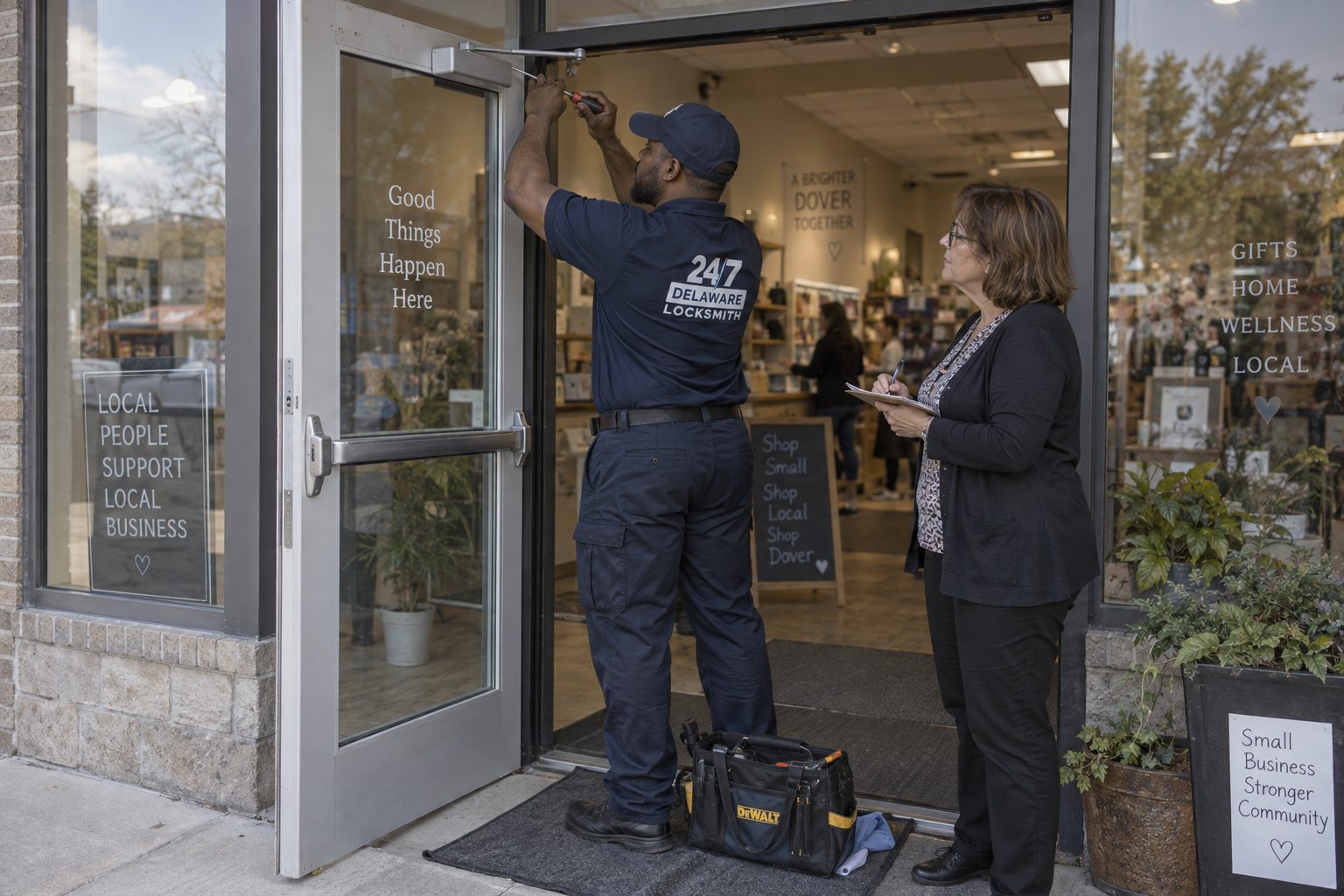
The commercial difference
A shop door is not a house door with a sign on it.
Commercial hardware is a separate discipline with separate standards, separate failure modes and, in the case of exit devices, separate legal obligations. Treating it as residential work with a bigger invoice is how businesses end up with doors that fail in a year.
Cycle counts change everything
A house door is opened perhaps a dozen times a day. A shop door on a busy street is opened several hundred. Residential hardware fitted to a commercial door is not a security decision, it is a countdown, and we find it constantly on converted premises across Elsmere, Marshallton, Milford and every old main street in the two counties. Grade 1 hardware exists because of this, and on a genuinely busy door the higher grade is cheaper within two years.
Egress is not optional
Anything on an exit route has to let people out without a key, without special knowledge, and in a single motion. That is why panic bars exist and why the tempting solutions, a padlock on the back door after hours, a thumbturn removed to stop staff propping it, are the ones that turn a break-in into something much worse. We will tell you what a door has to do before we fit what you asked for.
Documentation is the deliverable
One practical test of whether you own your system: if your locksmith stopped trading tomorrow, could somebody else pick it up? With a chart, yes, in an afternoon. Without one, a new company has to survey every door, decode every cylinder and rebuild the record from scratch, and you pay for that twice over. The chart is not paperwork, it is the thing that makes the system transferable.
A master key system without a keying chart is a system you do not really own. If your locksmith holds the only record of who can open what, you cannot audit it, you cannot expand it predictably, and you cannot change it without going back to them. We hand the chart over. That is the part that matters, and it is the part most businesses never receive.
Commercial services
What we do on a business.
Storefront Door Locks
Aluminum stile doors, hook bolts and deadlatches. Frequently the fault is a pivot or an alignment rather than the lock, and adjusting beats replacing.
Life safetyPanic Bars & Exit Devices
Rim, mortise and vertical rod devices, dogging, and fire-rated doors where dogging is not permitted. Egress first, then security.
AccessMaster Key Systems
Designed to your roles, documented in a chart you keep, with restricted keyways where you also need to control who can have copies cut.
MaintenanceDoor Closer Repair
Sweep, latch and backcheck valves. A door that slams has usually been adjustable the whole time, nobody knew closers had valves.
ElectronicAccess Control
Standalone keypads through to credentialed systems with audit trails. Fail-safe or fail-secure is a decision, and it is yours to make knowingly.
SafesSafes
Opening, combination changes, servicing and anchoring. Including the safe that came with the premises and nobody has the combination for.
Who has access
The question most businesses cannot answer.
Ask any owner how many keys exist to their premises and how many are unaccounted for. The honest answer, almost always, is that nobody knows, and it is the answer that matters most when something goes wrong.
How it happens
Not through negligence. Through time. Staff leave and a key does not come back. A contractor is given one for a fortnight's work in 2019. A managing agent changes and the key records do not follow. Somebody has a copy cut because it was easier than asking. Five years on, a drawer contains unmarked keys of unknown provenance and the business has no idea which doors they open.
What a master key system actually gives you
Structure. Each role gets exactly the access it needs and nothing more: a cleaner opens the front and the utility cupboard, a supervisor opens the stockroom, an owner opens everything. One key per person rather than a bunch. And because it is designed rather than accumulated, you can add a door or remove a person without unpicking the whole thing.
Restricted keyways
Where it also matters that nobody can quietly have a copy cut, restricted keyways solve the other half of the problem. Blanks are controlled and copies require authorisation, so "I got one cut at the hardware shop" stops being possible. It is the right choice for premises holding records, stock or cash, and unnecessary for a small office where everyone is family. We will tell you which you are.
What fails, and why
The five commercial faults we are called to most.
Nearly every commercial call-out in both counties is one of these, and four of the five are maintenance problems rather than hardware failures.
| Symptom | What it usually is |
|---|---|
| Storefront door will not latch | Rarely the lock. Aluminum stile doors sag on their pivots or bottom arms, and the hook bolt or deadlatch stops meeting the keeper. Adjustment, or a pivot, not a new lock, and anyone quoting a full door has not looked. |
| Door slams, or will not close fully | The closer. It has three adjustment valves, sweep, latch and backcheck, that almost nobody knows exist, and a closer that has been slamming for a decade has usually been adjustable for a decade. When a closer genuinely is finished it leaks oil, and then it is replacement. |
| Exit device sticking or noisy | Cycle wear, misalignment on vertical rod devices, or somebody has dogged it down permanently and the mechanism has taken a set. On a fire-rated door dogging is not permitted at all, which is worth knowing before an inspection rather than during one. |
| Key works sometimes | A worn cylinder, a worn key, or both. On a commercial door with a high cycle count this arrives years earlier than on a house. A fresh key cut to code sometimes fixes it; a cylinder past service does not. |
| Nobody knows who has keys | Not a fault, but the most consequential problem on this list. It is solved once, properly, with a designed and documented system rather than another rekey that will be in the same state in three years. |
Before you accept a quote for a new door
On aluminum storefront hardware, "you need a new door" is one of the most expensive sentences in this trade and it is frequently wrong. A sagging stile door, a worn pivot, a keeper out of alignment and a failed closer arm all produce the same symptom, a door that will not latch, and all four are repairs measured in parts and hours rather than thousands.
Ask what specifically has failed and why it cannot be adjusted or replaced as a component. A straight answer is easy to give when one exists.
Scheduling
Work that does not cost you a trading day.
- Tell us your quiet window. Before opening, after closing, a slow weekday, a closed Sunday. We will schedule to it rather than to our own convenience.
- Batch the work. Six locks in one visit costs far less than six call-outs across a year, and it means one interruption instead of six.
- Check your lease first. Tenants in managed retail and office property frequently need landlord approval before changing entrance hardware, and some centres specify what may be fitted. Better found out before the work than after.
- Flag anything fire-rated. Fire doors have requirements that ordinary doors do not, including on dogging, closers and any hardware fitted to them. Tell us and we will fit accordingly.
- Say if you are mid-fit-out. Hardware decided at fit-out costs a fraction of hardware retrofitted afterwards, and the key policy is far easier to set before staff arrive than to unpick later.
- Plan for turnover, not for today. If your staff change regularly, design the system for that rather than rekeying reactively every time someone leaves.
Landlords and property managers
Turnover work, done on your calendar.
Rekeying between tenancies is dramatically cheaper booked in batches than handled one urgent call at a time, and it puts the work on your schedule rather than a tenant's. Across Newark's student lets, Camden's military-turnover rentals and Wilmington's older apartment stock, the pattern is the same: the landlords who batch it in August pay a fraction of what the ones handling it ad hoc in November do.
Two things worth knowing. First, in a property let by the room for several years, the number of keys in existence is not the number on your file, it is considerably higher, and the tenants know it even if the records do not. Second, a keying chart for a multi-unit property is worth more than any individual rekey, because it means the next change is a phone call rather than an investigation.
For common doors, access panels and mail kiosks in association-managed property, we work directly with the managing agent. Tell us who that is and we will deal with them rather than putting a resident in the middle.
Coverage
Commercial work across both counties.
Wilmington office and retail, Newark's Main Street trade, the Christiana and Concord Pike corridors, Dover's state and base-adjacent tenancies, and the independents on every old main street from Odessa to Milford.
Questions
About commercial hardware.
Can you work outside our trading hours?
Yes, and for most businesses it is the right call. Changing hardware on a shop or restaurant door during service costs you more in lost custom than the work costs in the first place. Tell us your quiet window, before opening, after closing, a slow weekday, and we will schedule to it. Out-of-hours labour carries a premium, and it is almost always smaller than a disrupted trading day.
Our back door has a padlock on the inside after hours. Is that allowed?
Almost certainly not, if it is on an exit route. Anything on a means of escape has to open from the inside without a key and without special knowledge, in one motion, whenever the building is occupied. A padlocked exit is the arrangement that turns an incident into a serious one, and it is the sort of thing an inspection finds. There are legitimate ways to secure a rear door, an exit device with an alarm, a delayed egress arrangement where permitted, and we will fit one of those rather than the padlock.
Our storefront door will not lock. Do we need a new door?
Usually not, and this is where businesses get overcharged most. Aluminum stile doors sag on their pivots and bottom arms over years of use, and when the door drops even slightly the hook bolt or deadlatch no longer meets the keeper. The symptom is a door that will not lock; the cause is alignment. Pivots, arms, keepers and closers are all replaceable components. Ask what specifically has failed before accepting a quote for the whole door.
How do we control who can get keys copied?
A restricted keyway. The blanks are controlled and copies require authorisation, which means an employee cannot quietly have one cut at a hardware shop. It is the right choice for premises holding records, stock or cash, and it pairs naturally with a master key system so each role holds one key with exactly the access it needs. For a small office where everyone is trusted it is usually unnecessary, and we will say so rather than sell it.
What is fail-safe versus fail-secure, and which do we want?
It describes what an electrified lock does when power is lost. Fail-safe unlocks; fail-secure stays locked. Which is correct depends on the door: an exit route generally has to remain passable, a server room or a stock store generally should not spring open in a power cut. It is a decision with real consequences and it should be made knowingly rather than defaulted to whatever the installer had in the van. We will explain the trade-off for each specific door rather than applying one rule to the building.
The safe came with the premises and we have no combination. Can you open it?
Usually, with proof that the premises and its contents are yours, a lease, a purchase agreement, business documentation. Whether it opens non-destructively depends on the safe: many can be manipulated or have the combination recovered, some require drilling and repair afterwards, and a few older or heavily damaged units are not economic to save. We will tell you which category yours is before starting, with the cost of each route.
Do you handle multi-site or property management work?
Yes, and it is better done as a programme than as a series of emergencies. That means a keying structure designed across the sites, documentation you hold, scheduled maintenance on closers and exit devices before they fail, and batched turnover work. The businesses that do this spend noticeably less than the ones calling reactively, and they can answer the "who has access" question when it is asked.
Can you service hardware you did not install?
Yes. Most commercial premises in Delaware are running hardware installed by several different contractors across several decades, none of whom left records, that is the normal situation rather than an unusual one. Part of the work is establishing what is actually fitted before deciding what to do with it. We will document what we find and give it to you, whether or not the follow-up work goes to us.
Keying plans for businesses with changing staff
A business that hires seasonal or part time staff in Delaware faces a quiet problem: keys walk out the door and nobody knows how many exist. The first step is a simple list of who holds what, even if it is written on paper. From there, a keying plan can decide which doors need individual keys, which can share a key, and which should be restricted so duplicates cannot be casually made. Restricted keyways are one tool, and they only help if the paperwork behind them is kept honestly.
We usually talk through the rhythm of the business before suggesting anything. A restaurant that changes crews every season, a shop with weekend help, and an office with a stable team all need different plans. The question is how expensive a lost key would be in practice: a nuisance, or a security event. If one key opens everything, the answer is bigger than the owner may realize. Sometimes the cleanest move is to rekey the cylinders rather than hunt for missing keys, and we will explain that tradeoff plainly.
Preparation helps. Gather the current keys, note which doors are used for deliveries, staff entry, and closing, and mention any doors that stick or latch poorly. Tell us whether insurance paperwork or a landlord has requirements for the hardware, since a leased space sometimes limits what can be changed. Call us to describe the building and to confirm availability, ideally for a time outside your busiest hours. The scope and any quote are explained before work begins, so you can decide calmly. We would rather explain too much than leave you guessing about what is being done.
Doors that struggle through humid summers and freezing winters
Commercial doors take more punishment than residential ones, and Delaware weather adds to it. In humid summers, wood doors swell and rub on the frame, aluminum doors can feel sticky at the latch, and the strike plate may stop lining up with the bolt. In winter freeze, metal contracts, weatherstripping hardens, and a door that closed fine in October may not latch properly by January. People often blame the lock when the real cause is the door moving slightly in its opening. Small details you mention early often turn out to shape the whole approach.
A careful look at the door tells the story. We check whether the gap around the door is even, whether the hinges are loose, whether the closer is pulling the door fully shut, and whether the latch lines up with the strike. A bolt that scrapes the edge of the strike hole is a sign of misalignment, not a failing lock. Fixing alignment is often more effective than replacing hardware, and it keeps the lock from wearing out early because it no longer has to fight the frame.
What you can do is notice patterns and share them. Does the door only stick on hot days? Does it fail to latch when the heating is on? Does it need a shoulder to close? Those details narrow things quickly. If the door is also a fire exit, mention that, because the exit hardware has rules of its own. Call us to describe what the door does through the seasons and to confirm availability. The scope and any quote are explained before work begins. Asking questions at any point is welcome, and nothing proceeds until you are comfortable.