

What car key replacement actually covers
Two very different jobs hide behind one phrase, and the difference matters for both time and cost.
Car key replacement means making a car a new working key when the one you have is gone, broken, or simply doesn't exist yet. That sounds simple, but the actual job splits into two very different situations depending on whether you still have a working key somewhere.
If you have a spare, even an old one sitting in a drawer, the job is a duplication. We read the existing key's cuts and, for most vehicles built after the late 1990s, its transponder data, then cut and program a matching second key. This is the faster and less involved of the two paths, because the car already trusts a key like the one we're about to hand you.
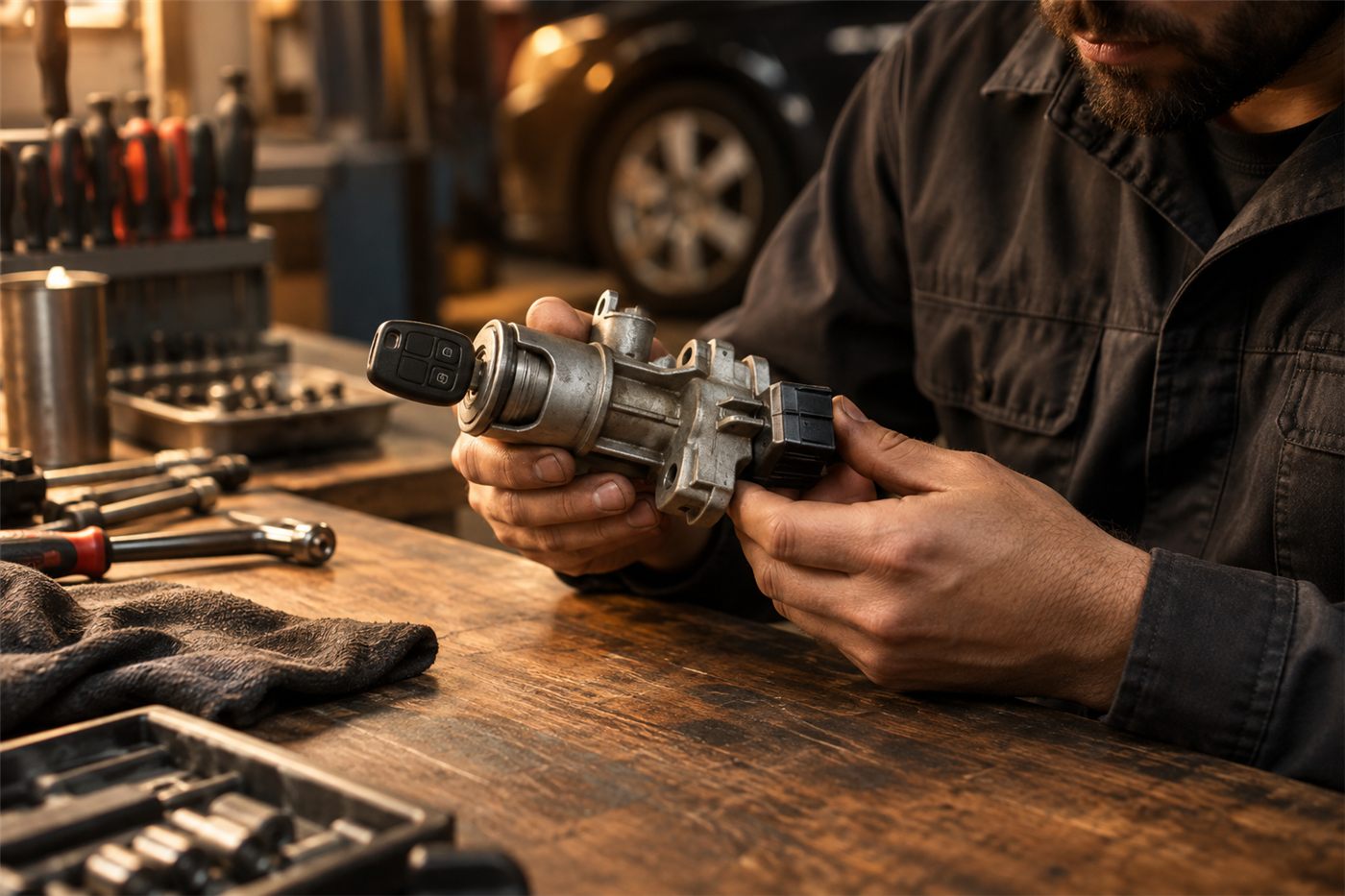
If every key for the car is gone, lost, stolen, or thrown out with a coat, the job becomes origination. There's no key to copy from, so we have to create one from nothing that the vehicle's immobilizer will accept as valid. That usually means pulling the key code from the vehicle identification number, cutting a blank to that code, and then programming the transponder chip inside it so the car's computer recognizes the new key as authorized. We cover the chip and immobilizer side of that process in detail on our transponder keys pagesince it applies to more than just replacement jobs.
Replacement is different from repair. If your key still works but the plastic head has cracked or a button has stopped responding, that's usually a fob or shell issue, not a key replacement, and we can often reuse the original chip in a new housing. We separate that decision out because it changes both the parts needed and the price you should expect to pay.
When people call us for this
The situations repeat more than you'd think.
A homeowner in Bear finds their only key ring at the bottom of a pond after a canoe trip and needs a working key before Monday's commute. A Newark renter moving out discovers the previous tenant kept both sets of keys to the car they inherited with the lease, and Delaware's used-car market means this kind of gap happens often enough that we see it weekly.
A parent in Middletown wants a spare cut for a teenager who just got a license, before that teenager has the chance to lose the only key the family owns. A contractor working out of Dover needs a second key made for a work truck so two crew members can use the same vehicle on different schedules without waiting on each other.
Sometimes it's simpler than any of that. Someone buys a used car privately, the seller hands over one key, and the buyer wants a spare cut immediately rather than risk being stranded later. Other times a key snaps in half at the door lock or in the ignition, and while extraction is its own service, once the broken pieces are out, a full replacement key often follows in the same visit.
We also get calls after a key is stolen along with a wallet or purse, where the concern isn't just getting a new key, it's making sure whoever took the old one can't use it. That's a slightly different conversation, and we're upfront with customers about what re-keying the ignition and door locks would involve versus simply cutting a new key, since a new key alone doesn't stop an old one from working.
How the job actually gets done
The first thing we ask, before we even get in the car, is whether a spare key exists anywhere, even a nonfunctioning one. That single answer determines almost everything about the visit: the tools we bring, the time it takes, and whether we need to verify ownership before starting.
If a spare exists, we start by examining it. We check the physical cut pattern and, where the vehicle uses a transponder chip, read the chip's data if our equipment can access it without damaging the key. From there we select a matching blank, cut it to the same pattern either by tracing the original or by code if we can pull one, and cut the new key on a code-cutting or key-duplicating machine calibrated to that manufacturer's specifications. Once cut, if a transponder is involved, we program the new key's chip to the vehicle using the appropriate onboard or diagnostic procedure. Our car key programming page covers exactly how that programming step works and what determines whether it takes minutes or longer.
If no spare exists, we confirm ownership before cutting anything. We won't originate a key to a car we can't verify belongs to the person requesting it.
Once that's settled, we determine the key code, sometimes from the vehicle identification number through a manufacturer database, sometimes from the lock cylinder itself using specialized code-reading tools. We cut a fresh blank to that code on a calibrated machine. For vehicles with transponders, we then have to program that new key into the immobilizer system from a position of zero existing keys, which on many vehicles requires diagnostic equipment that can communicate with the car's onboard computer rather than a simpler self-learn procedure available when at least one working key remains.
Throughout either path, we test the finished key at every stage, not just at the end. A key that turns freely in the door lock but hesitates in the ignition, or one that starts the car but won't disarm an alarm system, tells us something specific about what still needs adjustment. We don't hand back a key and leave until it starts the car reliably, more than once, not just on the first try.
What makes this job simple or complicated
No prices here, just the honest factors that move the job one way or the other.
The single biggest factor is whether a working key or a usable spare exists. Duplicating from an existing key is straightforward work we can usually complete in one visit with standard equipment. Originating a key with no spare present, particularly on a vehicle with a proximity or push-button start system, involves more steps and sometimes specialized diagnostic tools.
Vehicle age and manufacturer matter too. Older vehicles without transponder chips, generally those built before the mid to late 1990s depending on the make, involve pure mechanical cutting with no electronic programming step at all. Newer vehicles, especially those with smart keys that communicate wirelessly with the car, often require dealership-level diagnostic access or specific aftermarket tools that not every locksmith carries.
How you're locked out or without a key also plays a role, and location within New Castle versus Kent County affects how long it takes us to reach you, since the counties differ meaningfully in road network and drive times between towns.
Finally, ownership verification adds a small amount of time but is not optional. We ask for identification and something connecting you to the vehicle, registration, insurance card, or similar, before originating any key.
Blank and key options
Not every replacement key is the same product, and the differences matter for both function and cost. Here's an honest look at what's actually available depending on your vehicle and how it's equipped.
| Key type | What it is | Trade-offs |
|---|---|---|
| Basic mechanical key | Simple cut metal key, no electronics, used on older vehicles | Cheapest and fastest to cut, but only available where the vehicle itself has no transponder requirement |
| Transponder key | Metal key with an embedded chip the immobilizer must recognize | Requires both cutting and programming; most vehicles from the late 1990s through roughly the mid 2010s use some version of this, though exact years vary by manufacturer |
| Remote head key | Transponder key with an integrated remote for locking and unlocking | Combines two functions in one unit; if only the remote button fails, sometimes just the shell or circuit board needs attention rather than a full new key |
| Proximity smart key / fob | No blade inserted into a slot; the car detects the key nearby and allows push-button start | Most complex and typically most involved to originate from scratch; battery condition and antenna placement inside the car can affect range and reliability |
| Aftermarket vs. OEM blank | Aftermarket blanks made to fit and program like factory originals; OEM blanks sourced from the manufacturer | Quality aftermarket blanks generally function identically once cut and programmed; OEM blanks are sometimes preferred for certain proximity systems where fit tolerances are tighter |
Mistakes that make this worse
- Waiting to get a spare cut until after the only key is already gone. A spare made while you still have a working key is a quick, low-stress duplication; the exact same car, once that last key disappears, needs full origination, which takes longer.
- Ordering a blank key online without knowing whether it needs programming, or programming it incorrectly with a mismatched aftermarket kit. A key cut wrong on a first attempt sometimes damages the lock cylinder it's tested in.
- Assuming any hardware store kiosk can handle a transponder or proximity key the way it handles a house key. Many kiosks can't originate a key with no existing key present, and some can't handle transponder programming at all.
- Continuing to use a single, aging original key indefinitely. Keys wear, and cuts on an original used daily for a decade can drift enough from the factory-precise shape to make future duplication less reliable.
Why this differs across New Castle and Kent County
Same service, different terrain.
New Castle County's population density and shorter distances between towns like Newark, Bear, and Wilmington mean we're often able to reach a car key call within a tighter radius, and the used-car turnover near the University of Delaware in Newark specifically drives a steady volume of calls from people who've just bought a car privately with only one key handed over at the sale.
Kent County covers more ground with fewer people per mile, and towns like Harrington, Felton, and Frederica sit a real distance from Dover, which means travel time is a bigger variable down there than it typically is closer to Wilmington. Dover's role as home to Dover Air Force Base also brings a rotating population of service members and their families, many driving vehicles registered in other states, which occasionally means working with a key code system tied to a different state's original registration paperwork.
Across both counties, winter road salt used on Delaware's highways and secondary roads takes a toll on the exposed metal parts of older mechanical keys and on exterior door lock cylinders that a key has to turn in, which is part of why we check the lock itself, not just the key, when a customer says a new key doesn't work right.
Related
The rest of the automotive work.
Key replacement is one part of it. Everything we do at a vehicle sits under automotive locksmith servicesand these are the pages most people need next.
 24 hours
Car Lockout Service
Locked out with the key inside. Opened with wedge and reach tooling, nothing near the wiring or airbag sensors in the door.
 Immobilizer
Car Key Programming
How onboard and diagnostic programming actually works once a key is cut, and what decides whether it takes minutes or longer.
 Chips
ChipsTransponder Keys
What is inside the key, and why a blade cut at a hardware store turns the ignition and still will not start the engine.
 All car work
Automotive Locksmith
The full picture: keys, fobs, lockouts and ignitions across New Castle and Kent counties.
 Repair
Ignition Repair
A key that will not turn and a key that turns but will not crank are two different faults with two different answers.
RemotesKey Fob Programming
Remotes and proximity smart keys. Often it is the battery rather than the fob, and that gets checked first.
Where we do this
We handle car key replacement calls throughout New Castle and Kent County, from dense residential streets to rural routes between smaller towns.
Frequently asked questions
Can you make a car key without the original?
Yes. If every key for the car is gone, we can originate a new one by pulling the key code from the vehicle identification number or reading it from the lock cylinder, then cutting and, if needed, programming a fresh key. We'll ask for identification and proof of your connection to the vehicle before doing this.
How long does replacing a lost car key take?
Duplicating from an existing spare is generally quick. Originating a key with no spare present takes longer, since it involves retrieving a code and, for many vehicles, programming a transponder chip. Some vehicles also impose a built-in security wait during programming, which we cover in more detail on our car key programming page.
What if I only have one key and want a spare made before I lose it?
That's the easiest version of this job. Bring or have available the one key you have, and we'll duplicate its cuts and, where applicable, its transponder data onto a new blank. Making a spare while you still have a working key is faster and simpler than waiting until that last key disappears.
Does a new key stop an old lost or stolen key from working?
Not automatically. Cutting a new key doesn't disable an old one on most vehicles. If a key was stolen and you're concerned about unauthorized use, ask us about re-keying the ignition and door locks, which is a separate step from key replacement and addresses that specific concern directly.
Do you need the car present to make a key?
For duplication from an existing key, having the car present isn't always required, but for origination when no key exists, we typically need the vehicle on site, since programming has to communicate directly with that specific car's immobilizer system.
What's the difference between a locksmith cutting a key and a hardware store kiosk?
Basic kiosks generally handle simple mechanical key duplication for vehicles without transponder requirements, and usually only when an original key is present. They typically can't originate a key from scratch and often can't program a transponder chip at all, which limits them for many vehicles built after the late 1990s.
Can you replace a proximity smart key that starts the car with a push button?
In many cases, yes, though proximity and smart key systems are generally the most involved to originate, particularly with no existing key present. Equipment availability and procedure vary by manufacturer, so we'll confirm what's needed for your specific vehicle before the visit.
Will a new key work immediately or does it need to sync?
Once we've completed cutting and, where applicable, programming, we test the key on site before we consider the job finished. Some vehicles do have a brief onboard security delay during the programming step itself, which we walk you through if it applies to your car.
Testing the new key before we leave
A key that looks right is not necessarily a key that works, so testing is a real part of the job rather than a formality. Once a key is cut or programmed, we try it in every place it needs to work: the driver door, the other doors if the vehicle has individual locks, the trunk or hatch, the glovebox where relevant, and of course the ignition. We turn it several times, not once, because a poorly cut key sometimes works on the first try and then binds. We want to see smooth, repeatable operation.
We also check the electronic side. A remote that unlocks the doors but does not start the engine, or a transponder that starts the car but leaves the remote dead, is a half finished job. We confirm each function separately, including panic buttons and any trunk release the fob offers, and we check that existing keys still work after the new one has been added. If the vehicle supports it, we also confirm the dashboard shows no security warning light after the key has been used a few times.
Last, we show you what you now have and what you should do with it. That includes keeping the spare somewhere other than the car, noting how many keys the vehicle recognizes, and asking us if anything feels off in the coming days rather than ignoring it. A key that sticks or hesitates after a week is easier to correct early. Call us to talk through your situation and to confirm availability. The scope and any quote are explained before work begins. Taking a few minutes to describe the situation properly usually makes the whole visit smoother for everyone.