

The short answer
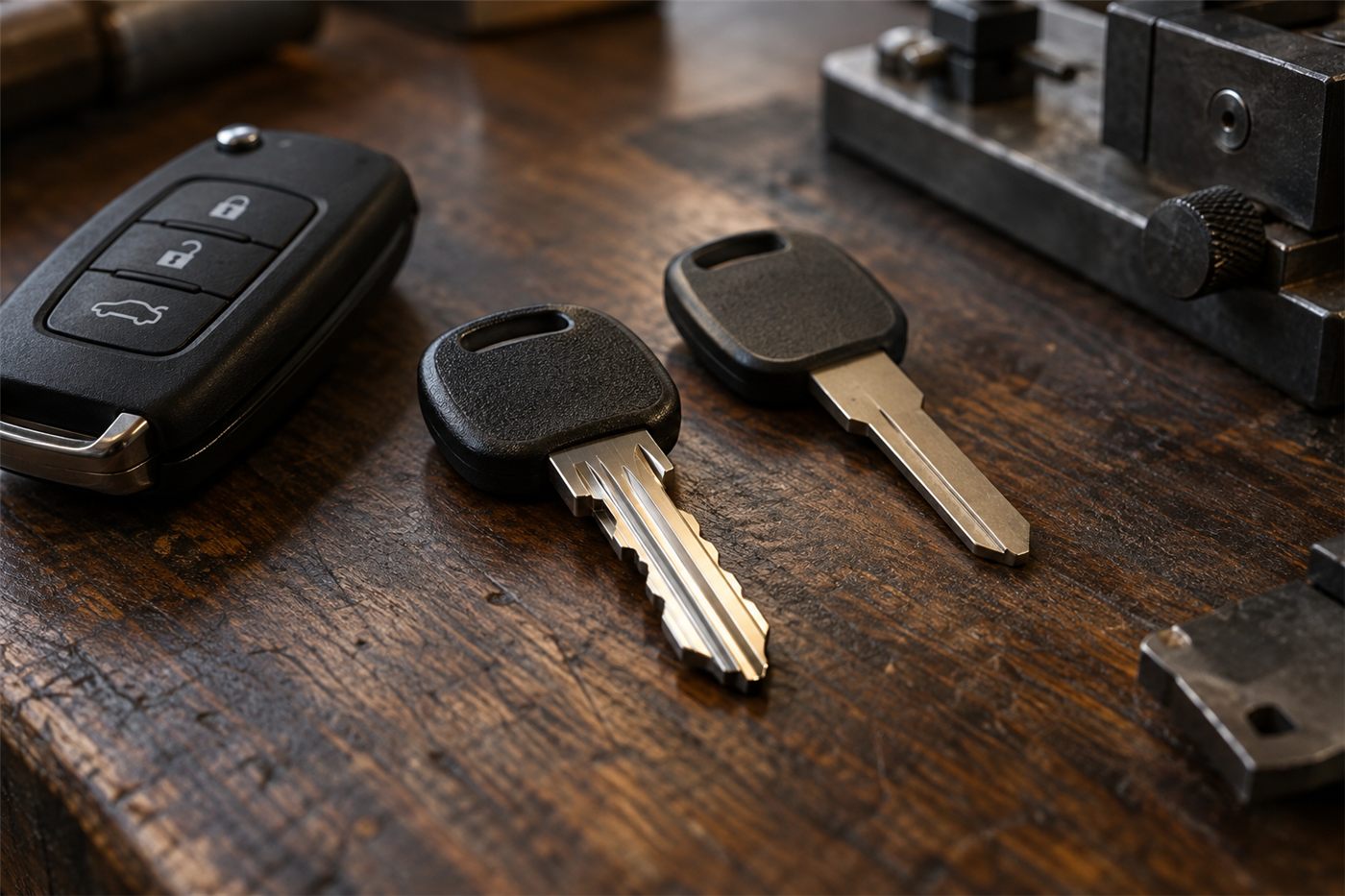
A transponder key contains a small chip with no battery. When you turn the key, the car powers the chip through a coil around the ignition, asks it a question, and only allows the engine to run if the answer is right.
That system is called an immobilizer. It became common on cars sold in the United States from the late 1990s onward and is now close to universal. It is the reason a key cut at a hardware store can open your door and turn your ignition, yet the engine starts and dies within a couple of seconds, or does not crank at all.
The blade and the chip are separate. You can have a perfectly cut blade with no chip the car recognizes, or a recognized chip in a key whose blade is worn out. A working car key needs both, and most car key jobs involve one side, the other, or both.
The mechanism
What happens in the second after you turn the key.
A radio conversation that takes a fraction of a second.
Around the ignition cylinder of a keyed car sits a small coil of wire, usually hidden behind the plastic trim. When you turn the key to the on position, the car sends a short burst of radio energy through that coil. The chip in the key head picks up that energy, which is enough to power it for a moment, and replies with a signal of its own.
On early and simpler systems, the reply was essentially a fixed identification code. The car compared it to the codes it had stored and allowed the engine to start if it matched. On most later systems, the exchange is a challenge and response. The car sends a changing challenge, the chip performs a calculation using a secret stored inside it, and returns the result. The car does the same calculation and compares. Because the challenge changes, simply recording one reply is not enough to fool the car next time.
If the reply is missing or wrong, the immobilizer tells the engine computer not to run. Depending on the vehicle, the engine may not crank at all, may crank but not fire, or may start briefly and then stall. A security light on the dashboard, often a key or a car with a padlock symbol, usually flashes or stays lit to tell you the immobilizer has refused the key.
All of this happens in well under a second, every time you start the car, and you normally never notice it.
Key types
Transponder keys and their relatives.
| Key type | What it contains | Where you see it |
|---|---|---|
| Basic transponder key | A metal blade and a chip in a plastic head, no buttons | Many cars from the late 1990s through the 2010s, and base trims of later models |
| Remote head key | Blade, chip and remote buttons in one head | Very common on sedans, SUVs and trucks from the mid 2000s onward |
| Flip key | A remote head key with a folding blade | Many European models and some others |
| High security or laser cut blade | A blade cut along its side rather than its edge, plus a chip | Many newer vehicles of most makes |
| Smart or proximity key | A battery powered fob that exchanges signals with the car without being inserted | Push button start vehicles |
Smart keys still carry the same idea
A push button start fob is a more elaborate version of the same principle. The car still has to be satisfied that a genuine key is present before the engine will run. Most smart fobs also contain a backup transponder, which is why many cars let you start with a dead fob battery by holding the fob against the start button or placing it in a marked spot.
Copies
Why a hardware store copy will not start the car.
A key copying machine reproduces the shape of the blade. That is all it does. The copy will unlock the doors and turn in the ignition, but unless it also carries a chip that the car recognizes, the immobilizer will refuse it.
There are three ways a new key can end up with a chip the car accepts.
Programming. The new key's chip is added to the car's list of accepted keys, usually through the diagnostic port under the dashboard using dedicated equipment, and on some older models through an onboard procedure that requires existing working keys. This is the standard approach and the one that works across the widest range of vehicles.
Cloning. On some vehicles, the data from an existing chip can be copied onto a special blank chip, so the car sees the new key as the old one. Cloning does not change anything in the car. It works only for certain transponder types, and only when you have a working key to copy.
Some older kiosks and shops offer transponder copying for certain vehicles using cloning. When it works, it is convenient. When the vehicle uses a type that cannot be cloned, the copy will unlock the doors and never start the engine.
The practical lesson is simple. If your car has a transponder, a new key is a blade plus a chip, and the chip has to be dealt with properly for the key to be any use in the ignition.
What goes wrong
The common transponder failures.
- A cracked key head. The chip is a small glass or plastic capsule, or a component molded into the head. If the head cracks and the chip falls out, the key turns and the car will not start. Sometimes the chip is still in the broken head and can be moved into a new shell.
- A worn blade. The chip is fine but the blade no longer turns the ignition smoothly, or only turns with jiggling. A new blade cut to the car's code, with the chip programmed or transferred, fixes it.
- A dropped or crushed key. The chip can be damaged by a hard impact. The key looks fine and the car refuses it.
- A faulty antenna ring. Less common, but the coil around the ignition can fail or come loose. Every key then fails, not just one, which is a useful clue.
- Interference from other keys. On some cars, another transponder key held close to the ignition, such as the key for a second vehicle on the same ring, can confuse the reader. Take the other key off the ring and try again.
- A car that has lost its key memory. After certain electrical repairs or module replacements, a car can need its keys reprogrammed.
- A key that was never programmed. A copy cut elsewhere, or a used key from another vehicle, that the car simply does not know.
Diagnosis
Is it the key, or is it the car?
A few simple checks narrow down a no start problem before anyone is called.
Look at the security light. If the key or padlock symbol flashes rapidly or stays on when you try to start, the immobilizer is refusing the key. If the security light behaves normally and the engine still does not start, the problem may be elsewhere, such as the battery, the starter or fuel.
Try the spare. If the spare starts the car, the first key is at fault. If neither starts the car, suspect the antenna ring, the immobilizer module or the car's key memory.
Check the battery. A weak car battery can cause odd immobilizer behavior as voltage drops during cranking. Clicking, dim lights and slow cranking point to the battery, not the key.
Remove other keys. Take the key off the ring, especially if another car key or a fob is attached, and try again.
If these checks point to the key, the answer is usually a new key or a transferred chip. If they point to the car, a locksmith may still help, since some immobilizer faults are key programming issues, but some belong with a mechanic or dealer.
Programming
What programming actually involves.
Programming a transponder key means adding its chip to the list of keys the car accepts. How that happens depends on the manufacturer and the model year, and the variation is wide.
On some older vehicles, the owner can add a key with an onboard procedure, turning existing working keys in the ignition in a set sequence. These procedures only work with enough existing keys, often two, and not all vehicles have them.
On most vehicles, programming is done with equipment that connects to the diagnostic port. The equipment communicates with the immobilizer, gains security access using methods the vehicle maker set up, and adds the new key. Some vehicles build in a waiting period before security access is granted, which can mean sitting with the car for a set time while it counts down. That is a deliberate anti theft measure, not a sign that anything is wrong.
On some vehicles, adding a key also clears keys that are not present. That is useful when a key has been lost or stolen, since the lost key stops working, but it means every key you want to keep must be at the appointment.
When every key is lost, the job is more involved. The blade has to be cut from the vehicle's key code or by decoding a lock, and the car has to accept a new key with no existing key to authorize it. On many vehicles that is routine with the right equipment. On some newer models it takes longer or needs dealer involvement. Our all keys lost page explains it further.
Cost factors
What makes a transponder key job simpler or harder.
| Factor | Effect |
|---|---|
| A working key is available | Makes almost every job simpler, and allows cloning where the vehicle supports it |
| All keys lost | Blade cut from code or decoding, plus all keys lost programming |
| Plain transponder versus remote head | A remote head key adds remote programming and a more costly key |
| Edge cut versus high security blade | High security blades need a different cutting machine |
| Vehicle security design | Some models need longer procedures or waiting periods |
| Where the car is | A mobile visit avoids towing a car that cannot start |
Remote starters
Aftermarket remote start and the immobilizer.
Aftermarket remote starters have to deal with the immobilizer too, because the car will not run without a recognized key present. Installers use a bypass or interface module that satisfies the immobilizer during a remote start. Older installs sometimes did this by hiding a spare transponder key inside the dashboard.
That hidden key is worth knowing about. If your car has an old remote starter and you are missing a spare, it may be tucked behind a panel. If you are selling the car, or you have had it for years and do not know its history, it is worth asking the installer or a technician whether a key is hidden inside, since it weakens the car's theft protection.
Remote starter modules can also cause immobilizer confusion when they fail. If a car with an aftermarket remote start suddenly refuses its keys, the remote start module is one of the things to check.
Spares
Why the second key matters more than people think.
With a transponder system, the difference between having one working key and having none is enormous. With one key, a spare is a straightforward job: cut a blade, program or clone the chip, test it, done. With none, the blade has to be produced without an original and the car has to accept a key without an existing one to vouch for it. On some vehicles, onboard programming procedures also require two working keys, so dropping to one key quietly removes an option you may not have known you had.
If you are down to a single key, treat that as a problem to solve now, while it is still the easy version. Keep the spare at home, never in the car, and test it every few months by using it for a day. A spare that has sat in a drawer for years is sometimes found to be a blade copy with no working chip, which is exactly the wrong moment to discover it.
Delaware specifics
What we see on the road here.
Older pickups and work vehicles in Kent County. Plenty of trucks around Dover, Harrington and the farm country still use plain transponder keys, often with worn blades after years of use. A new key cut to code with the chip programmed usually solves a sticky ignition that owners have lived with for months.
Used cars bought with one key. Across both counties, a lot of used cars change hands with a single key. Adding a spare while that key works is far simpler than all keys lost programming later.
Student and commuter cars in Newark and Wilmington. Hardware store copies that open the door and do not start the car are a frequent call. The fix is a key with a properly programmed chip.
Winter. Cold mornings expose weak car batteries, and a weak battery can make a healthy transponder system act up. If the car cranks slowly and the security light flickers on a frosty morning, check the battery first.
The short version, if you read nothing else
Your key is a blade plus a chip. The blade turns the lock, the chip convinces the car. A copy without a recognized chip will not run the engine. Keep a programmed spare, and when a key is lost, have it removed from the car's memory.
Related
The neighbouring questions.
If your fob rather than your key is the issue, see what affects the cost of a lost fob. For the difference between keys and push button start, see push button start versus key.
Where we do this
Transponder keys across both counties.
Questions
About transponder keys.
Does a transponder key need a battery?
No. The chip is powered by the car's antenna ring for the instant it needs to answer. If your key has remote buttons, those use a battery, but the transponder side does not.
How do I know if my car has a transponder key?
Most cars sold in the United States from the late 1990s onward do. A thick plastic head on the key, a security light on the dashboard, and a vehicle that starts and immediately stalls with a copied key all point to a transponder system. The owner's manual usually mentions an immobilizer.
Can a transponder key be copied?
The blade can be copied anywhere. The chip must be programmed to the car or, for some vehicle types, cloned from a working key. A blade copy alone will not run the engine.
My car starts and dies after two seconds. Is that the key?
Very often, yes. That pattern is typical of an immobilizer refusing the key. Check the security light, try the spare, and remove other keys from the ring.
Can the chip be moved from a broken key into a new one?
Sometimes. If the chip is a separate capsule and undamaged, it can be moved into a new shell with a new blade. Where the chip is built into the head's circuit, a new key and programming may be needed.
Will a lost transponder key still start my car?
Yes, until it is removed from the car's memory. When a replacement is programmed, lost keys can usually be erased so they no longer work.
Do magnets damage transponder chips?
Everyday magnets are not a common cause of failure. Physical damage from drops, crushing and water is far more common.
Can you program a key if I have lost all of them?
On many vehicles, yes, on site. Some newer models need more steps or dealer involvement. We confirm ownership first and tell you what applies to your car when you call.