

The decision
Change the lock, or just the key?
Most people asking for new locks want different keys. Some need different hardware.
Why we ask what you want to fix
When someone calls and says they want their locks changed, we ask one question first: what is wrong with the locks you have? If the answer is that the hardware works fine but too many people have keys, the answer is usually rekeying. It changes which key opens the lock without replacing anything else, and it uses the hardware you already paid for.
If the answer is about the hardware itself, a lock change is the right job. The lock is worn and hard to turn. A part inside has broken. The finish has corroded. The door was forced and the lock was damaged. The lock is the wrong type for the door, like a privacy knob on an exterior door. Or the owner simply wants a different style, a lever instead of a knob, a handle set instead of separate pieces, a keypad instead of a key.
Many visits combine both. A homeowner may replace a failing front deadbolt and rekey the back door and garage entry to match the new key. A business may replace a broken storefront lock and rekey the rest of the building at the same time. We plan the visit around what each door actually needs.
Reasons
When the hardware itself has to go
- Worn internal parts. Locks have springs, cams, tailpieces and latches that wear. When a lock grinds, sticks, fails to return, or needs the key jiggled in a particular way even with a new key, the parts inside are often at the end of their life.
- Damage from a break in or attempted entry. A forced door often leaves a bent bolt, a cracked housing or a cylinder that was pried or twisted. Even if it still locks, a damaged lock has lost strength. Replace it, and look at the frame as well.
- Corrosion and weather damage. Exterior locks near the water in Delaware City, New Castle and along the river, or on doors that face driving rain, can corrode until the finish flakes and the mechanism binds.
- The wrong function for the door. A passage knob with no lock on an exterior door, a privacy lock that locks with a button anyone can pop, or a storeroom lock on a door that people need to lock from inside, are all common mismatches.
- An older lock with a weak design. Some older locks offer very little resistance to force or manipulation. Replacing them with a well built modern lock is a real improvement.
- Accessibility needs. A knob can be hard to turn for someone with arthritis or limited grip. Lever handles are easier, and some households also want keyless entry for family members who struggle with keys.
- Style and renovation. New doors, new paint or a kitchen remodel often bring a wish for matching hardware. That is a perfectly good reason.
Lock functions
Choosing the right kind of lock for each door
Door hardware comes in functions, which describe what the lock does and how it is operated. Picking the right function for each door matters more than picking a brand or a finish.
Entry locks lock with a key from outside and a button or turn from inside. They are used on exterior doors, usually paired with a deadbolt, and on interior doors that need a key.
Passage sets do not lock at all. They are used on hallways, closets and rooms that never need locking.
Privacy locks lock with a button or turn from inside and have a small emergency release hole outside. They are meant for bathrooms and bedrooms, not for security.
Deadbolts add a separate bolt that does not spring back. They are the main security lock on most exterior doors. Our deadbolt installation page covers them in detail.
Handle sets combine a decorative exterior handle with a thumb latch, a deadbolt and an interior knob or lever. They are common on front doors where appearance matters.
Commercial functions include storeroom locks that are always locked from outside, classroom and office functions that lock with a key from one side, and many others. Commercial doors often use heavier cylindrical locks or mortise locks built into the door edge. Our commercial locksmith page covers business hardware.
Knobs, levers and grips
Knobs are traditional and still very common. Levers are easier to operate with a full hand, an elbow or an arm full of groceries, and they are often preferred for older family members and anyone with limited grip strength. Levers must be installed with the correct handing so they rest level. Keypad and smart locks replace the key entirely on the outside, and we cover them on our keypad lock and smart lock pages.
Materials, finishes and what lasts
Two locks can look identical in a package and behave very differently after five years on a door. Solid metal housings, heavier springs and bolts that are not hollow hold up to daily use and to force far better than thin stamped parts and plastic internals. Weight is a rough but useful clue. If the lock feels light and flimsy in the hand, it will probably feel the same way on the door.
Finish matters most on exterior hardware. Plated finishes can wear through where hands touch them, and some finishes pit and discolor quickly when exposed to weather. Finishes marketed for exterior use, and solid materials such as brass or stainless steel, generally hold up better. On a door that faces the weather directly or sits near the water, it is worth choosing a finish meant for those conditions rather than one chosen only to match the interior.
Matching matters too. Many homeowners want the front door handle set, the deadbolt and the interior hardware to share a finish. Finishes with the same name can differ slightly between product lines, so if appearance is important, we choose pieces from the same line or show you samples first.
Fit
Making new hardware fit an existing door
Most residential doors are bored to common dimensions, and most replacement locks are made to fit them. That means a new knob, lever or deadbolt usually goes into the existing holes without any new drilling. We still check every door, because the exceptions are where lock changes go wrong.
The backset, the distance from the edge of the door to the center of the lock, must match. Most locks adjust between the two common sizes, but older doors sometimes have unusual backsets. Door thickness must be within the range the lock is built for. Very thick doors need longer screws or special kits, and thin doors may not hold the lock properly.
The latch or bolt faceplate must sit flush in its mortise on the door edge. A new faceplate that is a different shape or size from the old one leaves gaps or does not sit flat. We adjust the mortise as needed. The strike on the frame must line up with the new latch or bolt. A new lock with a slightly different latch position can miss the old strike, and a latch that does not catch cleanly will not hold the door.
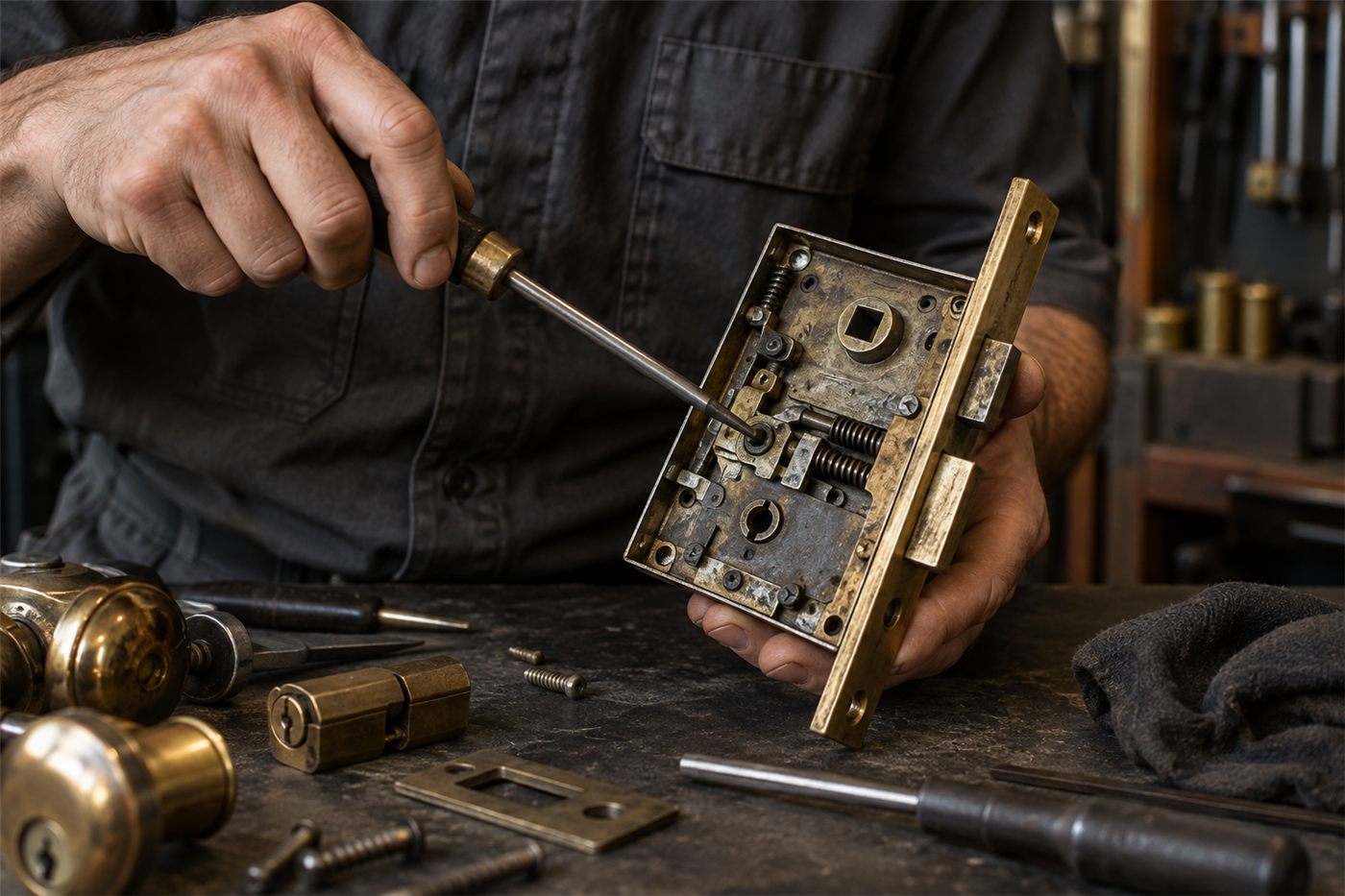
Old homes add another wrinkle. Many older houses in Wilmington, New Castle and Dover have original mortise locks built into the door edge, with a large rectangular pocket cut into the door. Modern bored locks will not fit those doors without filling and reboring, or without a conversion plate designed to cover the old pocket. In some cases, a new mortise lock that fits the existing pocket is the better choice. We look at the door and explain the options before removing anything.
How it works
What happens during a lock change
Remove, inspect, fit, key, test.
We start by agreeing on which doors are included and what each will get. Then we remove the old hardware and look at what is underneath: the bore, the edge hole, the mortise, the strike, and the condition of the wood or metal around them.
If anything needs attention, such as a split around the bore, a loose strike or a door that sags, we deal with it before the new lock goes in. A new lock on a door with those problems will not work well for long.
The new lock is installed and adjusted. We key it to the key you want, whether that is your existing key, a new key shared with other doors or a key of its own. We test it with the key and with the inside turn or button, with the door open and closed, and we make sure the latch catches cleanly every time the door swings shut.
Before we leave, we hand over every key and confirm how many exist. We take the old hardware away if you want us to, or leave it with you if you prefer.
Keying
One key for every door, if you want it
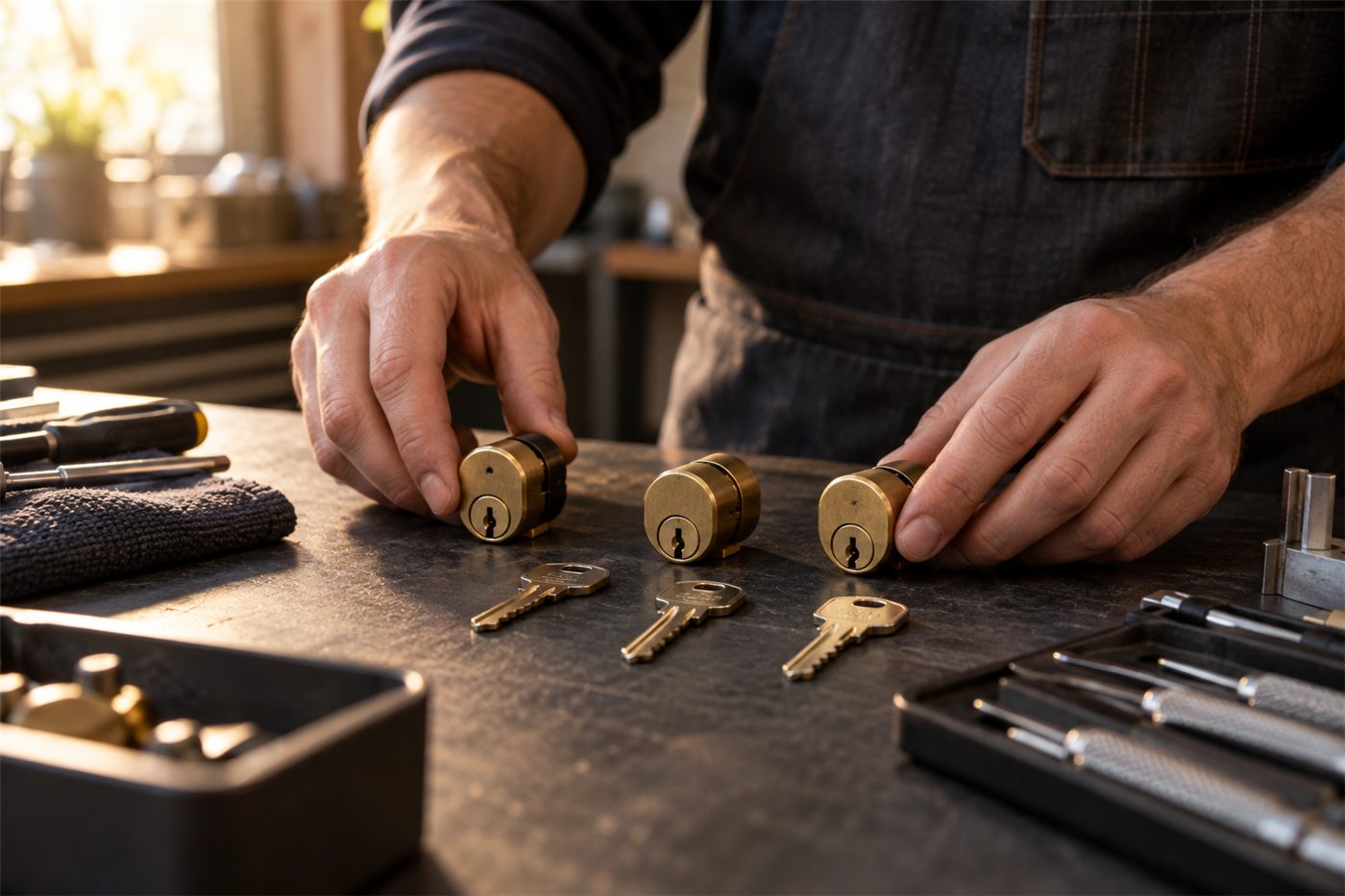
A lock change is the easiest time to fix the problem of too many keys. New locks come with their own keys, but they can almost always be keyed to match each other, and often to match other locks in the house that are not being replaced. Many households end the visit with one key that opens the front door, the back door and the garage entry, instead of three different keys that nobody can tell apart.
If the reason for the lock change is a security concern, such as a break in, a lost key or a household change, we key everything to a new key so no old key works anywhere. If the concern is just worn hardware, we can match the new lock to your existing key so nothing else has to change.
For businesses, new hardware is often fitted into an existing master key system. The new lock must be keyed to the system so the right people can open it. That requires the owner's authorization and information about the system, which we ask for before the visit.
After the new locks go in
New locks need very little, but a few habits keep them working. Give the keys a trial run from both sides of every door over the first week, including the door you rarely use. If a latch or bolt starts to drag as the weather changes, call us before it gets worse, since a small strike adjustment is easy while the problem is new.
Keep track of the keys. Write down how many you received, who has them and where the spare is kept. That list is what lets you decide later, calmly, whether a lost key means rekeying. If the new locks came with a key code card, store it somewhere safe and away from the keys, because it can be used to cut new keys.
Finally, keep the paperwork for the hardware. Manufacturers sometimes offer replacement parts or finish support, and knowing the exact model makes that simple.
Compared
Lock change, rekey or repair
| Situation | Usually the right job |
|---|---|
| Hardware works well, keys are the concern | Rekey |
| Lock is stiff but otherwise sound | Repair and service, possibly rekey |
| Lock is broken, corroded or damaged by force | Lock change |
| Wrong type of lock for the door | Lock change |
| Want levers, a keypad or a new style | Lock change |
| Door sticks or latch misses the strike | Door and strike adjustment first, then decide |
Avoid these
Lock change mistakes that cause trouble later
- Buying hardware before measuring. A lock bought for the wrong backset, door thickness or handing will not fit. Measure first, or let us bring the right hardware.
- Replacing the lock and ignoring the strike. A new lock that does not line up with the strike will not latch reliably. The strike is part of the job.
- Putting a privacy lock on an exterior door. Privacy locks are for bathrooms and bedrooms. They are easy to open from outside by design.
- Ending up with a new key for every door. Ask for the new locks to be keyed alike, or keyed to your existing key.
- Choosing hardware on looks alone. A beautiful lock with a weak mechanism or a thin bolt looks good and protects poorly. Look for solid construction.
- Forgetting the garage entry and basement doors. Those doors are often the weakest in the house and the easiest for someone to work on unseen.
Local factors
Lock changes in Delaware homes and businesses
Old mortise locks, salt air and new construction.
In older neighborhoods in Wilmington, Elsmere, New Castle and Dover, we regularly find original mortise locks and doors that have held several generations of hardware. These jobs take more care, but the result can respect the look of an older home while giving it modern security.
Along the river and near the bay, exterior hardware corrodes faster. Finishes and materials that stand up to moisture are worth choosing for doors that face the weather.
In newer neighborhoods around Middletown, Townsend, Smyrna and Camden, lock changes are usually about upgrading builder grade hardware or changing style. Those doors are standard and the work is straightforward, and it is a good time to add reinforced strikes as well.
For businesses across both counties, lock changes often follow damage, a failed lock at opening time or a change of tenant. We handle storefront, office and back door hardware and fit it into existing key systems where needed.
Questions
Frequently asked
Should I rekey or change my locks after moving in?
If the existing locks work well and you like them, rekeying handles the unknown key history. If the locks are worn, damaged or not what you want, a lock change handles both the hardware and the keys at once.
Will new locks fit my existing doors?
Usually, since most doors and locks share common dimensions. Older doors with mortise locks, unusual backsets or damaged holes may need a conversion plate, a mortise replacement or some preparation. We check each door before choosing hardware.
Can the new locks use my current key?
Often, if they share a compatible keyway. Or we can key all of them to a new key if you want old keys to stop working.
Can you replace just the handle and keep the deadbolt?
Yes. Knobs, levers and deadbolts are separate pieces on most doors. We replace what needs replacing and key the new piece to match the rest.
Do you supply the locks or can I buy my own?
Either works. We can bring hardware suited to the door, or install hardware you already bought if it fits and is solidly built. If we see a problem with it, we will tell you before installing it.
What should I do with a lock damaged in a break in?
Replace it, and have the frame and strike checked. A lock that survived a forced entry may still work but has often lost strength. The frame usually needs attention too.
Can you change locks on a business after hours?
We handle commercial lock changes as quickly as the situation requires, including after hours when a door cannot be secured. Tell us whether the door is currently locked or unsecured when you call so we can plan.
Are lever handles less secure than knobs?
Not inherently. A well built lever lock is as secure as a well built knob. The deadbolt provides most of the security on an exterior door either way.
Time for new locks?
Call and we will fit hardware that suits each door and key it the way you want.